





Beautiful English Floor Clock- c1790-1820 - "George"
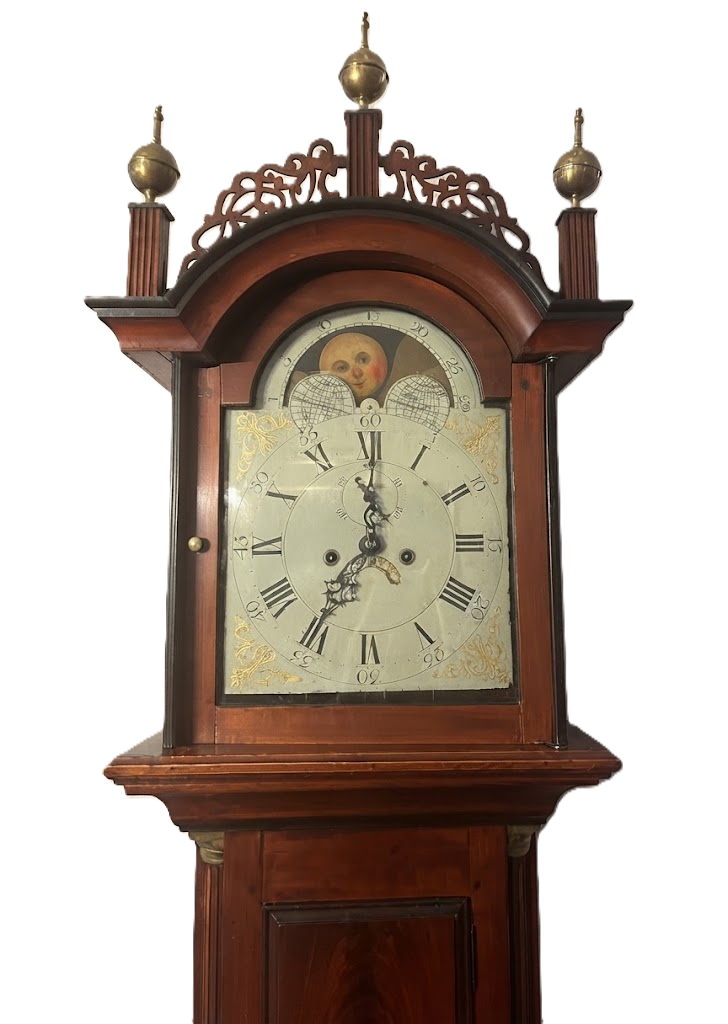
Standing in stately elegance, this magnificent late Georgian tall case clock (c. 1790–1810) represents the peak of British horology, marrying fine mahogany cabinetwork with an astronomical moon-phase complication.
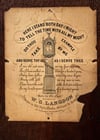
Crafted in England during the reign of George III, the dial carries a cast-iron falseplate from the famed Osborne’s Manufactory in Birmingham. The painted dial features gold-leaf corner spandrels, Roman hour numerals, a subsidiary seconds bit, a calendar date aperture, and a rotating "penny moon" lunar disc in the arch that tracks the lunar phases against twin painted world hemispheres. The figured mahogany case features an architectural broken-arch swan-neck pediment with delicate openwork fretwork and brass steeple finials. Inside the waist door rests an intact 19th-century paper motto label from historic Boston clockmaker and dealer W.G. Langdon (89 Court St.), providing genuine American provenance.
Clock Specifications & Craftsmanship:
- Style: Late Georgian / George III Moon-Dial Tall Case (Grandfather) Clock
- Circa: c. 1790–1810
- Origin: England (Dial components by Osborne Manufactory, Birmingham; 19th-century retail by W.G. Langdon, Boston)
- Case Details: Rich figured mahogany with ebony stringing, swan-neck pediment with pierced fretwork, three brass ball-and-steeple finials, fluted columns, and historic paper door label
- Dial & Complications: Painted iron dial with gold-leaf spandrels, subsidiary seconds, calendar day window, and rotating mechanical moon phase arch
- Movement: Handcrafted 8-day weight-driven English brass movement striking the full hour count on an overhead bronze bell
The label was added later when the clock was resold in the mid-to-late 1800's by W.G. Langdon (probably an antique at the time).
Horological Work: While the label markets him as a "Dealer in Old Style Clocks" (which often meant he sold or refurbished earlier Federal-era tall clocks and timepieces), Langdon was also a maker himself. Today, his name occasionally crosses specialty auction blocks on beautiful, weight-driven mahogany banjo clocks featuring classic Boston reverse-painted glass panels.
The Sniper Connection: In an incredible historical twist, Langdon's expertise in micro-mechanics went far beyond gears and springs. He was an expert marksman. Because of his precision machining skills as a watchmaker, the government actually contracted him in 1862—right in the middle of the Civil War—to manufacture specialized heavy sniper rifles equipped with telescopic sights!
The author of the lovely "Motto for Old Clock" poem—Charles H. Frothingham—was a well-connected Boston businessman, secretary, and author during the latter half of the 19th century.
Beyond penning dedicatory poems for local artisans like Langdon, Frothingham is best known in local history circles for writing and publishing an 1884 travel book titled A Pleasure Guide to Nantasket Beach, and Boston Harbor.
It is incredibly rare to find original paper motto labels like the one shown intact and legible, as the paper usually crumbles or the ink fades completely after a century inside a wood case.
I like to refer to this clock as "George" due to fact that it was quite possibly born while George Washington was alive. That really gives it some perspective, doesn't it?