








Requirements Gathering & Analysis Template V1.0
On Sale
$30.00
$30.00
NEW ITEM SALE (Get it for FREE - limited offer)
We're offering an exclusive sale:
the first five buyers will receive their purchase for free.
The subsequent ten customers will enjoy a 90% discount,
followed by a 75% discount for the next fifteen,
and a 50% discount for the following twenty buyers.
100% off Code: R8UGQK8L7O (ONLY 5 AVAILABLE)
90% off Code: JPGQD2MDVU (ONLY 10 AVAILABLE)
75% off Code: 04SLW8RDRJ (ONLY 15 AVAILABLE)
50% off Code: R0QVL2AJCS (ONLY 20 AVAILABLE)
Template’s Overview
According to the Project Management Institute (PMI), the primary cause of project failure is the incorrect identification of scope. One contributing factor to this issue is the inadequate capture and management of the project's requirements. This template is designed to assist you in the process of requirements gathering, analysis, and evaluation, ensuring that the scope is accurately captured, thereby minimizing the risk of scope creep and enhancing the acceptance of deliverables.
The provided template guides users through defining project goals and deliverables, collecting and analyzing requirements, and mapping their relationships to ensure alignment with project objectives. It facilitates the organization of project goals and deliverables, ensuring every requirement is justified, actionable, and traceable. Users can categorize requirements, conduct in-depth analysis, and utilize traceability matrices to link requirements to goals and deliverables. Additionally, the template allows for the management of relationships between different requirements and the evaluation of their importance and relevance to the project's success.
- Designed to avoid scope creep by aiding in the clear definition of scope and the efficient gathering, analysis, and evaluation of project requirements.
- It includes sections for defining project goals and deliverables, categorizing different requirements, and detailing their specifics, including acceptance criteria.
- The template allows for the organization of goals and deliverables, ensuring that every requirement is actionable and traceable.
- Requirements vs. goals Traceability Matrix and a Requirements vs. deliverables Matrix to align and track the impact of requirements on project goals and deliverables.
- A Requirements Relations page aids in managing the interdependencies between different requirements.
- The Requirements Evaluation section classifies requirements based on their necessity and relation to the project goals.
- Lastly, a Summary section overviews the project’s goals, deliverables, scope, exclusions, acceptance criteria, and assumptions.
Template’s Sections:
Project Definition
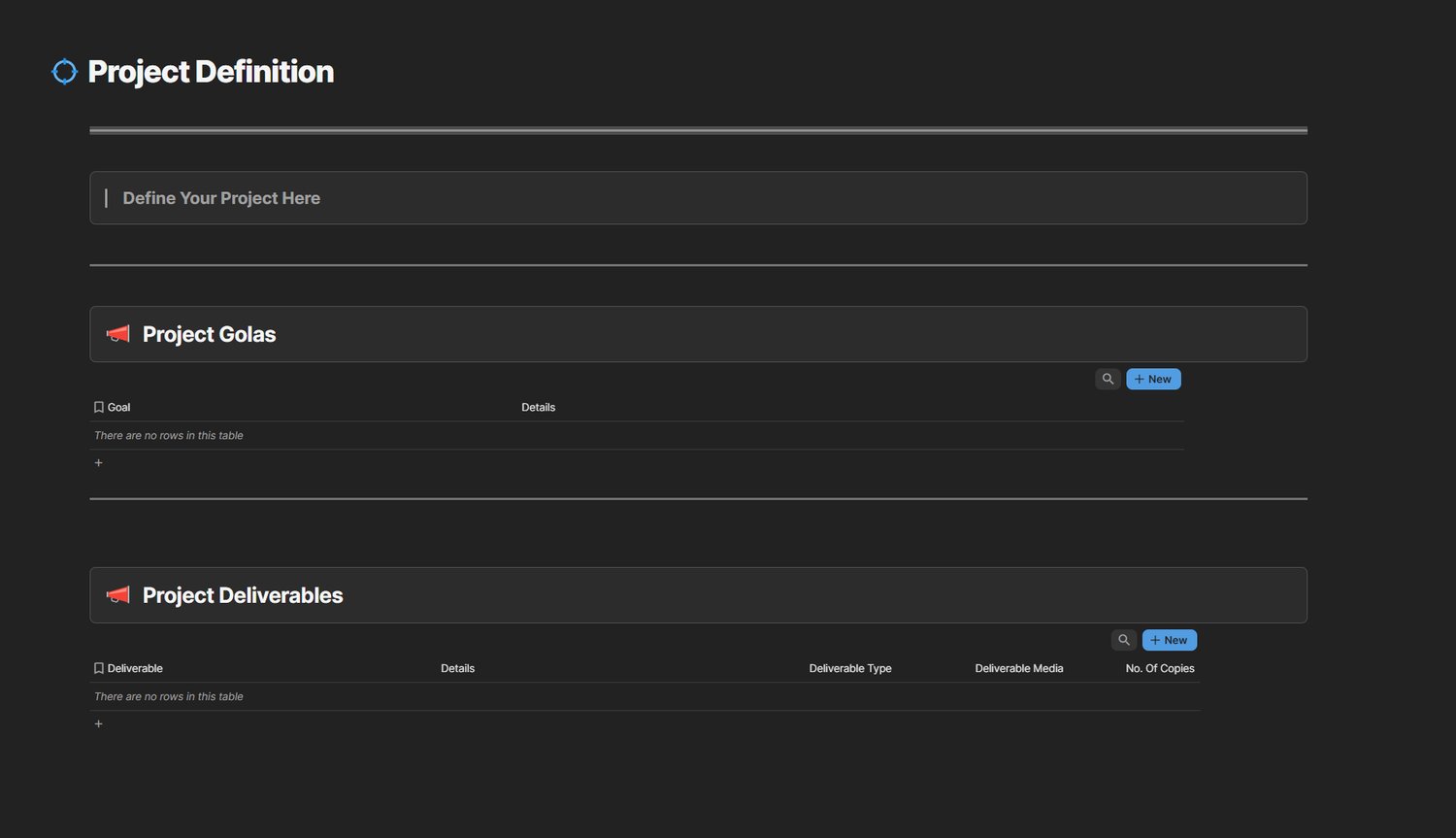
Providing sections for defining the project goals and listing the project deliverables. The template includes two tables where users can outline their project goals and the specific details associated with each, as well as a comprehensive list of deliverables, detailing the type, media, and quantity for each item. Deliverables may range from products and services to documents, and can be tagged with the type of media they are associated with, whether cloud-based, soft copy, etc.
Requirements Gathering
Effective requirements gathering, essential for satisfying the conditions or capabilities of a system as defined by PMI. The template includes a section for capturing requirements, detailing their specifics, and noting the reasons and acceptance criteria for each requirement. Users can utilize the 'Expand Row' button for an enlarged view and document additional details and comments in the provided sections. The template features a table to organize the requirements into categories such as Stakeholder, Functional, Project, and Business, with provisions for specifying client requirements and details. This structured approach ensures a comprehensive collection of requirements and supports the creation of a requirements traceability matrix.
In-depth Analysis
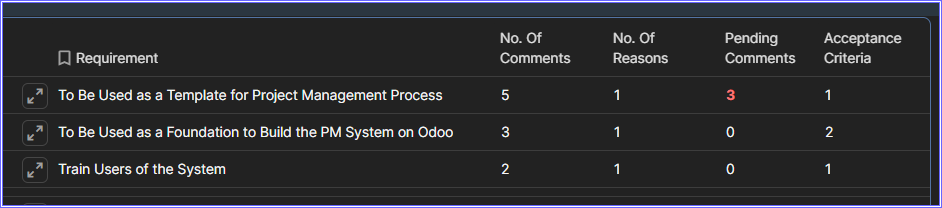
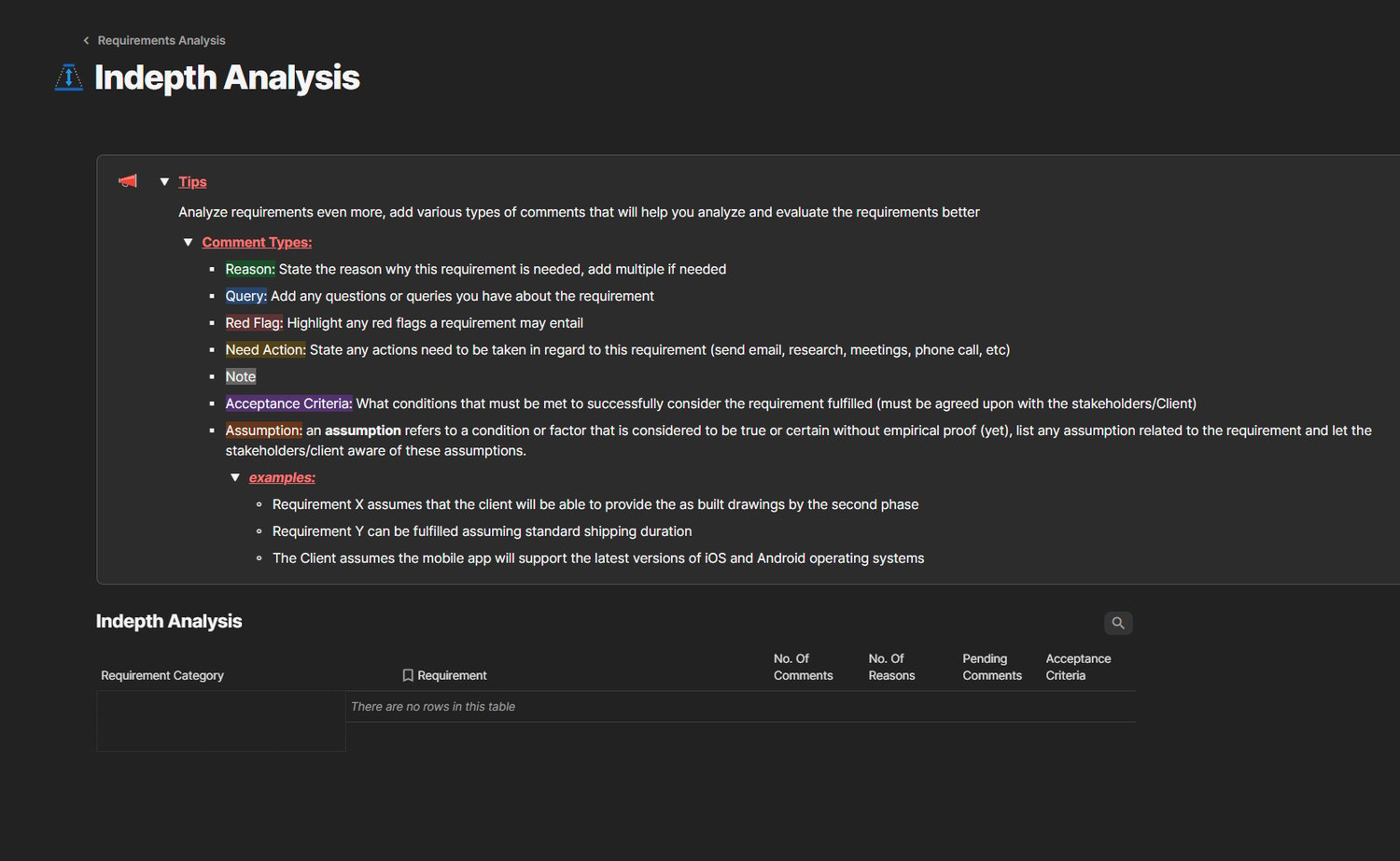
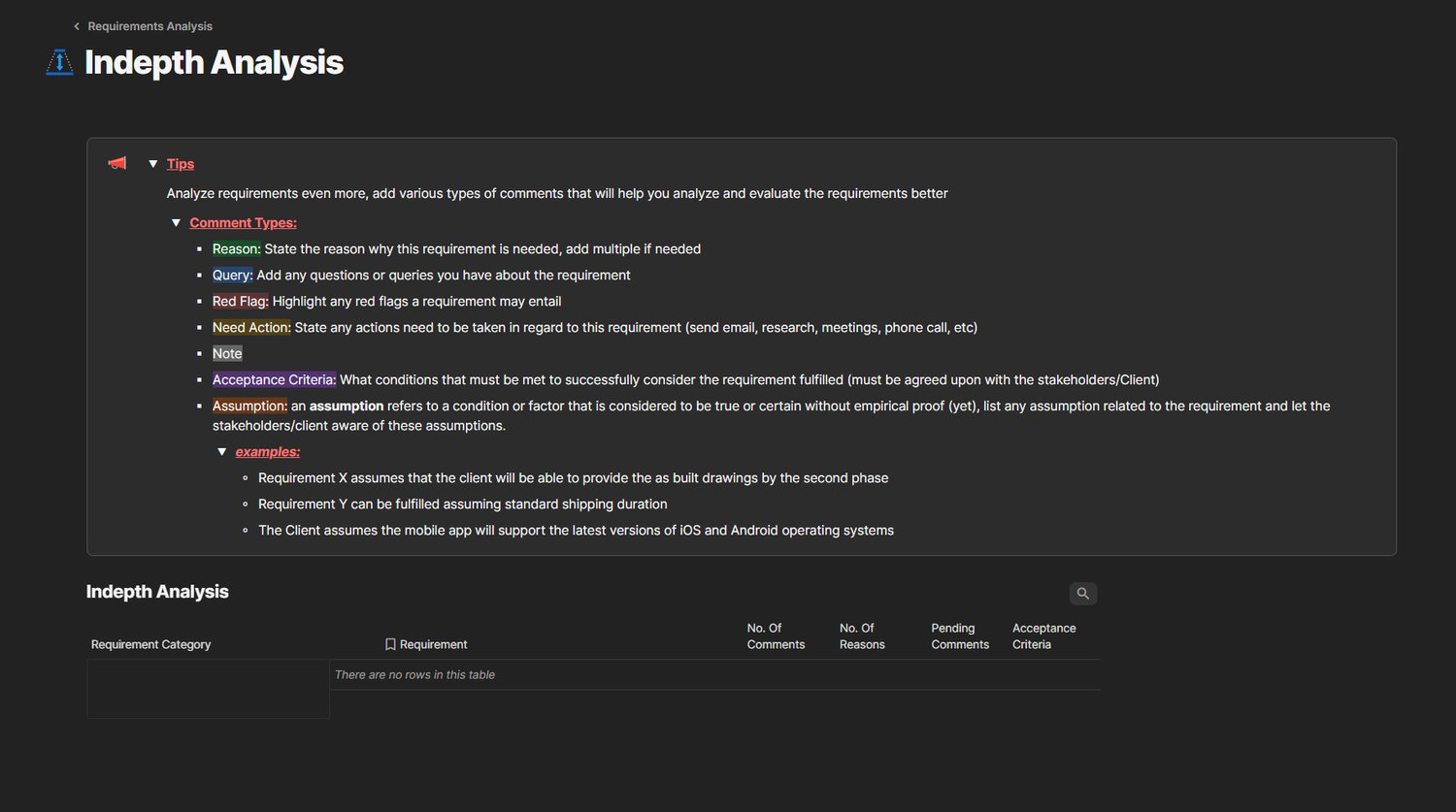
This page is designed to facilitate in-depth analysis of client requirements. It encourages users to engage in a thorough examination by utilizing various comment types, such as stating reasons, posing queries, identifying red flags, suggesting needed actions, noting assumptions, and establishing acceptance criteria. These comments aim to clarify the necessity of each requirement and the actions to address them, while also highlighting potential issues and assumptions that may not have empirical proof. Examples for assumptions are provided. The page also includes a table with columns for the specific client requirement, number of comments, reasons, pending comments, and acceptance criteria, serving as a structured approach for stakeholders and clients to assess and agree upon what is needed to fulfill each requirement successfully.
Requirements Vs Goals
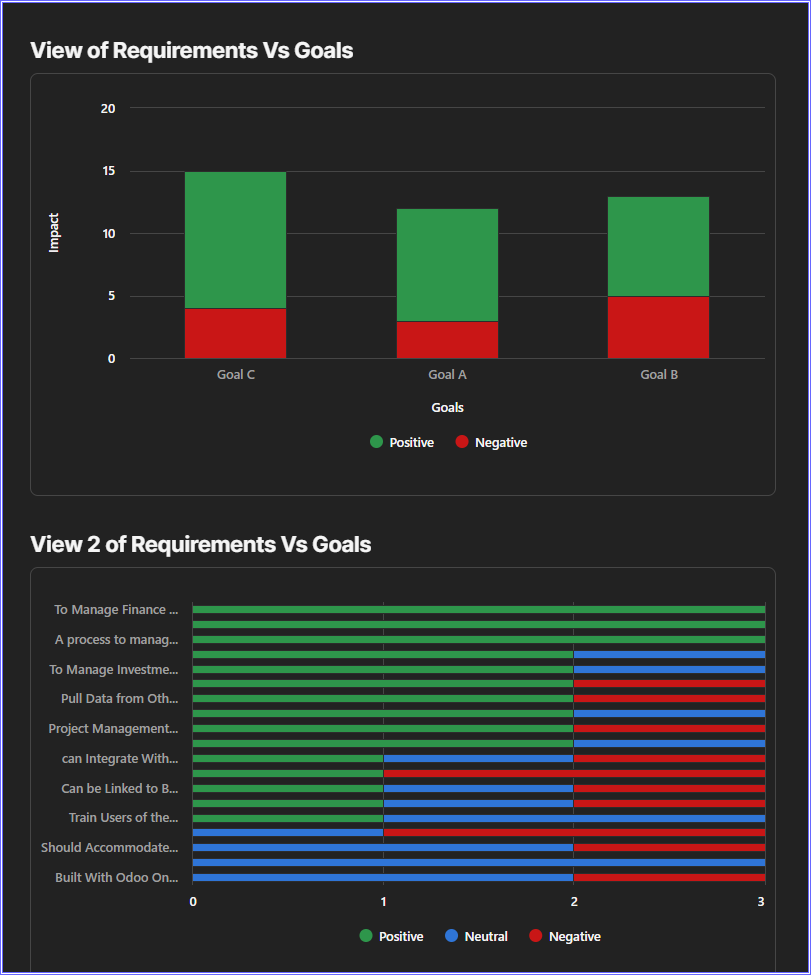
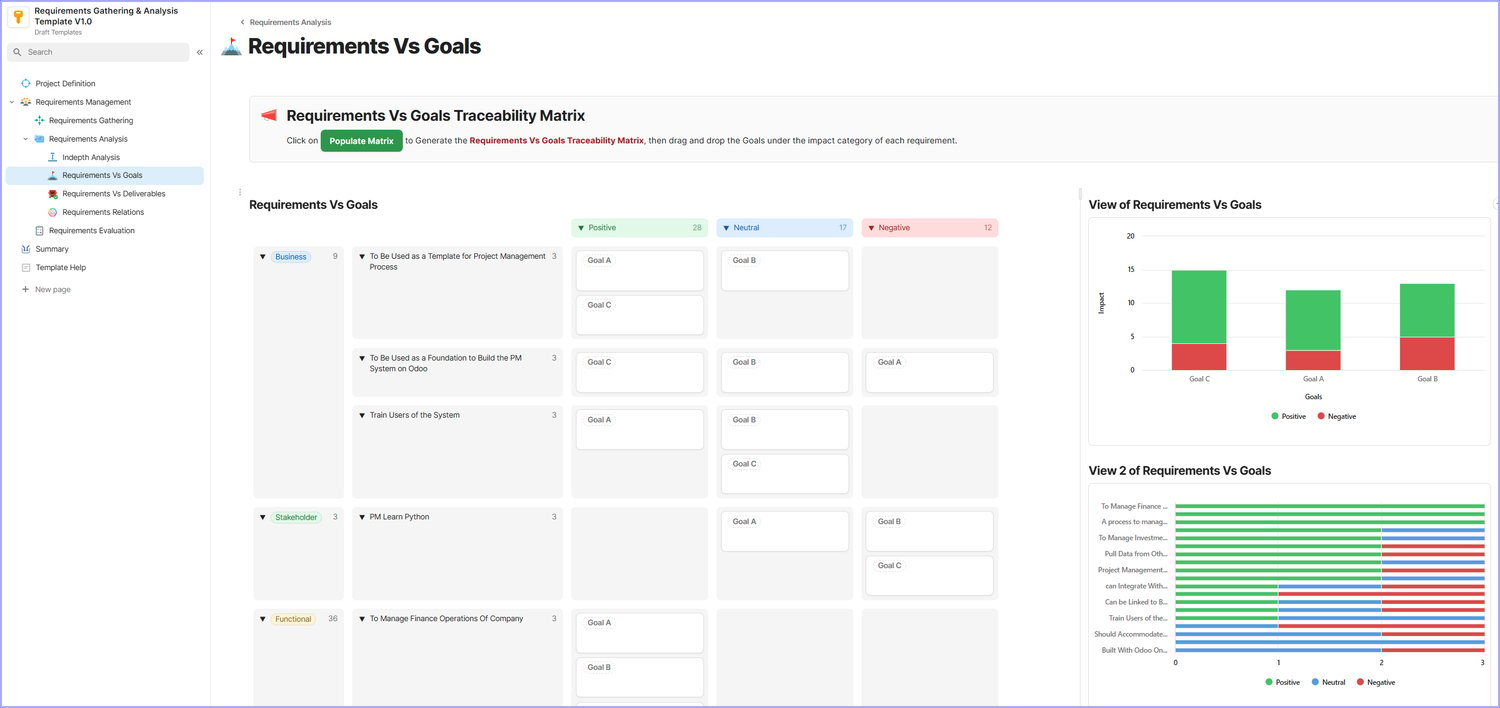
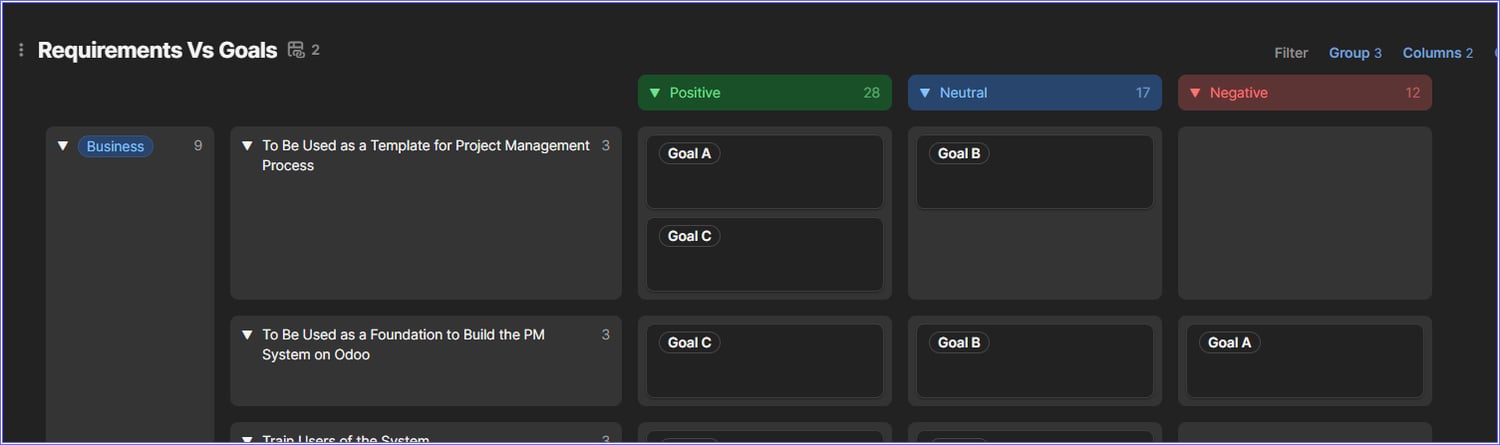
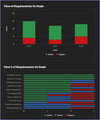
The Requirements Vs Goals Traceability Matrix is a Coda template designed to establish and visualize the relationship between project requirements and goals. Users can generate the matrix by clicking on the "Populate Matrix" button and can then allocate goals to each requirement by categorizing their impact as positive, neutral, or negative. The template includes multiple views to sort and present the data, emphasizing the connection between each requirement and its impact over project’s goals. This helps in tracking how well requirements are aligned with goals across different categories such as stakeholder, functional, project, and business needs.
Requirements Vs Deliverables
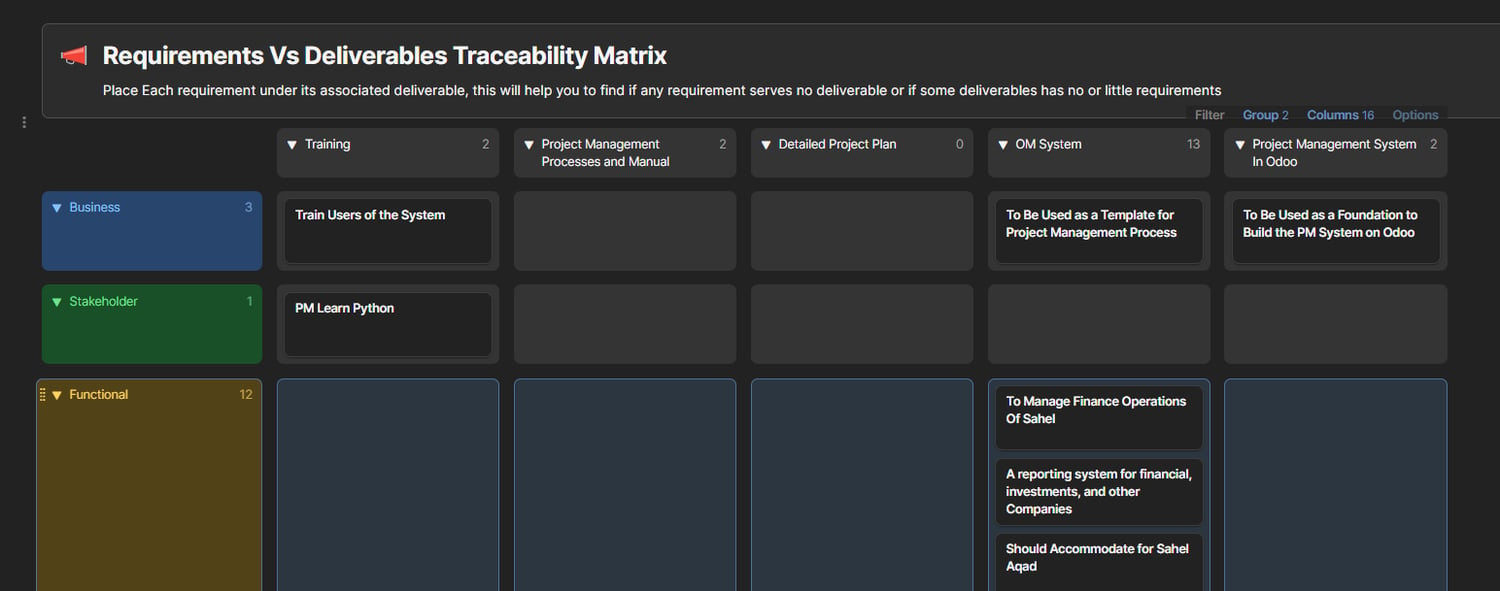
The "Requirements Vs Deliverables Traceability Matrix" page is a tool designed to map out and align client requirements with the corresponding deliverables. This matrix ensures that each requirement is linked to a deliverable, highlighting any requirements without deliverables or deliverables with insufficient requirements.
Requirements Relations
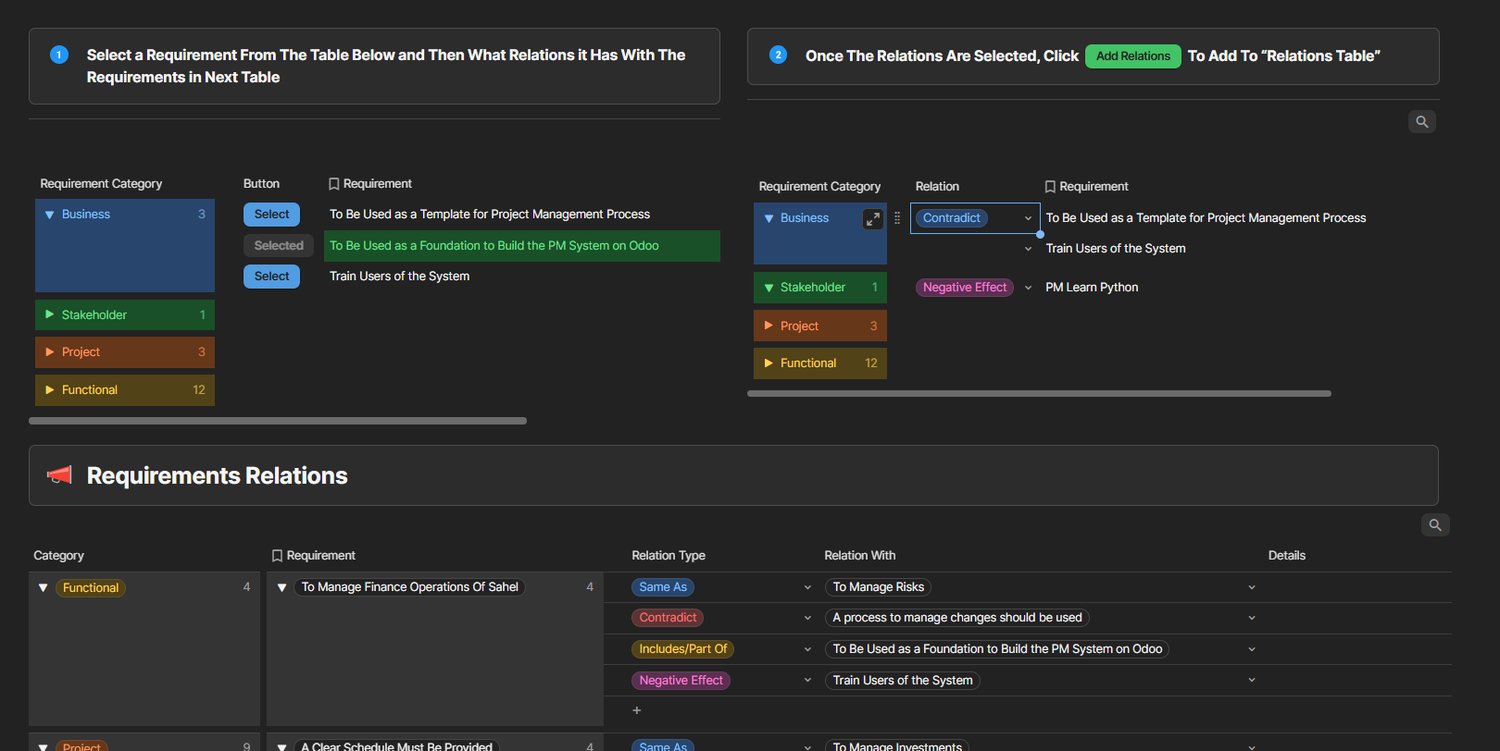
This page is designed to establish and manage relationships between different requirements. Users can select a requirement from the first table, each with a ‘model’ button and a specific client requirement. Once selected, users can determine the relations of this requirement with others in the second table. After defining relationships, these can be added to the “Relations Table,” which details the requirement, its relation type (like 'Same As', 'Contradict', 'Includes/Part Of', etc.), the requirement it is related to, specific details, and the category. This helps in visualizing and managing how each requirement impacts or relates to others within a project.
Requirements Evaluation
This page is designed to classify client requirements into four categories based on their necessity and relation to the project goals: Must-haves (essential requirements), Should-haves (important but not critical), Could-haves (nice to have but not vital), and Won’t-haves (out of scope and potentially negative).
Summary
Give an overview summary of the project’s goals, deliverables, scope, exclusions, acceptance criteria and assumptions
You Might Also Like
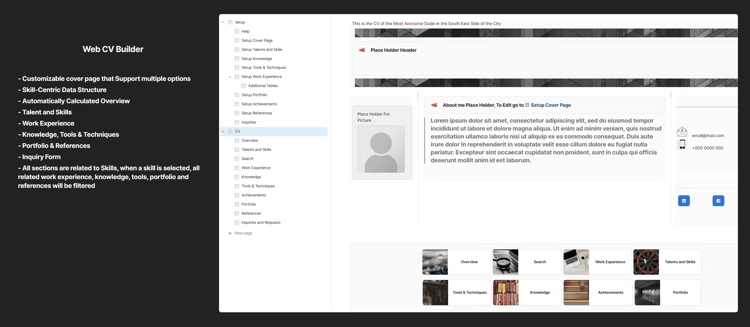
Web CV Builder Template
$25.00