
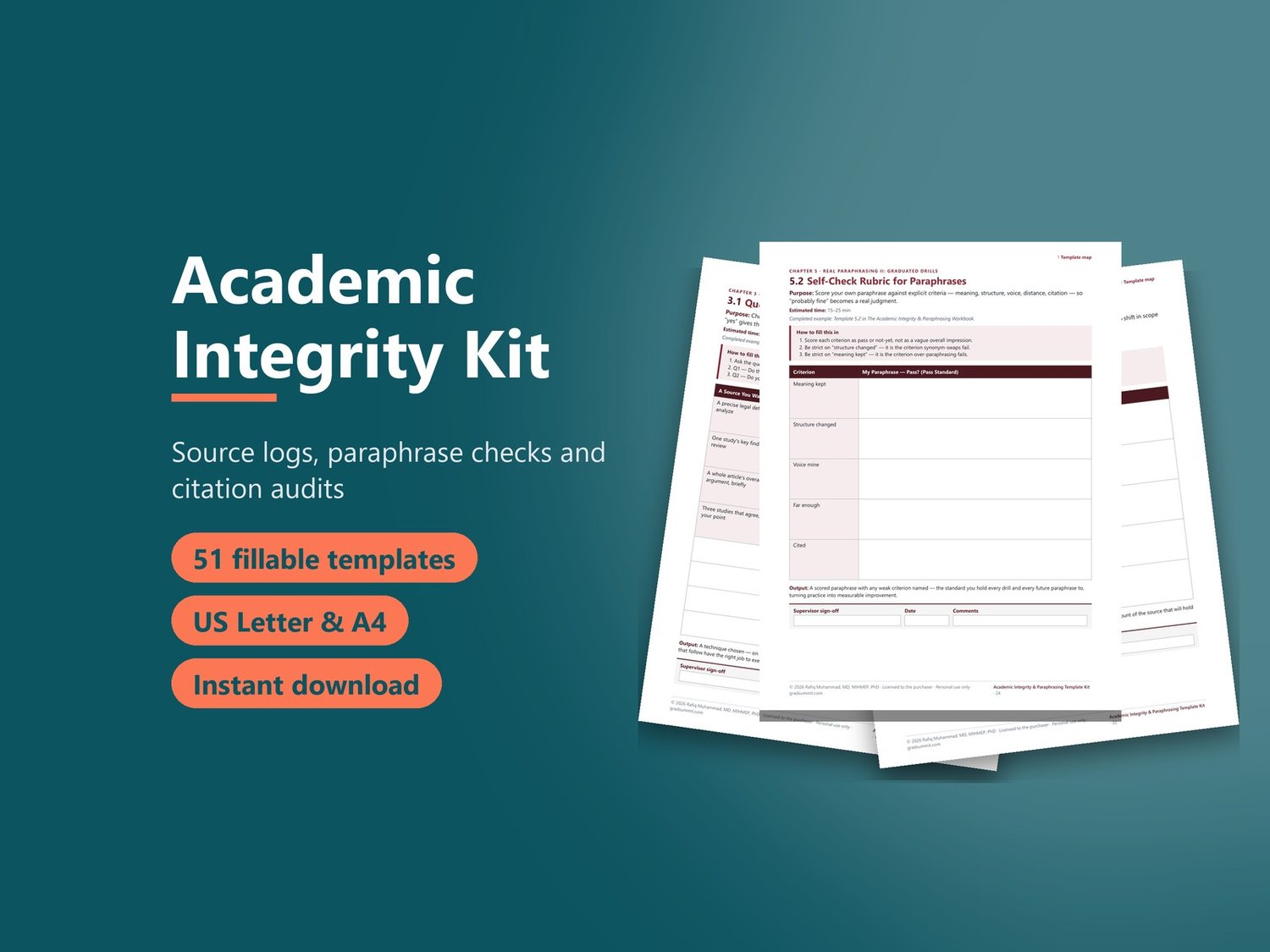
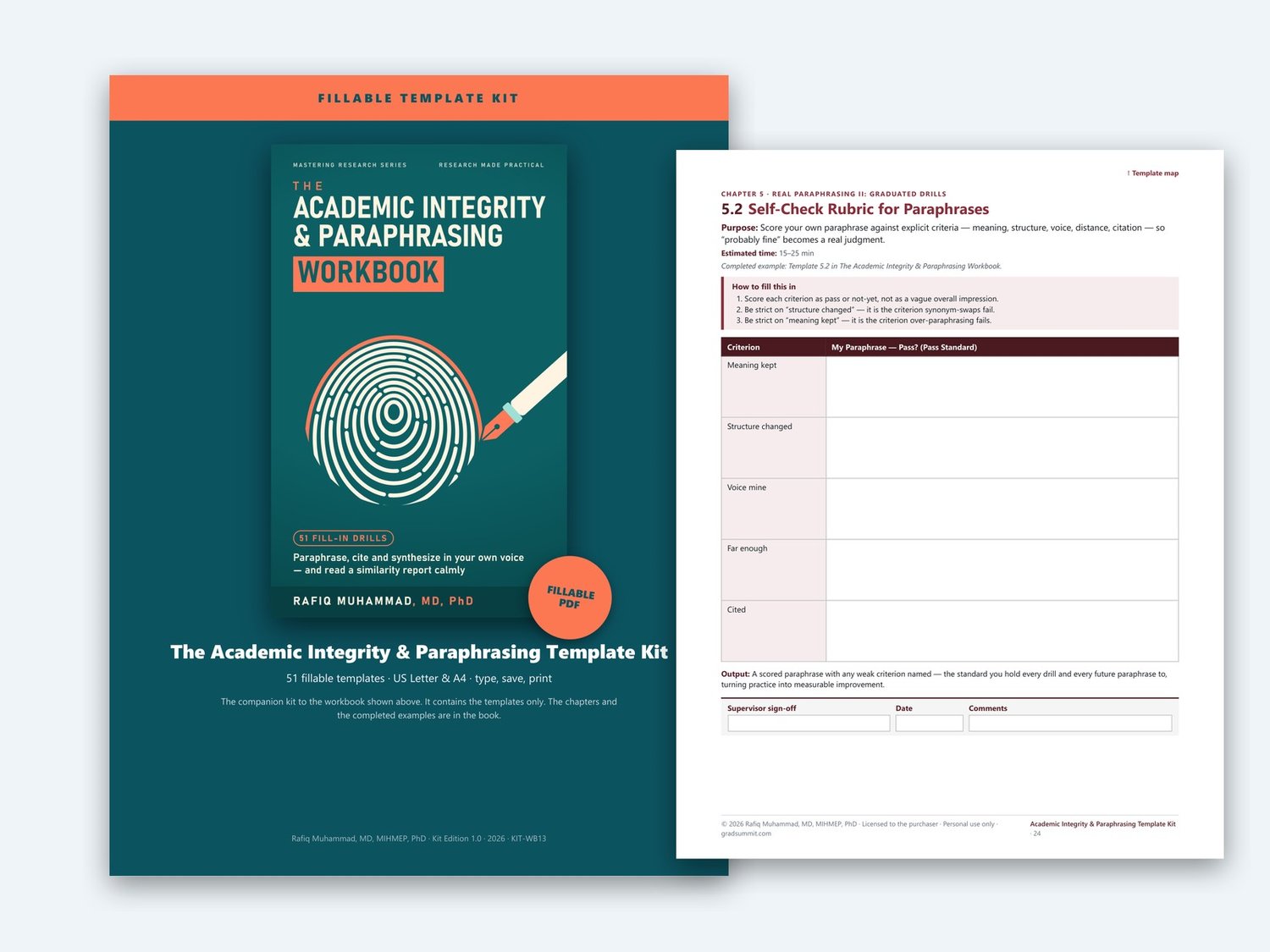

The Academic Integrity & Paraphrasing Template Kit: 51 Fillable Templates (US Letter + A4)
For the student who wants to write from sources without fear of a similarity report: paraphrase, cite and check your work with confidence.
Every integrity and paraphrasing template from the workbook, ready to type into: source logs, paraphrase checks, citation audits and similarity-report reviews.
WHAT YOU GET
- 51 fillable templates in one fillable PDF (57 pages, 634 fillable fields)
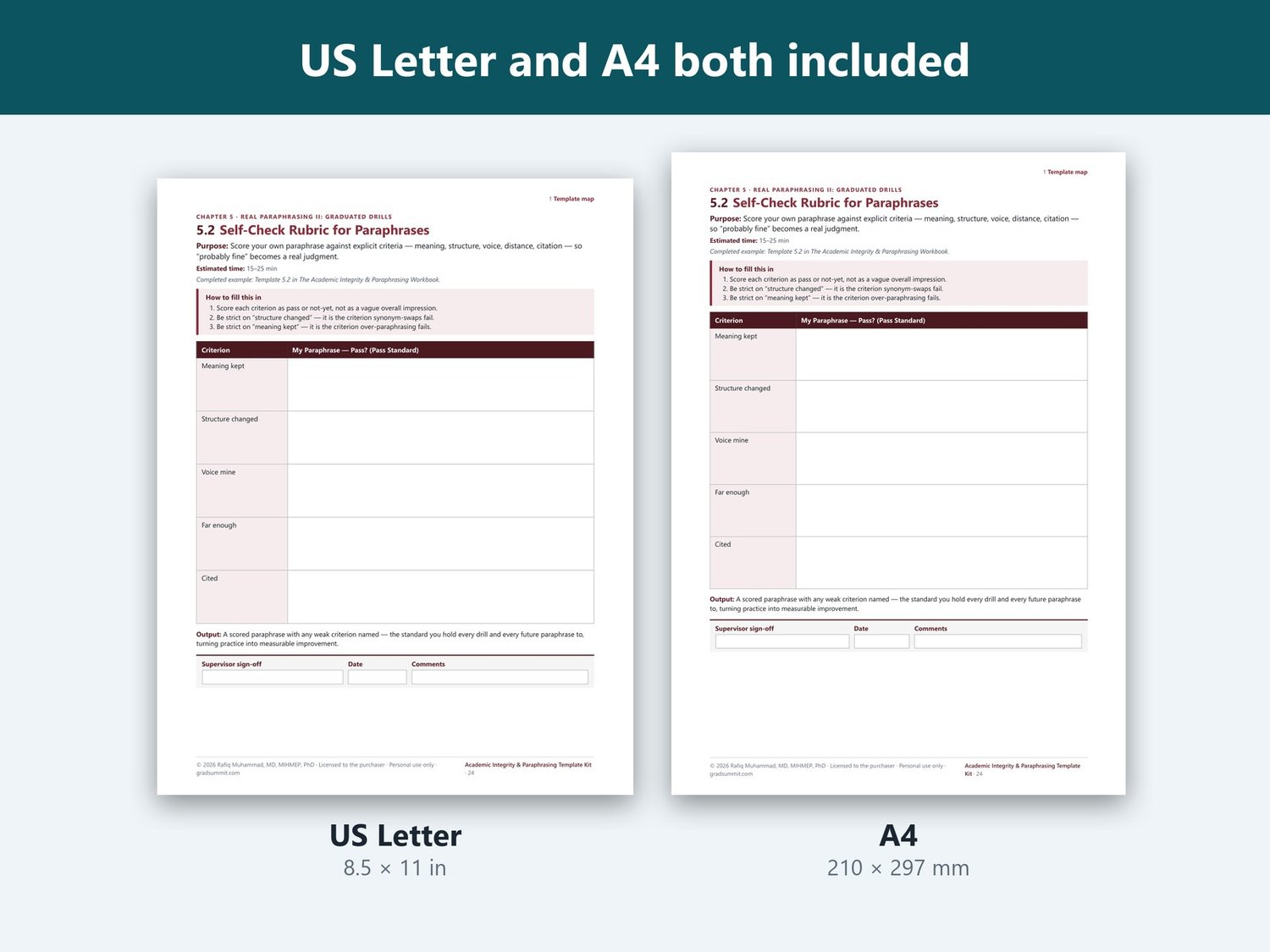
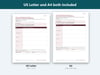
- US Letter and A4 versions, both included
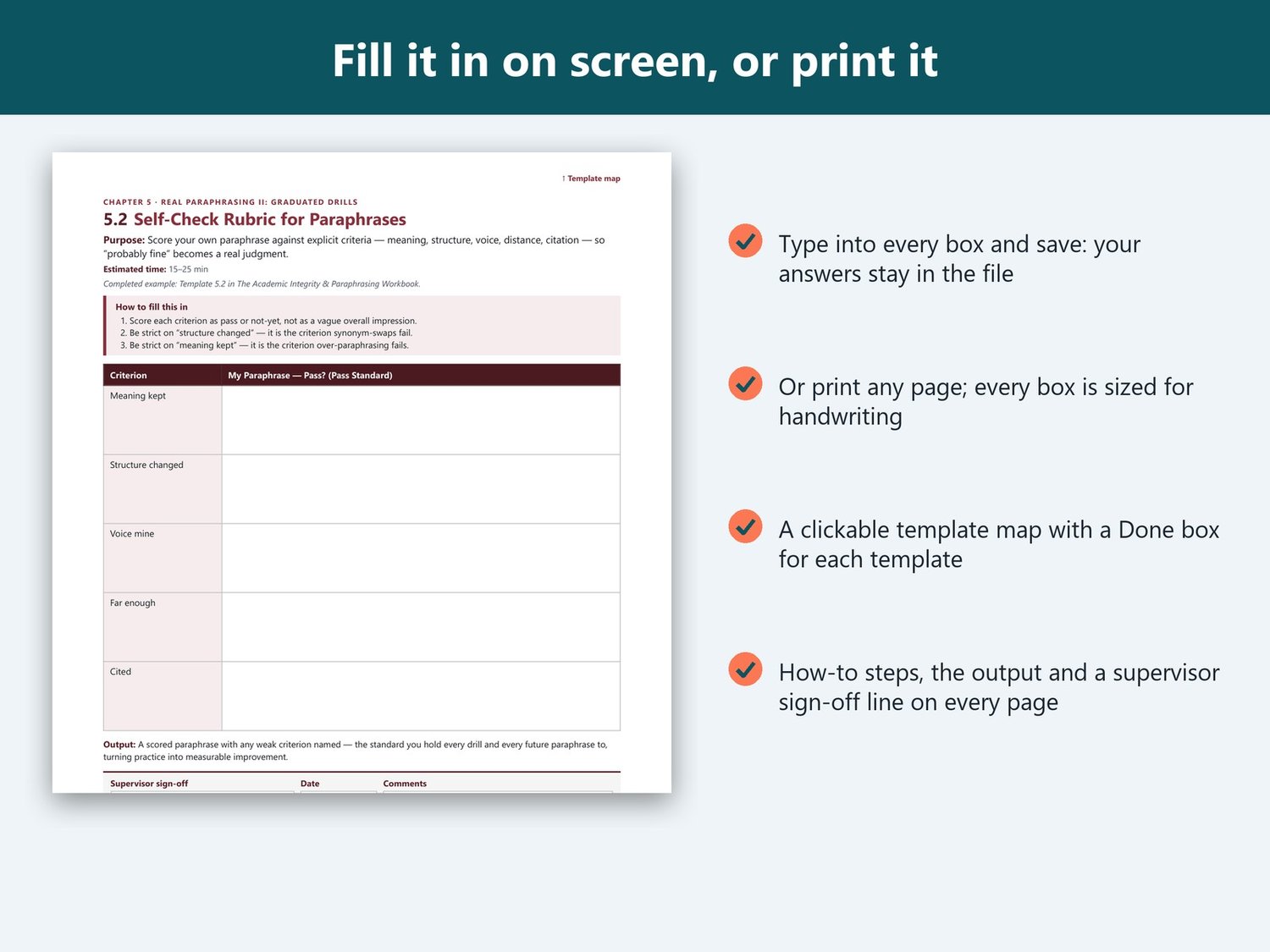
- Type into the boxes and save, or print and write by hand
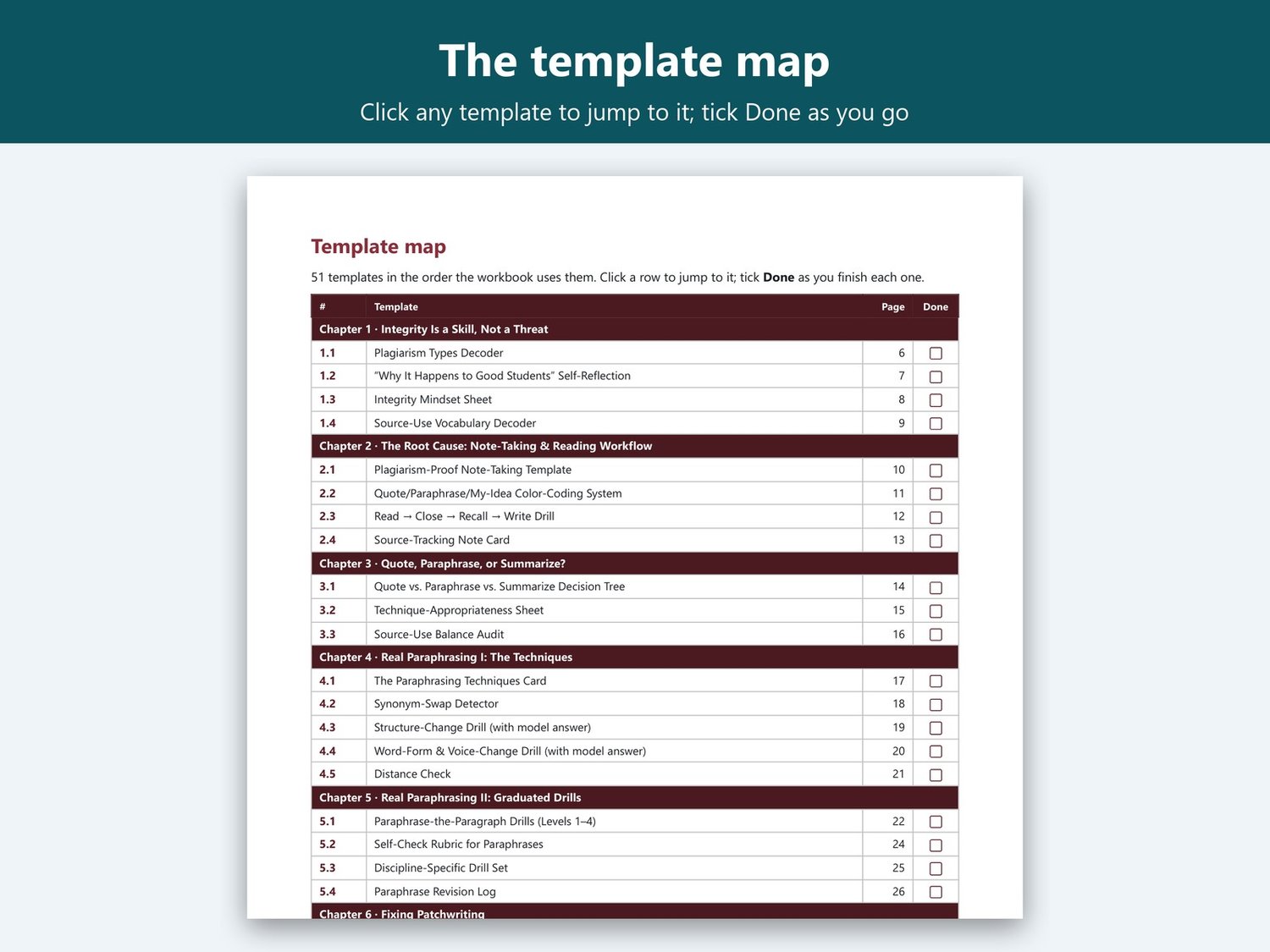
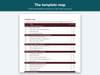
- A clickable template map with a Done box for every template, and bookmarks
WHAT'S INSIDE
- 1.1 Plagiarism Types Decoder
- 1.2 “Why It Happens to Good Students” Self-Reflection
- 1.3 Integrity Mindset Sheet
- 1.4 Source-Use Vocabulary Decoder
- 2.1 Plagiarism-Proof Note-Taking Template
- 2.2 Quote/Paraphrase/My-Idea Color-Coding System
- 2.3 Read → Close → Recall → Write Drill
- 2.4 Source-Tracking Note Card
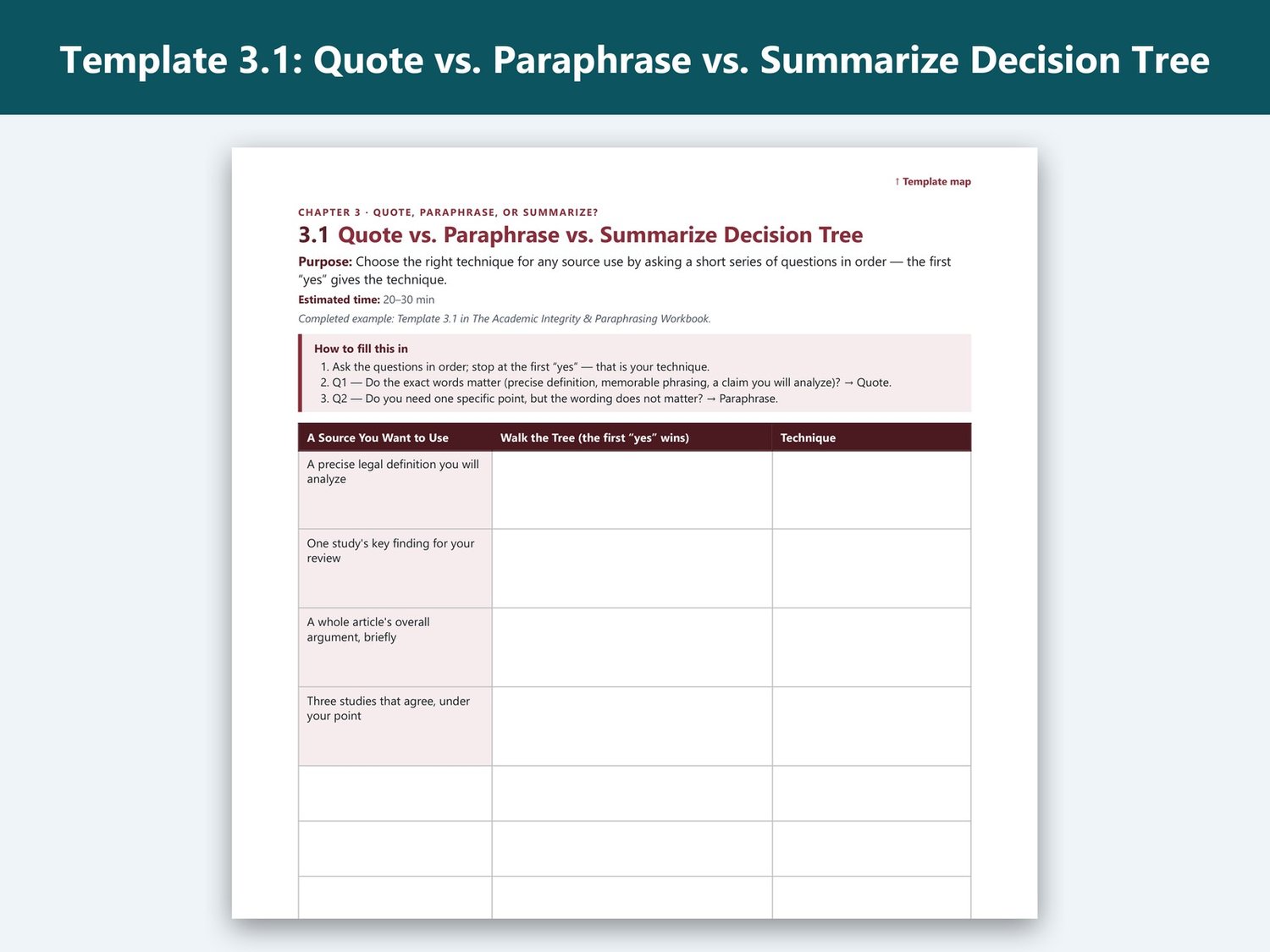
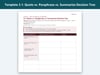
- 3.1 Quote vs. Paraphrase vs. Summarize Decision Tree
- 3.2 Technique-Appropriateness Sheet
- 3.3 Source-Use Balance Audit
- 4.1 The Paraphrasing Techniques Card
- 4.2 Synonym-Swap Detector
- 4.3 Structure-Change Drill (with model answer)
- 4.4 Word-Form & Voice-Change Drill (with model answer)
- 4.5 Distance Check
- 5.1 Paraphrase-the-Paragraph Drills (Levels 1–4)
- 5.2 Self-Check Rubric for Paraphrases
- 5.3 Discipline-Specific Drill Set
- 5.4 Paraphrase Revision Log
- 6.1 Patchwriting Fixer
- 6.2 Patchwriting Diagnostic
- 6.3 Patchwrite-to-Paraphrase Repair Drill (with model answer)
- 6.4 “Comprehension-First” Repair Protocol
- 7.1 Summary-Building Worksheet
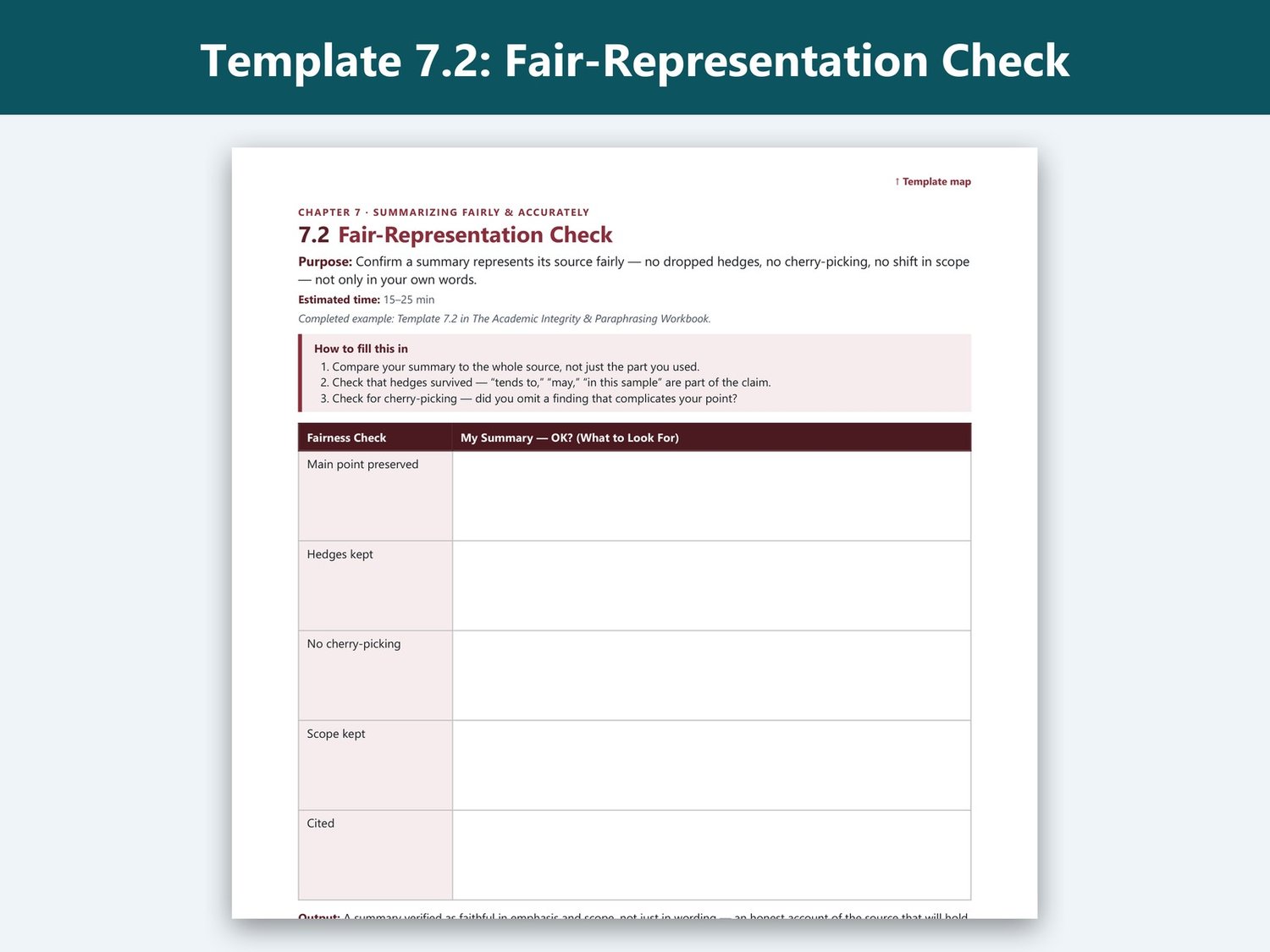
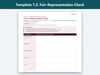
- 7.2 Fair-Representation Check
- 7.3 Multi-Source Summary Drill (with model answer)
- 7.4 Summary Length-Calibration
- 8.1 “When to Cite” Checklist
- 8.2 Citation-Density Self-Audit
- 8.3 Common-Knowledge Test
- 8.4 Signal/Attributive Phrase Bank
- 8.5 Cite-the-Paraphrase Reminder Drill
- 9.1 Synthesis-Without-Plagiarism Templates
- 9.2 Source-by-Source → Synthesis Converter
- 9.3 Synthesis Matrix-to-Prose Drill (with model answer)
- 9.4 Voice-Ownership Check
- 10.1 Self-Plagiarism Risk Check
- 10.2 Acceptable-Reuse Decision Sheet
- 10.3 Thesis-to-Paper Reuse Planner
- 10.4 Methods-Reuse & “Standard Phrasing” Guide
- 11.1 Similarity-Report Interpretation Guide
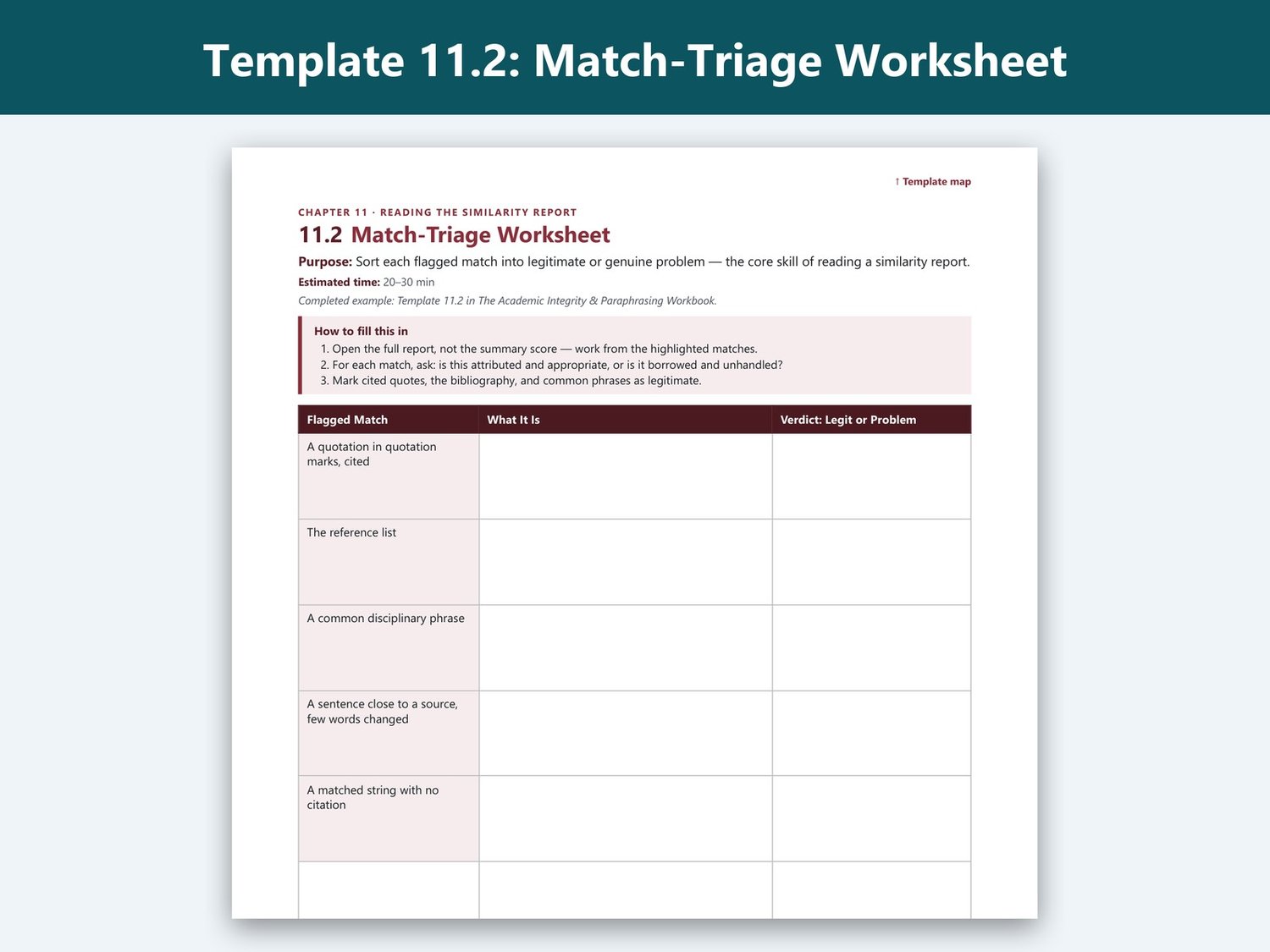
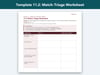
- 11.2 Match-Triage Worksheet
- 11.3 False-Positive Filter
- 11.4 Similarity-to-Action Plan
- 11.5 AI-Detection Caveat Note
- 12.1 Integrity Self-Declaration & Reflection
- 12.2 Pre-Submission Integrity Checklist
- 12.3 Personal Phrase Bank Builder
- 12.4 Remediation & Help Pathways Map
- 12.5 Ongoing Skill-Development Plan
EVERY TEMPLATE PAGE GIVES YOU
- Its purpose and how long it takes
- Short steps on how to fill it in
- Fillable boxes sized for real answers
- The output it produces
- A supervisor sign-off line
- Where to find the completed example in the workbook
HOW TO USE IT
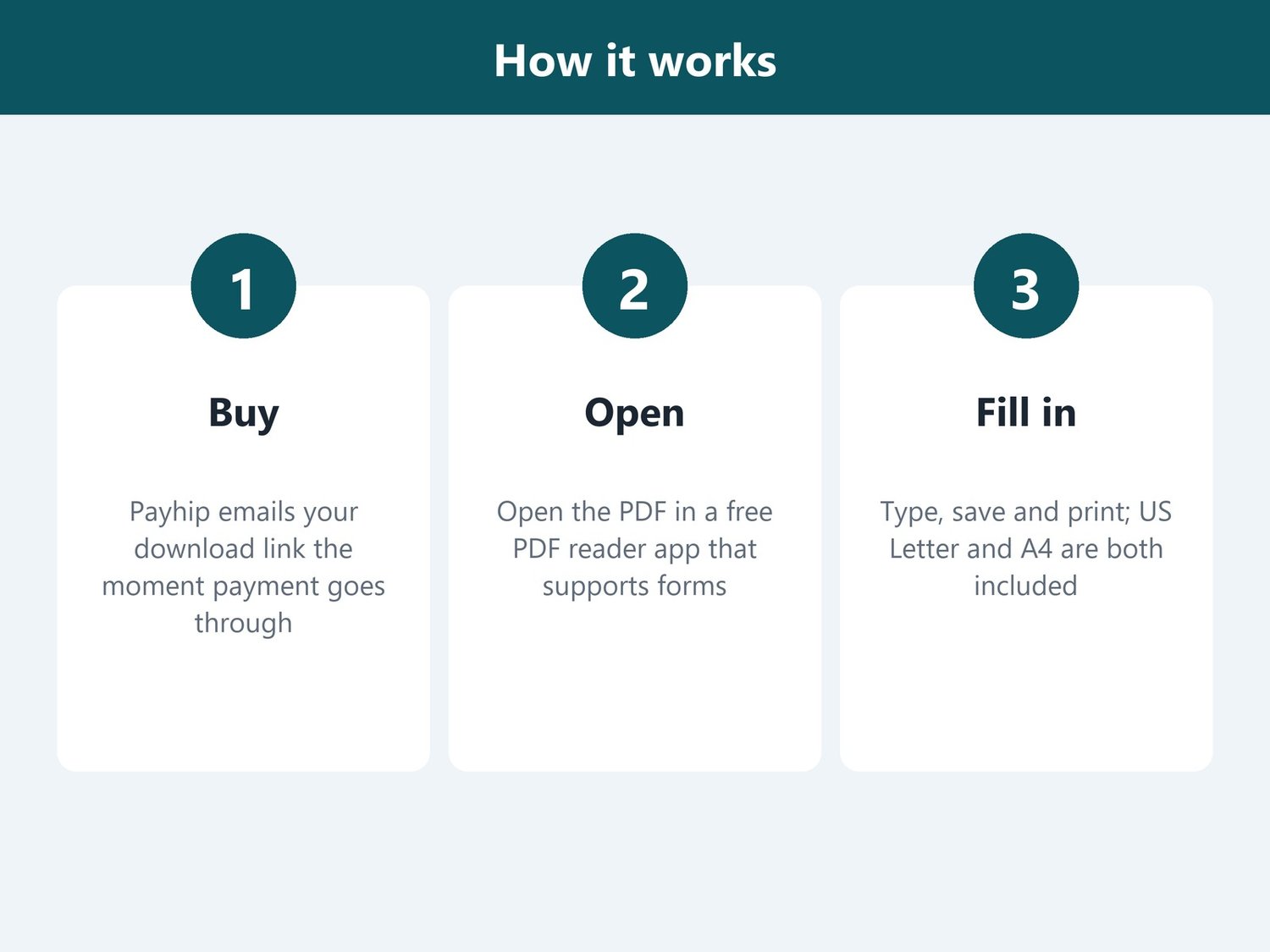
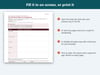
- Open the PDF in a free PDF reader app that supports fillable forms (Adobe Acrobat Reader is free and works best). Some phone and browser viewers do not save typed answers.
- Click a box and type. Save often: your answers stay in the file.
THE KIT AND THE WORKBOOK
The kit gives you the tools. The Academic Integrity & Paraphrasing Workbook teaches the method: it explains every template and shows a completed example of each one. If this is your first time, start with the workbook: https://www.gradsummit.com/workbooks/academic-integrity-paraphrasing-workbook/
LICENCE
For the buyer's own use. Every page is stamped with the buyer's email and the purchase date. Please do not share or resell the files. For a class or research group, ask about a group licence.
By Rafiq Muhammad, MD, MIHMEP, PhD. The templates were drafted with the help of AI tools and written, checked and laid out by the author.