

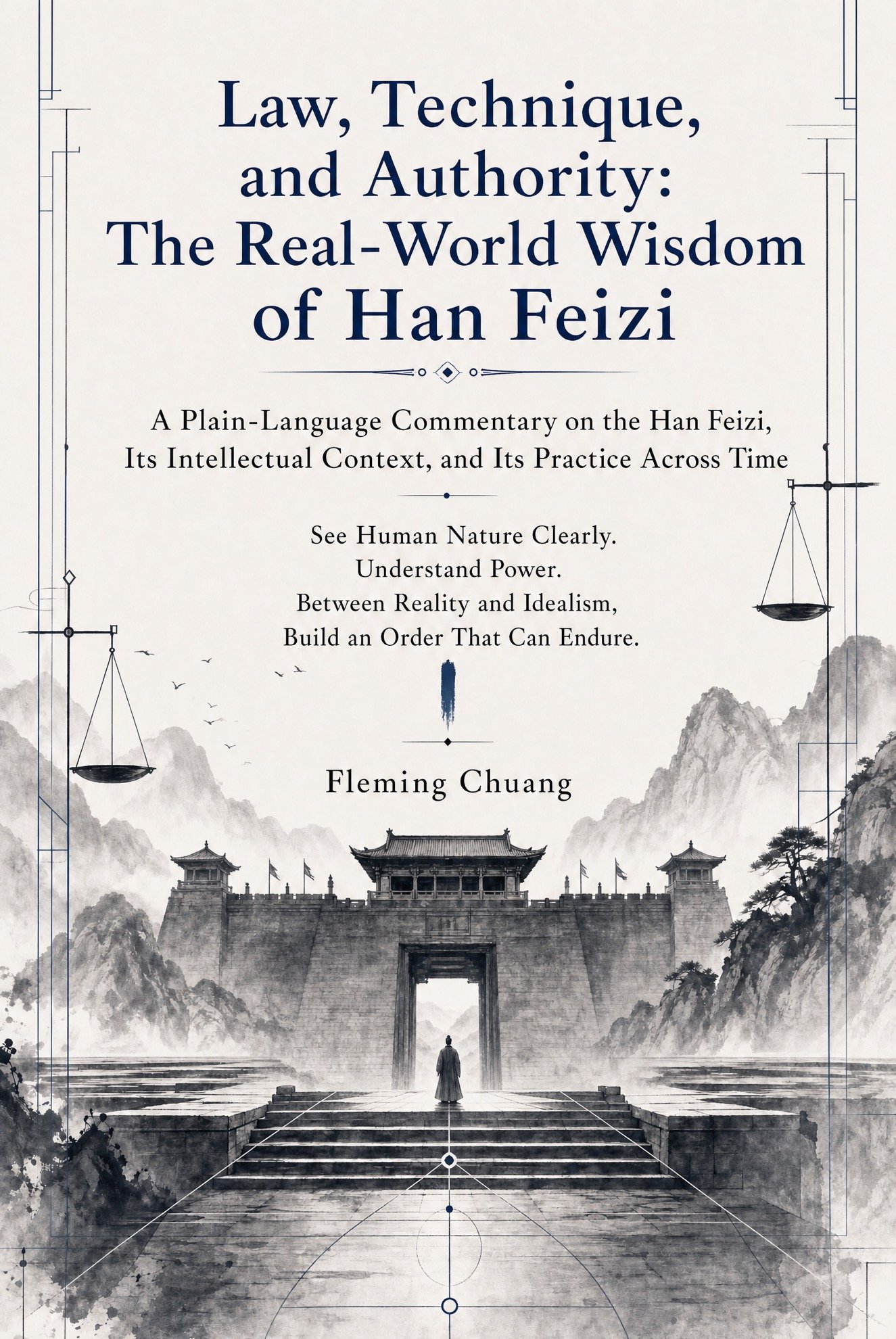
Law, Technique, and Authority: The Real-World Wisdom of Han Feizi
Why do organizations fail when their rules are unclear, incentives are distorted, and power is left unchecked? More than two millennia ago, Han Feizi confronted these questions with a strikingly unsentimental account of human motivation, political authority, and institutional order.
Law, Technique, and Authority offers an accessible, plain-language commentary on the Han Feizi, one of the most important works of ancient Chinese Legalist thought. It introduces Han Feizi’s historical world and intellectual context, then guides readers through his central ideas of fa (law and public standards), shu (administrative technique and the management of information), and shi (positional authority and the force of office).
The book places classical passages alongside modern English translations, philosophical discussion, historical examples, and practical reflections. Across essays on preserving a state, persuading rulers, detecting corruption, establishing standards, managing rewards and punishments, appointing officials, recognizing danger, and adapting to changing circumstances, Han Feizi emerges as a sharp analyst of incentives, institutional failure, factional power, and strategic communication. His engagement with Laozi, Confucianism, Mohism, and the wider intellectual world of the Warring States period further reveals a thinker who was not merely a theorist of punishment, but a systematic designer of political order.
At the same time, this book does not ask modern readers to accept Han Feizi uncritically. It examines the dangers of concentrated power, harsh enforcement, political suspicion, and the reduction of human relationships to calculated interests. Ancient statecraft is placed in conversation with modern rule-of-law values, accountability, organizational governance, and individual dignity.
Whether you are studying Chinese philosophy, political thought, leadership, management, or the mechanics of persuasion, this commentary provides a practical entry point into Han Feizi’s difficult and enduring questions: How should power be structured? How can institutions outlast individuals? When does loyalty become a liability? And how can we face reality without surrendering our ideals?