
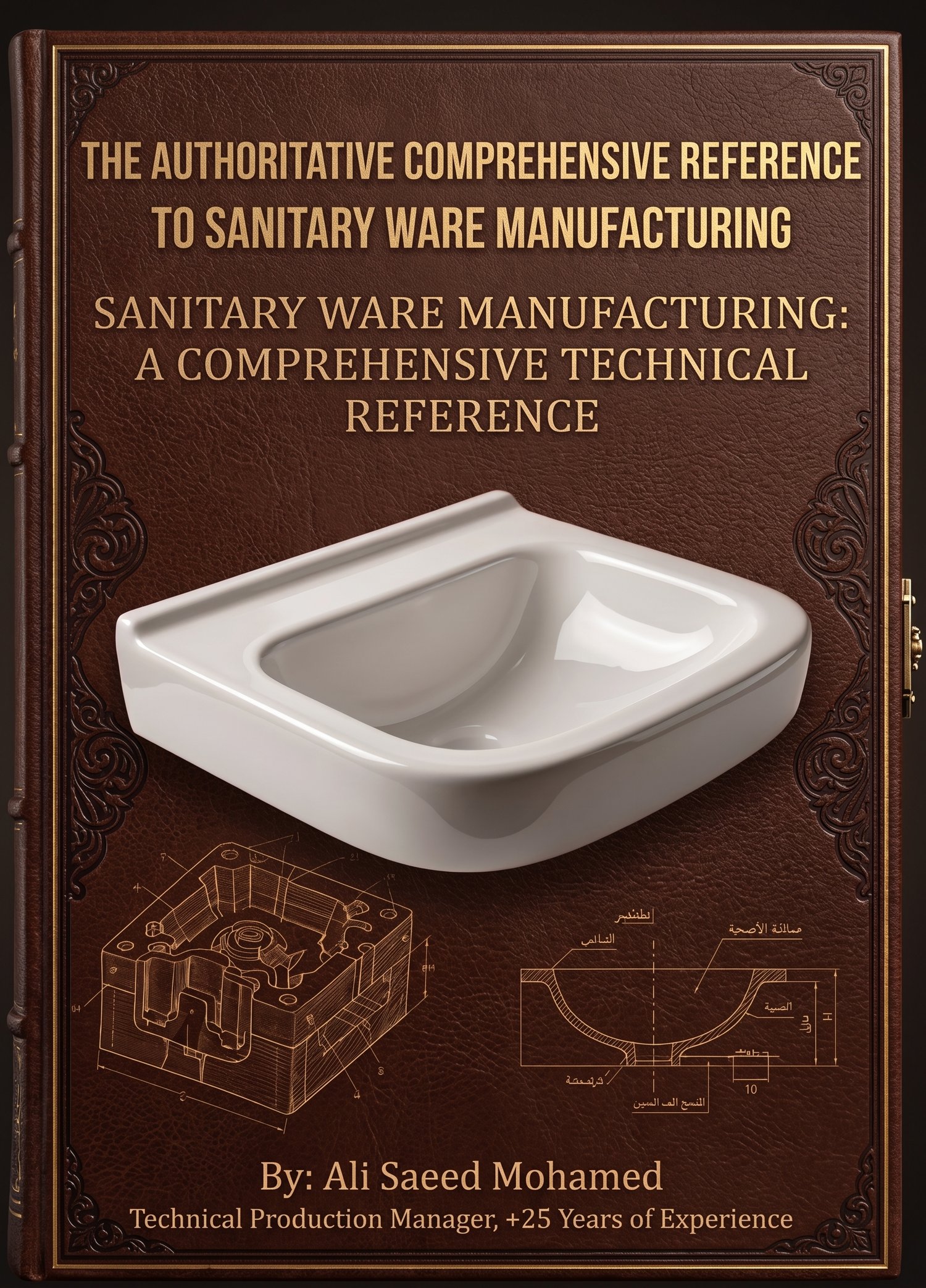
Sanitary Ware Manufacturing Reference
On Sale
$120.00
$120.00
Industrial Ceramic Engineering: Vitreous China, Fine Fire Clay, and Sanitary Ware Manufacturing
Bridging advanced materials science with practical plant operations, this handbook provides factory managers, ceramic engineers, and production specialists with complete formulations, rheological control strategies, and shop-floor troubleshooting protocols.
What’s Inside the Book:
- Chapter 1: The Science of Sanitary Ware Materials: Origins, Properties, and Glaze Chemistry
- An in-depth exploration of geological origins, physical-chemical characteristics, and high-temperature glaze formulations essential for high-performance ceramic manufacturing.
- Chapter 2: Sanitary Ware Body Processing: Milling, Slip Control, and Quality Testing
- A comprehensive roadmap for industrial particle comminution, slurry stabilization, and QA/QC testing standards across the initial preparation cycle.
- Chapter 3: Advanced Ceramic Body Formulations: The Fine Fire Clay Matrix
- Technical formulation strategies for large-format Fine Fire Clay (FFC), focusing on structural integrity, thermal stability, and load-bearing performance.
- Chapter 4: Glaze-Body Fit and Thermomechanical Defect Resolution
- Mitigation blueprints for thermal expansion mismatches, addressing crazing, peeling, pinholing, and mechanical failure at production scale.
- Chapter 5: Strategic Localization of Raw Materials and Quality Validation
- Systematic frameworks for benchmarking, validating, and integrating regional mineral deposits into industrial batching without sacrificing quality.
- Chapter 6: Slip Rheology and Environmental Variable Control
- Targeted controls for dynamic slip parameters (viscosity, thixotropy, yield stress) against seasonal humidity, ambient temperature shifts, and water hardness.
- Chapter 7: Advanced Rheological Characterization of Geological Deposits
- Analytical techniques to evaluate the plasticity, colloidal stability, and particle size distribution of raw clay deposits.
- Chapter 8: Hybrid Body Formulation and Recipe Engineering
- Formulation models designed to balance mechanical vitreous strength with the low-shrinkage advantages of refractory fire clays.
- Chapter 9: Industrial Slip Preparation and Aging Protocols
- Best practices for industrial agitation, maturation aging periods, degassing, and rheological stabilization prior to casting.
- Chapter 10: Troubleshooting Local Material Defects in Sanitary Ware
- A field diagnostic guide to resolving core casting defects, iron spotting, pyroplastic deformation, and warpage stemming from localized minerals.
- Chapter 11: Advanced Recipe Optimization and Export Material Integration
- Cost-effective batch optimization techniques combining imported, highly refined components with standard mineral feedstocks.
- Chapter 12: Advanced Raw Material Sourcing and Supplier Integration
- Supply chain qualification audits, technical specification thresholds, and quality variance handling for bulk industrial suppliers.
- Chapter 13: Engineering the Fire Clay Matrix for Large-Scale Production
- Manufacturing solutions for scale: managing high-volume drying kinetics, firing curves, and structural stability in large-scale casting environments.
- Chapter 14: The Engobe Interface and Defect Resolution in FFC
- Troubleshooting interface anomalies between engobes, refractory bodies, and top glazes, eliminating delamination and crawling.
- Chapter 15: Comparative Analysis of Sanitary Ware Matrices: Vitreous China vs. Fine Fire Clay
- A side-by-side engineering evaluation comparing VC and FFC on water absorption, shrinkage, yield rates, and operational economics.
- Chapter 16: The Engineering and Formulation of the Engobe Interface
- Formulation methods for intermediate bonding layers that balance coefficient of thermal expansion (CTE) and match drying contractions.
- Chapter 17: Standard Operating Procedures for Local Mountain Materials
- Step-by-step SOPs covering the extraction, sorting, beneficiation, and initial crushing of unrefined quarry materials.
- Chapter 18: Advanced Milling and Slip Preparation Dynamics
- Optimizing ball mill grinding dynamics, media-to-charge ratios, energy efficiency, and particle shape distributions.
- Chapter 19: Comprehensive Laboratory Testing Protocols
- Standardized laboratory testing regimes: modulus of rupture (MOR), dilatometry, loss on ignition (LOI), and XRF/XRD phase confirmation.
- Chapter 20: Technical Data Sheets and Material Specifications
- A catalog of target TDS metrics, acceptable variance tolerances, and performance envelopes for commercial raw minerals and industrial slurries.
- Chapter 21: Practical Problems & Field Insights
- Real-world root cause analysis, floor-level corrections, and operational workarounds derived from daily factory line management.
Designed as an active shop-floor reference and technical manual, this guide equips professionals to stabilize slip rheology, engineer local materials, and eliminate defects across both Vitreous China and Fine Fire Clay manufacturing lines.