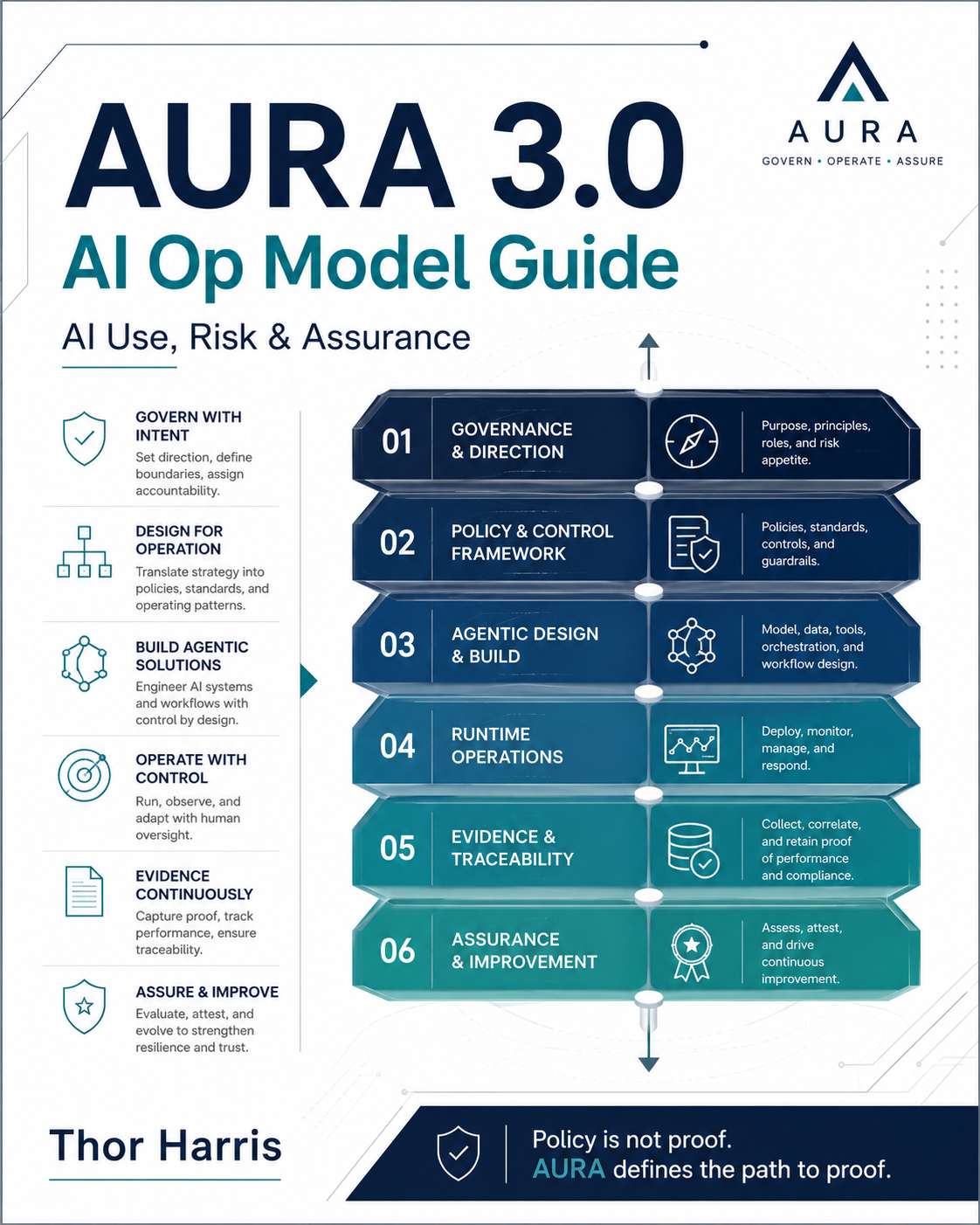

AURA 3.0 AI Architecture and Integration Practitioner
AURA 3.0™ Evidence Automation Practitioner Summary
How AURA turns delivery and runtime activity into traceable, decision-grade evidence.
Free practitioner summary. 15 pages. Version 1.0, July 2026.
Policy is not proof. Evidence should be produced as a by-product of delivery and operation, preserved with provenance, routed to named decision owners and available for independent review. This summary shows the technical teams who build and run AI systems exactly how to make that happen.
Who it's for
SecDevOps engineers, AI Ops, SRE and SOC teams, observability specialists, data and visualisation teams, BI developers, and the platform and integration teams who hold the evidence chain together. Risk, audit and governance teams get an acceptance checklist to test whether the technical implementation actually produces dependable assurance evidence.
The target state
A named reviewer can select one material AI use case and follow its intended use, tier, control design, test results, release decision, runtime events, incidents and assurance findings without reconstructing the story from email, screenshots or personal explanation.
What's inside
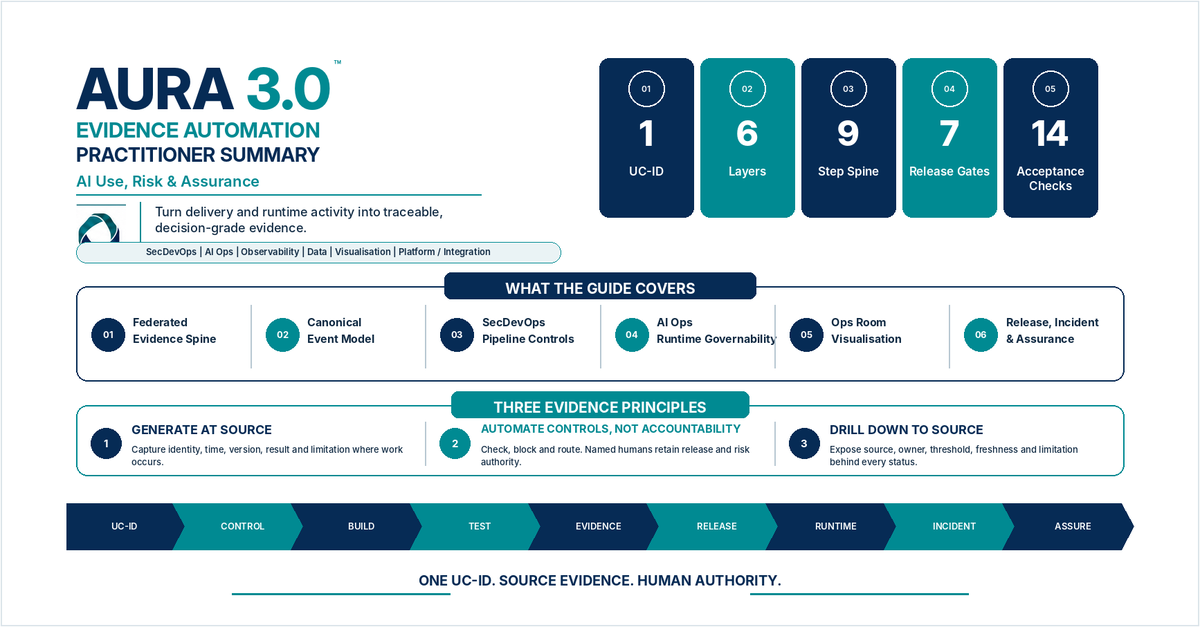
- The federated evidence spine: one UC-ID joining backlog, change, repository, pipeline, model registry, observability, incidents, GRC and BI
- Six evidence automation principles, including "automate controls, not accountability" and "drill-down or the status is not decision-grade"
- The Nine-Step Spine translated into technical implementation questions, each with its primary proof
- A canonical data and event model as the minimum design standard for fields, feeds, APIs and identity
- SecDevOps implementation view: converting release controls into executable pipeline steps and evidence events
- AI Ops implementation view: connecting runtime telemetry to intervention, incidents and learning
- Visualisation and Ops Room design: dashboards as decision surfaces with source, owner, threshold, freshness and drill-down, not decorative status
- Release gate and decision automation, runtime governability, roles and handoffs
- A first 90 days implementation backlog, acceptance checklist and the anti-patterns that break evidence chains: the pipeline green fallacy, screenshot evidence, agent-approves-agent, missing feeds shown as green, and the tool-first programme
What changes in practice
Every governed event carries the same use-case identifier. Each fact has one authoritative home. Evidence is captured at source with identity, time, version, result and integrity status. Missing, stale or failed evidence feeds become visible control failures, never rendered as green. Every dashboard claim can be followed to the control, gate, test, event and source record behind it.
Want the full model?
This summary is drawn from the AURA 3.0 Canonical Core Guide and its controlled companions. The full bundle contains the complete operating model: six layers, one spine, fourteen epics, seventy-nine stories, core templates, three companion guides and the Excel diagnostic toolkit. It's available in this store.