
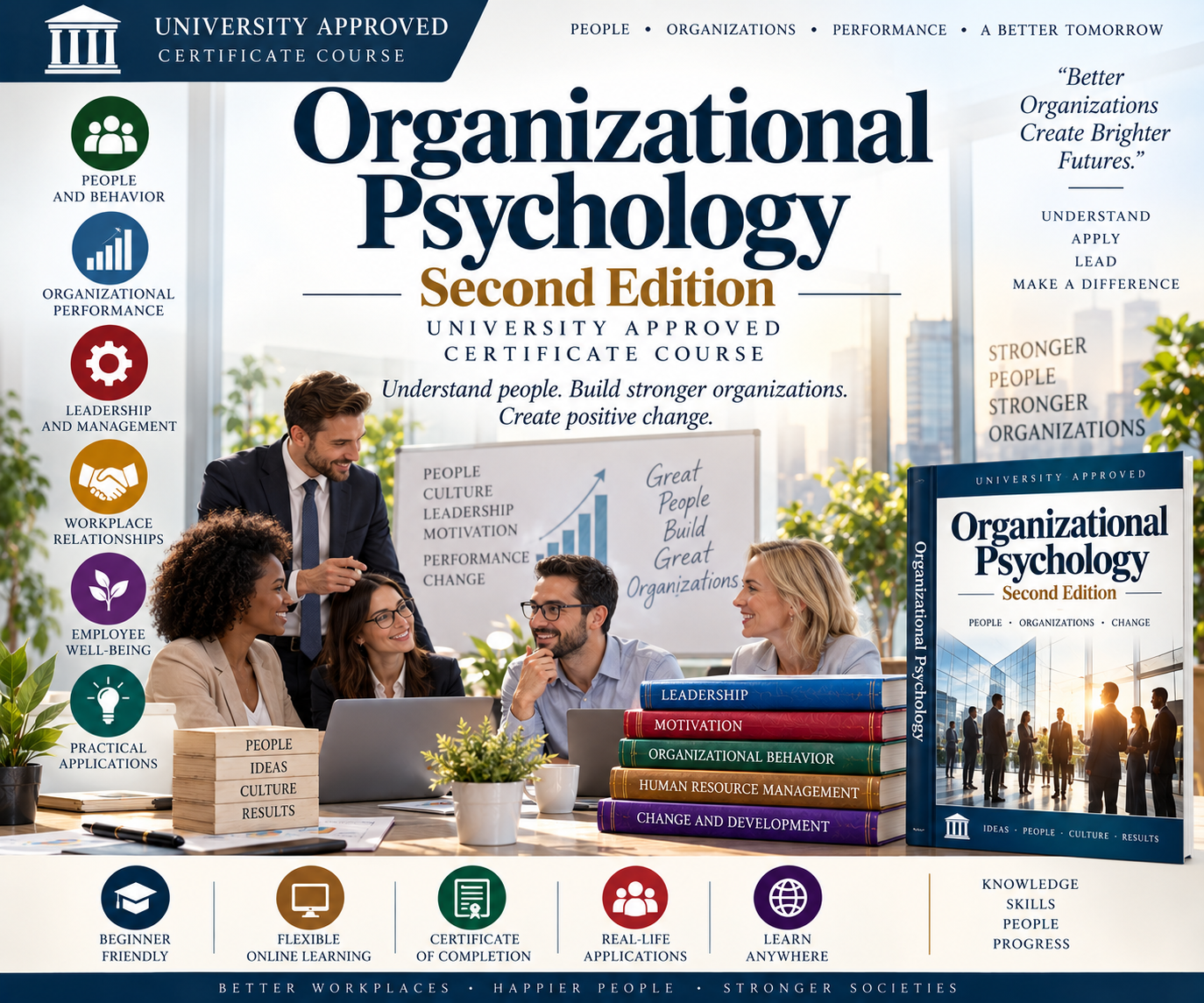
Organizational Psychology Second Edition University Approved
Organizational Psychology – Second Edition
University Approved Certificate Course
Understand People. Build Stronger Organizations. Create Positive Change.
Organizations are built around people.
Every workplace depends on motivation, communication, leadership, teamwork, decision-making, culture, performance, relationships, adaptation, and the ability of individuals to work effectively together.
The Organizational Psychology – Second Edition – University Approved Certificate Course provides a comprehensive introduction to the psychological principles that influence people and behavior in workplaces and organizations.
This updated second edition explores key concepts in organizational psychology, employee behavior, leadership, motivation, workplace culture, communication, group dynamics, performance, well-being, change, and organizational development.
The course is designed for beginners as well as professionals who want to strengthen their understanding of human behavior in organizational settings.
It may be particularly useful for people working or studying in:
- Management
- Human resources
- Psychology
- Business
- Leadership
- Training and development
- Organizational development
- Coaching
- Education
- Consulting
- Administration
- Entrepreneurship
No previous specialist knowledge of organizational psychology is required.
What Is Organizational Psychology?
Organizational psychology examines how people think, feel, behave, communicate, perform, and develop within workplaces and organizations.
It applies psychological knowledge to practical organizational questions such as:
- What motivates employees?
- Why do some teams perform better than others?
- What makes leadership effective?
- How does workplace culture influence behavior?
- Why do employees become disengaged?
- How can organizations manage change?
- What influences job satisfaction?
- How can communication be improved?
- What contributes to employee well-being?
- How can performance be supported fairly and effectively?
Organizational psychology combines knowledge from psychology, management, behavioral science, human resources, sociology, and organizational studies.
What You Will Learn
Throughout the course, you will explore topics such as:
- Foundations of organizational psychology
- Individual behavior at work
- Motivation
- Personality
- Attitudes and values
- Job satisfaction
- Employee engagement
- Leadership
- Management
- Teamwork
- Group dynamics
- Communication
- Organizational culture
- Decision-making
- Conflict
- Workplace relationships
- Performance
- Employee well-being
- Stress
- Learning and development
- Organizational change
- Diversity and inclusion
- Human resource practices
- Organizational development
The course is designed to connect psychological theory with real-life organizational situations.
Foundations of Organizational Psychology
The course begins by introducing the field of organizational psychology and its major areas of interest.
You will explore how psychological knowledge can help organizations better understand:
- Employees
- Teams
- Leaders
- Workplace systems
- Organizational behavior
- Performance
- Development
You will also consider how organizational psychology differs from, but connects with, areas such as management, human resources, and occupational psychology.
Understanding Individual Behavior at Work
Every employee brings a different combination of:
- Personality
- Experience
- Values
- Expectations
- Skills
- Motivation
- Beliefs
- Goals
- Emotional responses
These differences can influence how people behave in organizations.
The course explores why understanding individual differences is important when managing, supporting, and developing employees.
Personality in the Workplace
Personality can influence workplace behavior in many ways.
It may affect:
- Communication
- Leadership
- Teamwork
- Decision-making
- Stress response
- Conflict
- Adaptability
- Work preferences
The course introduces learners to the idea of personality traits and encourages responsible use of personality-related information.
Personality should not be used to stereotype employees or assume that one type of person is always better suited to a particular role.
Values and Attitudes
Employees develop attitudes toward:
- Their work
- Their colleagues
- Their managers
- Their organization
- Change
- Responsibility
- Professional identity
Values and attitudes can influence motivation, engagement, commitment, and workplace relationships.
Understanding these factors can help organizations create environments that are more supportive and productive.
Motivation at Work
Motivation is one of the central subjects in organizational psychology.
Why do some employees remain highly motivated while others lose interest?
Why do people respond differently to the same reward?
What encourages sustained performance?
The course explores factors such as:
- Goals
- Recognition
- Responsibility
- Achievement
- Rewards
- Meaning
- Autonomy
- Feedback
- Growth
- Fairness
You will also explore major approaches to understanding workplace motivation.
Employee Engagement
Engaged employees often feel more connected to their work and organization.
The course explores factors that may influence engagement, including:
- Meaningful work
- Recognition
- Communication
- Leadership
- Development opportunities
- Trust
- Fairness
- Participation
Employee engagement should not be confused with simply expecting people to work harder.
Sustainable engagement is closely connected with supportive systems and realistic organizational expectations.
Job Satisfaction
Job satisfaction can be influenced by many factors.
These may include:
- Work environment
- Relationships
- Management
- Compensation
- Workload
- Recognition
- Opportunities
- Fairness
- Autonomy
- Job design
The course explores how satisfaction can affect broader areas such as commitment, morale, and retention.
Leadership
Leadership is one of the most important areas of organizational psychology.
Learners will explore:
- Leadership styles
- Leadership behavior
- Communication
- Motivation
- Influence
- Decision-making
- Trust
- Responsibility
- Ethical leadership
Effective leadership is not only about authority.
It also involves creating clarity, direction, trust, and conditions in which other people can perform effectively.
Leadership Styles
Different situations may require different leadership approaches.
The course introduces concepts associated with:
- Directive leadership
- Participative leadership
- Transformational leadership
- Transactional leadership
- Situational leadership
- Servant leadership
Rather than presenting one universal style as the best, the course encourages learners to consider context, organizational needs, and individual differences.
Management and Organizational Behavior
Managers influence organizational psychology through everyday decisions.
They can affect:
- Communication
- Motivation
- Fairness
- Performance
- Development
- Workload
- Team relationships
- Employee confidence
The course explores the difference between controlling people and managing systems effectively.
Teamwork
Modern organizations frequently depend on teams.
Teams can offer:
- Shared knowledge
- Different perspectives
- Creativity
- Problem-solving
- Mutual support
- Combined skills
However, teams can also experience:
- Conflict
- Poor communication
- Unequal participation
- Competition
- Lack of trust
- Role confusion
The course explores factors that can contribute to more effective teamwork.
Group Dynamics
Groups develop patterns of behavior over time.
These patterns may involve:
- Roles
- Norms
- Leadership
- Communication
- Influence
- Cooperation
- Conflict
- Decision-making
Understanding group dynamics can help managers and team leaders recognise why groups sometimes behave differently from individuals.
Workplace Communication
Communication affects almost every organizational process.
Poor communication can contribute to:
- Confusion
- Mistakes
- Conflict
- Low morale
- Reduced trust
- Poor performance
Effective communication involves more than sending information.
It also involves:
- Listening
- Clarity
- Feedback
- Appropriate channels
- Timing
- Respect
- Understanding
The course explores communication from both psychological and organizational perspectives.
Organizational Culture
Organizational culture refers to shared patterns of:
- Values
- Norms
- Beliefs
- Expectations
- Behaviors
- Traditions
- Communication
Culture can influence how employees behave even when formal rules are absent.
Learners will explore how culture can affect:
- Performance
- Trust
- Innovation
- Leadership
- Engagement
- Change
- Employee experience
Workplace Relationships
People spend a substantial part of their lives working with others.
Workplace relationships can influence:
- Motivation
- Satisfaction
- Performance
- Stress
- Retention
- Well-being
The course explores professional relationships between:
- Colleagues
- Managers and employees
- Teams
- Departments
- Leaders
Healthy professional relationships require communication, boundaries, respect, and fairness.
Conflict in Organizations
Conflict is common in organizations.
It can arise from:
- Different priorities
- Communication problems
- Resource competition
- Role ambiguity
- Personality differences
- Organizational change
- Unclear expectations
Not all conflict is destructive.
When managed appropriately, disagreement can sometimes improve decision-making and encourage new ideas.
The course explores constructive approaches to workplace conflict.
Decision-Making
Organizations depend on decisions.
People do not always make decisions purely rationally.
Judgement can be influenced by:
- Bias
- Emotion
- Experience
- Pressure
- Group influence
- Limited information
The course introduces psychological ideas that can help learners understand how workplace decisions are made and how decision-making can sometimes be improved.
Performance
Performance is influenced by more than ability.
It can also be affected by:
- Motivation
- Resources
- Expectations
- Training
- Feedback
- Management
- Work environment
- Role clarity
- Well-being
The course encourages learners to view performance as the result of multiple interacting factors rather than simply employee effort.
Performance Management
Performance management may involve:
- Goal setting
- Feedback
- Review
- Coaching
- Development
- Recognition
- Improvement planning
Effective performance management should support development and clarity rather than operate only as a mechanism for criticism.
Feedback
Feedback is a powerful organizational tool when used well.
Effective feedback is generally:
- Specific
- Constructive
- Respectful
- Timely
- Relevant
- Actionable
The course explores how poorly delivered feedback can reduce motivation and how more constructive approaches can support development.
Learning and Development
Organizations need employees who can continue learning.
Learning and development may include:
- Training
- Coaching
- Mentoring
- Professional development
- Skills programs
- Leadership development
- On-the-job learning
The course explores how learning supports both employee growth and organizational adaptability.
Career Development
Employees often want opportunities for progress.
Career development can involve:
- New responsibilities
- Training
- Mentoring
- Promotion
- Skills development
- Career planning
- Mobility
Organizations that support development may strengthen employee engagement and retention.
Employee Well-Being
Employee well-being has become increasingly important in organizational life.
Well-being can be affected by:
- Workload
- Work environment
- Relationships
- Management
- Job control
- Recognition
- Work-life balance
- Organizational culture
The course introduces learners to the importance of promoting responsible workplace practices rather than placing all responsibility for well-being on individual employees.
Workplace Stress
Some stress is a normal part of working life.
However, persistent excessive stress can negatively affect people and organizations.
Potential sources may include:
- Excessive workload
- Unclear roles
- Poor management
- Conflict
- Lack of control
- Job insecurity
- Organizational change
Learners will explore organizational approaches to understanding and reducing avoidable workplace stressors.
Burnout Awareness
Burnout can involve prolonged exhaustion, reduced professional effectiveness, and psychological distancing from work.
The course introduces burnout as a workplace well-being issue and emphasises the importance of appropriate organizational support and professional health guidance where necessary.
This course does not provide medical or psychological diagnosis.
Organizational Change
Organizations constantly change.
Change may result from:
- Technology
- Competition
- Growth
- Restructuring
- Regulation
- New leadership
- Economic conditions
- Market developments
Employees may respond to change with enthusiasm, uncertainty, resistance, or anxiety.
Understanding these reactions can help organizations manage change more responsibly.
Resistance to Change
Resistance is not always irrational.
People may resist organizational change because of:
- Uncertainty
- Lack of trust
- Poor communication
- Previous negative experiences
- Perceived loss
- Lack of participation
The course explores how clear communication, involvement, support, and realistic planning can improve change processes.
Organizational Development
Organizational development focuses on improving organizational effectiveness through planned change.
It may involve:
- Leadership development
- Team development
- Cultural change
- Communication improvement
- Learning
- Structural improvement
- Employee engagement
The course introduces organizational development as a systematic process rather than a single intervention.
Diversity and Inclusion
Modern organizations often include people with different:
- Backgrounds
- Experiences
- Ages
- Cultures
- Skills
- Perspectives
Diversity can provide valuable perspectives, but organizations also need inclusive systems that allow people to participate fairly.
The course explores themes such as:
- Bias
- Inclusion
- Respect
- Fairness
- Equal opportunity
- Belonging
Recruitment and Selection
Organizational psychology also contributes to understanding recruitment and selection.
Topics may include:
- Job requirements
- Candidate evaluation
- Interviews
- Assessment
- Bias
- Fairness
- Person-job fit
The course provides an overview rather than training learners to use specialist psychological assessments.
Human Resources and Organizational Psychology
Human resource management and organizational psychology overlap in many areas.
These may include:
- Recruitment
- Training
- Performance
- Motivation
- Employee relations
- Retention
- Development
- Organizational culture
Psychological knowledge can help HR professionals understand the human factors behind policies and workplace systems.
Ethics in Organizations
Ethical organizational behavior involves more than legal compliance.
The course encourages learners to think about:
- Fairness
- Honesty
- Transparency
- Responsibility
- Employee dignity
- Confidentiality
- Conflicts of interest
- Ethical leadership
Organizations often influence not only employees but also customers, communities, and society.
Psychological Safety
Psychological safety refers to an environment where people feel able to express ideas, questions, and concerns without unnecessary fear of humiliation or retaliation.
This can support:
- Learning
- Communication
- Innovation
- Teamwork
- Error reporting
- Collaboration
Psychological safety does not mean the absence of standards or accountability.
It means creating conditions where respectful participation is possible.
Innovation and Creativity
Organizations need new ideas to adapt.
Creativity can be supported when employees have:
- Appropriate freedom
- Resources
- Collaboration
- Feedback
- Psychological safety
- Opportunity to experiment
The course explores some of the organizational conditions that can encourage innovation.
Employee Retention
Why do employees stay?
Why do they leave?
Retention may be influenced by:
- Leadership
- Career opportunities
- Pay
- Workload
- Culture
- Recognition
- Relationships
- Meaningful work
- Flexibility
Understanding these factors can help organizations develop more sustainable people strategies.
Remote and Hybrid Work
Modern organizations increasingly use remote and hybrid work arrangements.
These working patterns can create opportunities as well as challenges involving:
- Communication
- Trust
- Coordination
- Isolation
- Autonomy
- Performance
- Team identity
Organizational psychology provides useful perspectives for understanding how people adapt to different working environments.
Real-Life Applications
The knowledge gained from this course can be useful in areas such as:
- Management
- Human resources
- Leadership
- Team development
- Employee engagement
- Training
- Coaching
- Workplace communication
- Organizational change
- Recruitment
- Performance management
- Consulting
This makes organizational psychology relevant to many professional roles.
Who Is This Course For?
This course may be suitable for:
- Managers
- Team leaders
- Human resources professionals
- Business owners
- Entrepreneurs
- Psychology students
- Business students
- Management students
- Coaches
- Trainers
- Consultants
- Administrators
- Project managers
- Supervisors
- Organizational development professionals
- Anyone interested in workplace behavior
No previous psychology qualification is required.
Beginner Friendly
The course introduces key concepts clearly and progressively.
Specialist psychological terminology is explained within context.
Learners can begin without previous academic study in organizational psychology.
Flexible Online Learning
Study according to your own schedule.
The online format is suitable for learners balancing education with:
- Employment
- Business responsibilities
- Family commitments
- University study
- Professional development
You can revisit material and progress at your own pace.
Second Edition
This Second Edition provides an updated and expanded approach to organizational psychology.
It brings together core principles with contemporary workplace topics and practical organizational applications.
The aim is to give learners a broader and more relevant understanding of how psychological principles can contribute to modern organizations.
What You Can Gain From This Course
By completing the course, you can develop a broader understanding of:
- Organizational psychology
- Employee behavior
- Motivation
- Leadership
- Management
- Teamwork
- Communication
- Workplace relationships
- Organizational culture
- Performance
- Employee engagement
- Well-being
- Stress
- Conflict
- Learning and development
- Organizational change
- Diversity and inclusion
- Human resources
- Organizational development
A Foundation for Further Study
This course may provide useful preparation for further learning in:
- Industrial and organizational psychology
- Human resource management
- Business psychology
- Leadership
- Management
- Organizational behavior
- Occupational psychology
- Coaching
- Organizational development
- Workplace well-being
- Business administration
Certificate of Completion
Learners who successfully complete the applicable course requirements may receive a Certificate of Completion for:
Organizational Psychology – Second Edition – University Approved Certificate Course
The certificate may be useful for:
- CVs and résumés
- LinkedIn profiles
- Professional development portfolios
- Continuing education records
- Academic portfolios
- Career development documentation
- Demonstrating additional learning
Course Format: Online
Edition: Second Edition
Level: Beginner / Introductory
Study Method: Self-Paced
Subject: Organizational Psychology
Certificate: Available upon successful completion of applicable course requirements
Why Choose This Course?
Understand Workplace Behavior
Explore why people think, feel, and behave differently within organizations.
Develop Leadership Awareness
Learn key psychological principles related to leadership and management.
Improve Team Understanding
Explore communication, group dynamics, motivation, and workplace relationships.
Understand Organizational Culture
Discover how shared values and expectations influence behavior.
Practical Applications
Connect psychological concepts with real workplace situations.
Contemporary Second Edition
Study an expanded version designed around both foundational and modern workplace topics.
Beginner Friendly
No previous organizational psychology qualification is required.
Flexible Online Learning
Study at your own pace and from wherever you are.
Certificate of Completion
Receive documentation of your learning upon successful completion of course requirements.
Better People Practices Create Better Organizations
Strong organizations are not created by systems alone.
They are created by people.
People who communicate.
People who lead.
People who learn.
People who cooperate.
People who adapt.
People who feel respected and able to contribute.
Organizational psychology helps us better understand these human processes.
The Organizational Psychology – Second Edition – University Approved Certificate Course provides a structured introduction to this important field and connects psychological knowledge with real organizational challenges.
Understand people.
Improve communication.
Strengthen teams.
Develop leadership.
Support employee well-being.
Build more effective organizations.
Better Workplaces. Happier People. Stronger Organizations.
Begin your organizational psychology learning journey today.
Important Professional Notice
This course is intended for educational and personal/professional development purposes.
Completion of this course does not qualify a learner as a licensed psychologist, industrial-organizational psychologist, occupational psychologist, psychotherapist, or other regulated psychological professional.
Professional titles, psychological testing, clinical services, employment assessment, and regulated practice may require additional accredited qualifications, supervised training, registration, or licensing depending on the relevant jurisdiction.
Learners should always work within the limits of their qualifications and applicable local professional regulations.