Calm Together: Co-regulation Strategies for Parents of PDA Children (20-Page Guide + Interactive Companion)
How your calm becomes their calm, and why that changes everything
You've been told to "stay calm" a hundred times. Nobody's told you how — or explained why your child can't just calm down on command, even when you ask kindly.
Here's what's actually happening: when your child is in survival mode, the thinking part of their brain has gone offline. They're not choosing to ignore you. They biologically can't process reasoning, questions, or instructions until their nervous system feels safe again — and that safety signal comes from you.
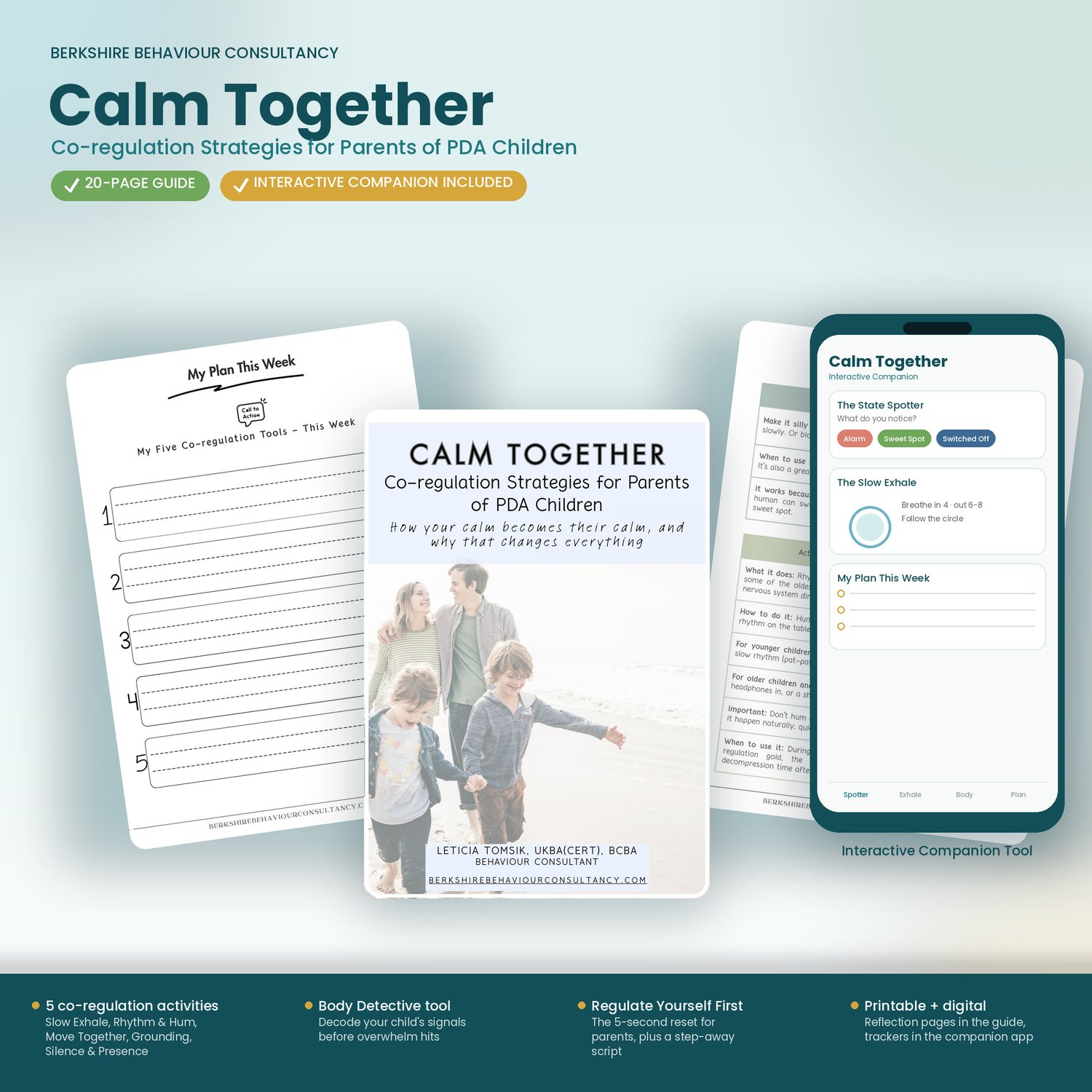
Calm Together is a 20-page guide that shows you exactly how to become that signal, plus an interactive companion tool so the strategies live with you day to day, not just on a shelf.
WHAT'S INSIDE THE GUIDE
The science, made simple — Why co-regulation works, explained without jargon, so you understand the why behind every strategy.
The Three States — Learn to read whether your child is in Alarm Mode, the Sweet Spot, or Switched Off, and exactly what each one needs from you. Behaviour is just the surface; this section teaches you to see the state underneath.
Your Voice, Your Face, Your Body — The three co-regulation tools you're carrying with you right now. Practical instead-of/try-this tables for tone, expression, and posture.
5 Practical Co-regulation Activities — The Slow Exhale, Rhythm and Hum, Move Together, Grounding, and Silence and Presence. Each one includes what it does, how to do it, and when to use it — adapted for younger children, older children, and teens.
The Body Detective — Help your child start noticing their own body signals before they reach crisis point. Includes a signal-to-response table plus space to map your own child's unique cues.
Regulate Yourself First — Because you cannot lend what you don't have. A five-step reset you can do in seconds, an exit script for when you need to step away, and a repair framework for the moments it doesn't go to plan.
Co-regulation in Daily Life — A flashpoint-by-flashpoint map (mornings, after school, mealtimes, screen transitions, bedtime, after a meltdown) showing you what to do and what to avoid, so you're never starting from scratch mid-crisis.
My Plan This Week — Reflective, print-ready pages to personalise everything to your family and track what's actually working.
PLUS: THE INTERACTIVE COMPANION
This guide comes with a browser-based interactive companion tool, so the strategies don't stay stuck on paper:
- The State Spotter — quickly identify which zone your child (or you) is in
- The Slow Exhale — a guided breathing circle you can use in the moment
- The Body Detective — build and save your own child's signal map
- My Plan This Week — a living tracker for your five co-regulation tools and your biggest challenge
No app download, no login. It works on your phone, tablet, or laptop, and autosaves your entries as you go.
WHO THIS IS FOR
Parents and carers of children with a PDA (Pathological Demand Avoidance) profile who want to understand why connection has to come before correction — and who are ready to try something that works with their child's nervous system instead of against it.
This isn't a behaviour chart. There's no scoring, no diagnosing, no pressure. Just a steady, practical way back to calm, together.