
Superintendent Coordination & Field Leadership
The Superintendent Coordination & Field Leadership course is a practical, self-study training program built for developing superintendents, field coordinators, and construction professionals who want to strengthen the skills required to lead work in fast-moving mission-critical environments.
This course focuses on what actually matters in the field: workface readiness, trade coordination, constraint management, factual reporting, communication, safety awareness, sequencing, and leadership under schedule pressure.
Superintendents are constantly balancing people, priorities, access, materials, inspections, schedule commitments, and changing site conditions. It is not enough to simply know that work is supposed to happen.
You need to understand what has to be ready before the work starts, what can block progress, who owns the next action, and what evidence proves the issue is actually resolved.
That is the mindset this course is designed to build.
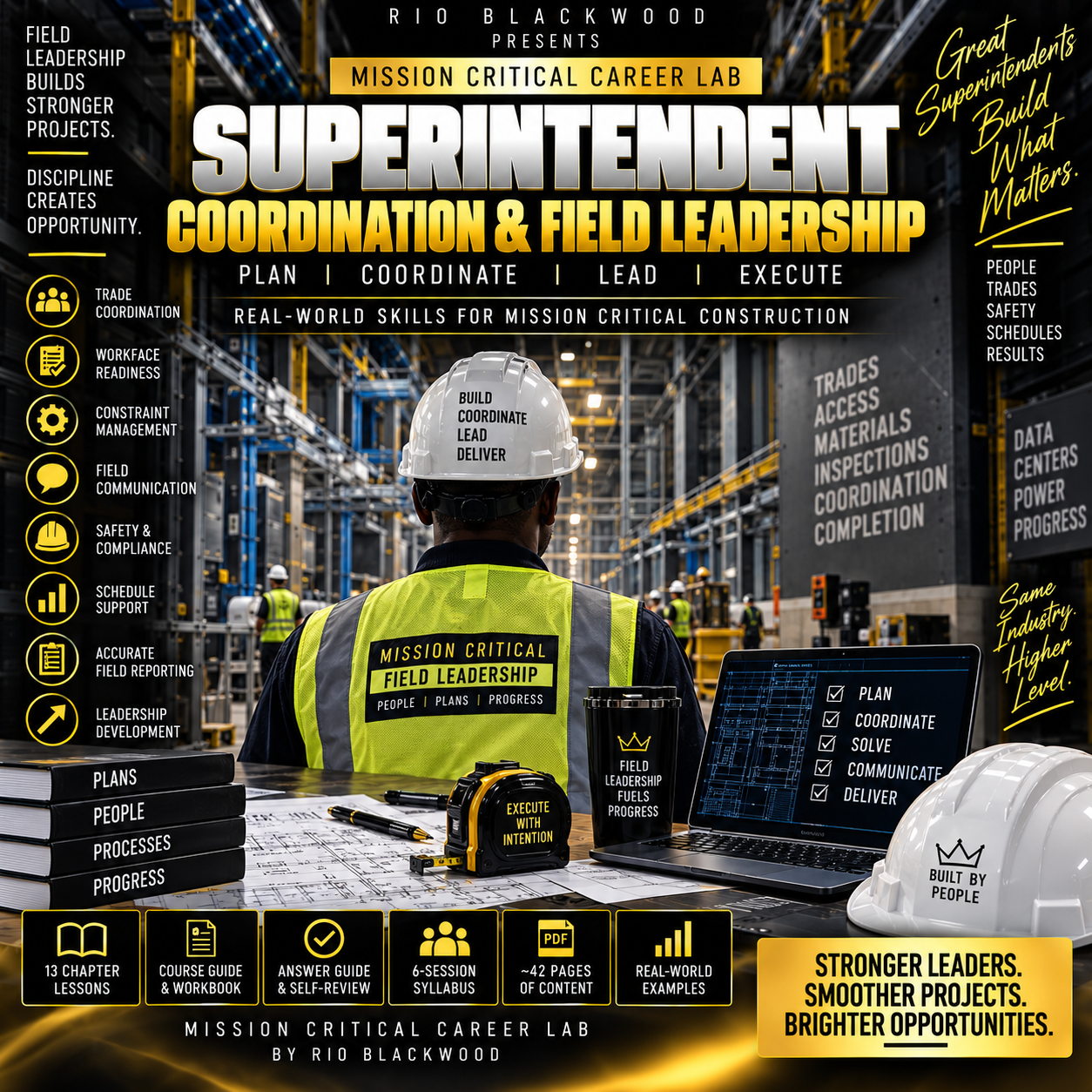
Inside, learners receive a course guide, practice workbook, answer and self-review guide, 13 individual chapter lesson files, and a six-session syllabus, totaling approximately 42 PDF pages across the included materials.
The course helps you practice how to:
- Separate observed facts from assumptions
- Identify the responsible person or trade
- Determine what evidence is needed to close an issue
- Recognize constraints before they become schedule problems
- Lead coordination conversations around real field conditions
- Improve trade communication and accountability
- Support workface readiness before crews mobilize
- Think through sequencing, access, inspections, materials, and release conditions
- Document field conditions clearly and professionally
- Escalate issues with useful information instead of vague complaints
- Strengthen leadership habits under schedule pressure
- Support safer, more organized, and more predictable field execution
A major focus of the course is constraint-based thinking.
Before work begins, the learner is encouraged to ask questions such as:
-Is the area actually ready?
-Are the drawings current?
-Are materials available?
-Has the required predecessor work been completed?
-Are inspections or approvals still pending?
-Does another trade need access first?
-Is the crew working from verified information?
Those questions sound simple, but they are often the difference between productive work and ten people standing around waiting for somebody to figure out what happened.
The course also reinforces the superintendent’s role as a communicator.
Strong field leadership means giving the project team accurate, timely, usable information. It means reporting what is actually happening, understanding what remains unresolved, coordinating with the appropriate people, and helping the team make decisions based on evidence rather than assumptions.
This course is especially useful for:
Developing Superintendents who want a stronger structure for field leadership.
Field Coordinators who are beginning to manage trades, constraints, and daily execution.
Assistant Project Managers and Field Engineers who want to understand the superintendent perspective.
Technicians and trade professionals preparing to move into supervisory roles.
Career changers entering mission-critical construction who want to understand what field leadership actually requires.
By the end of the course, the goal is for learners to think less like someone simply watching construction happen and more like someone responsible for helping the work become ready, coordinated, documented, and executable.
Plan the work. Clear the constraints. Coordinate the trades. Lead the field. Keep the project moving.