
Mission Critical APM Foundations
Mission Critical APM Foundations
Build a practical foundation for working as an Assistant Project Manager in mission-critical data center construction.
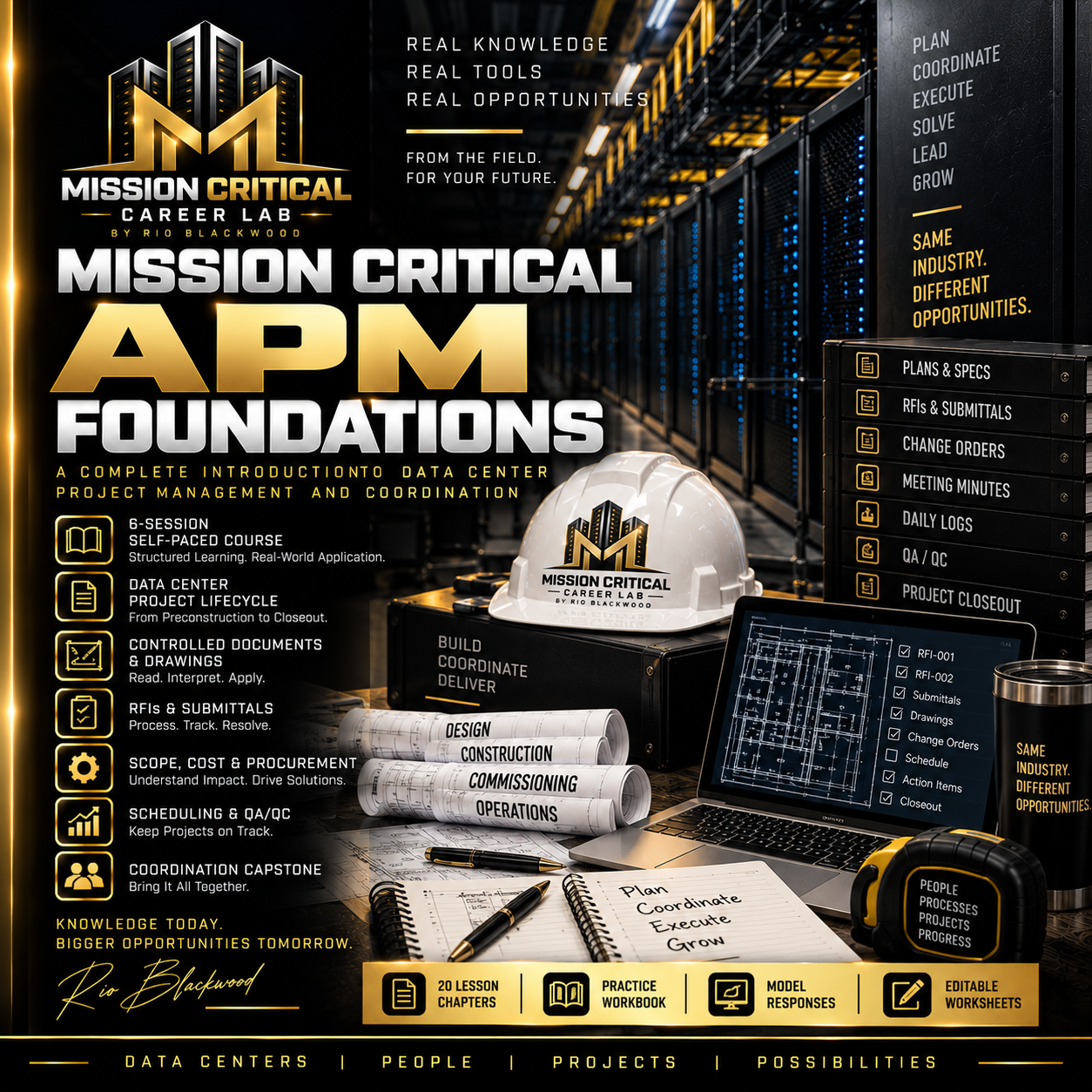
Mission Critical APM Foundations by Mission Critical Career Lab is a structured 6-session digital course designed to help developing APMs, project coordinators, field professionals, and career changers understand the documents, workflows, coordination responsibilities, and project-management fundamentals used throughout data center construction.
This is not an engineering certification course. It is practical career-development training focused on helping you understand how information moves through a mission-critical project and how an APM supports that process.
What You’ll Learn:
Session 1 — Role & Project Lifecycle
Understand what makes data center construction different, how a project progresses from planning through turnover, and how owners, designers, GC/CM teams, trade partners, vendors, AHJs, and commissioning teams interact.
Session 2 — Controlled Documents & Drawings
Learn how controlled project information works and build confidence navigating drawing sets, title blocks, revisions, legends, general notes, plans, sections, elevations, schedules, risers, details, and diagrams.
Session 3 — RFIs & Submittals
Learn how RFIs turn field conflicts into clear questions and how submittals move specified products toward approved installation.
Includes deeper lessons on writing usable RFIs and reviewing submittal information without crossing into design responsibility.
Session 4 — Scope, Cost & Procurement
Explore scope management, change orders, long-lead equipment, vendor information, FAT activities, receiving, material preservation, cost exposure, forecasting, and change estimating.
Session 5 — Scheduling & Quality
Build working knowledge of look-ahead planning, constraints, critical-path thinking, CPM concepts, pull planning, schedule recovery, QA/QC documentation, ITPs, hold points, NCRs, first-work inspections, and punch processes.
Session 6 — Coordination Portfolio Capstone
Bring the concepts together through practical coordination exercises involving:
- RFI workshops
- Change-management exercises
- Look-ahead planning
- Daily-log practice
- Turnover organization
- Project communication and field coordination
Included With the Course
- 6 structured learning sessions
- 20 lesson chapters
- Mission Critical APM Foundations course guide
- Practice workbook
- Model responses for self-review
- Editable practice worksheets
- RFI workshop
- Daily-log exercise
- Look-ahead workshop
- Change workshop
- Turnover index
- Course syllabus
- Self-paced downloadable learning materials
Who This Course Is For:
This course is designed for:
- New Assistant Project Managers
- Project Coordinators
- Field Engineers
- Technicians moving toward project-management roles
- Developing Superintendents who want stronger project-documentation knowledge
- Construction professionals entering the data center industry
- Low-voltage, electrical, IT, facilities, and technical professionals transitioning into mission-critical construction
- Career changers who want a structured introduction to data center project coordination
Learn How the Project Fits Together
An effective APM does more than update trackers.
You need to understand how drawings, RFIs, submittals, procurement, schedules, field conditions, quality documentation, cost impacts, and communication connect to one another.
Mission Critical APM Foundations gives you a structured place to build that understanding and practice the habits behind stronger project coordination.
Mission Critical Career Lab
Created by Rio Blackwood