



Fire Alarm Battery & Device Load Calculator (Excel)
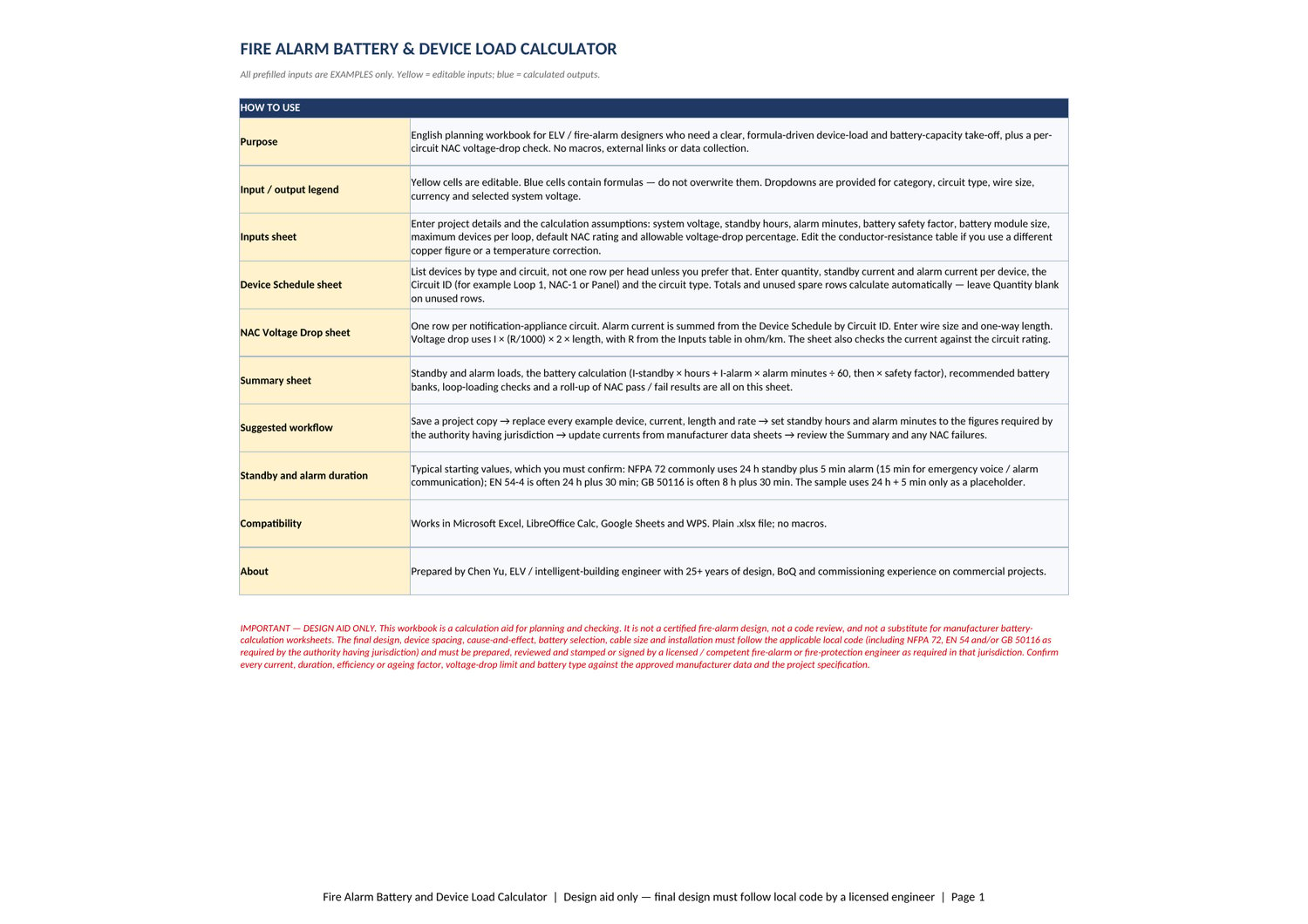
This Excel workbook is a working aid for fire-alarm battery and device-load calculations. It helps an ELV / fire-alarm designer list devices, total standby and alarm currents, size the battery, check loop loading, and run a per-circuit NAC voltage-drop check.
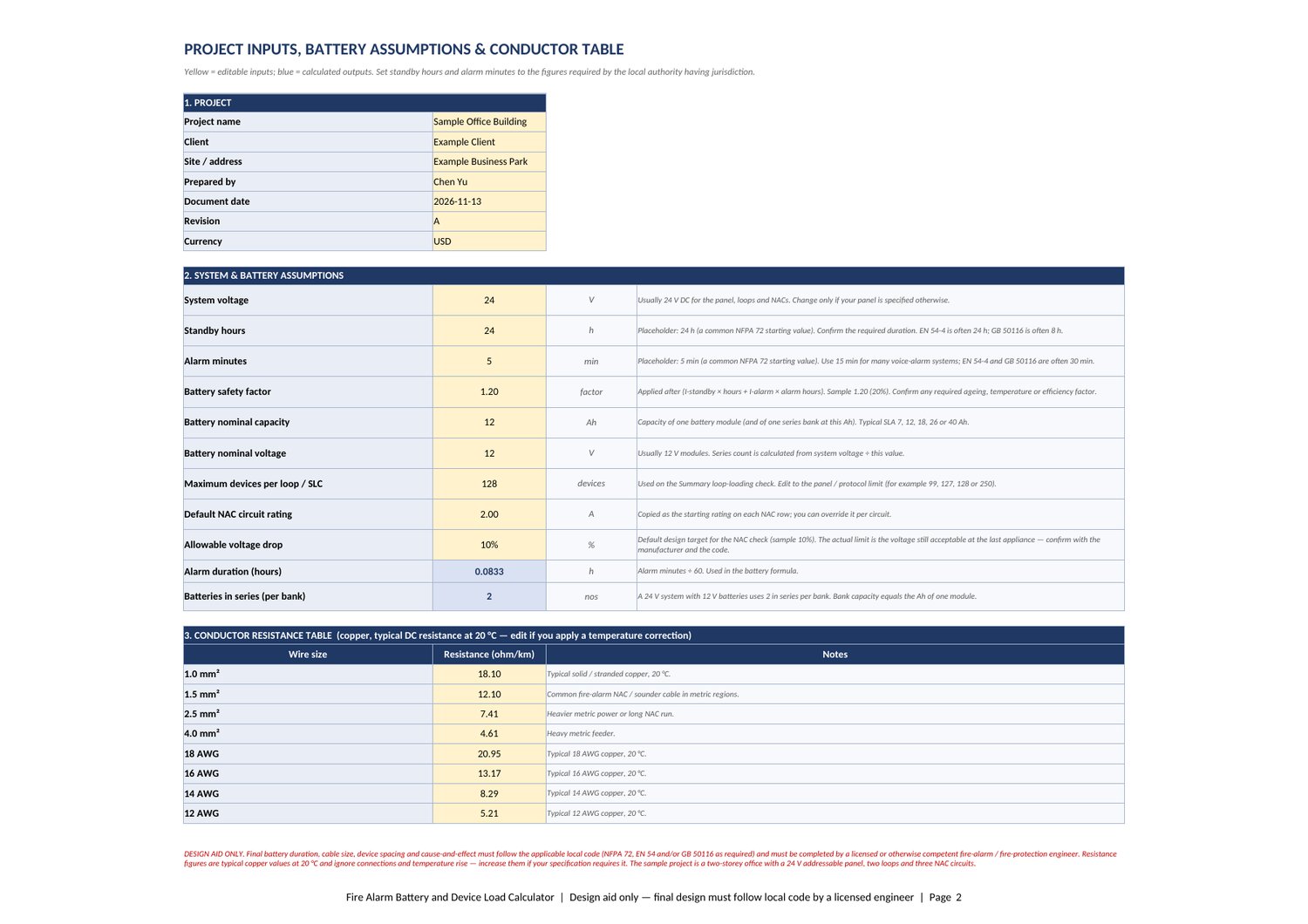
On the Inputs sheet you enter project details and the calculation assumptions: system voltage, standby hours, alarm minutes, battery safety factor, battery module size, maximum devices per loop, default NAC rating and allowable voltage-drop percentage. A conductor-resistance table (metric mm² and AWG, typical copper at 20 °C) is editable if you apply a different figure or a temperature correction. Standby hours and alarm minutes must be set to the duration required by the authority having jurisdiction. Typical starting values, which you must confirm, include NFPA 72 — often 24 h + 5 min (15 min for many voice-alarm systems); EN 54-4 — often 24 h + 30 min; and GB 50116 — often 8 h + 30 min. The sample uses 24 h + 5 min only as a placeholder.
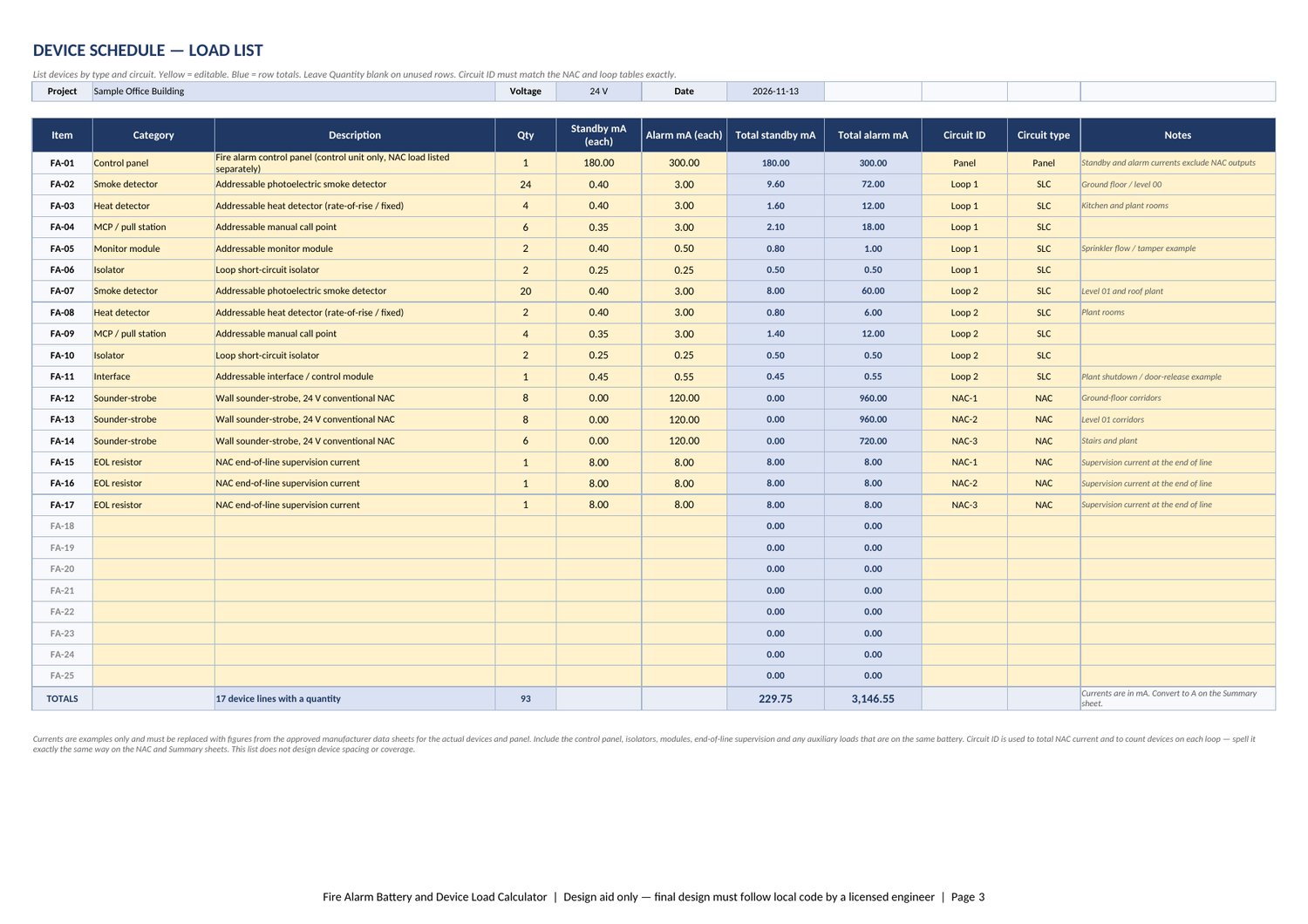
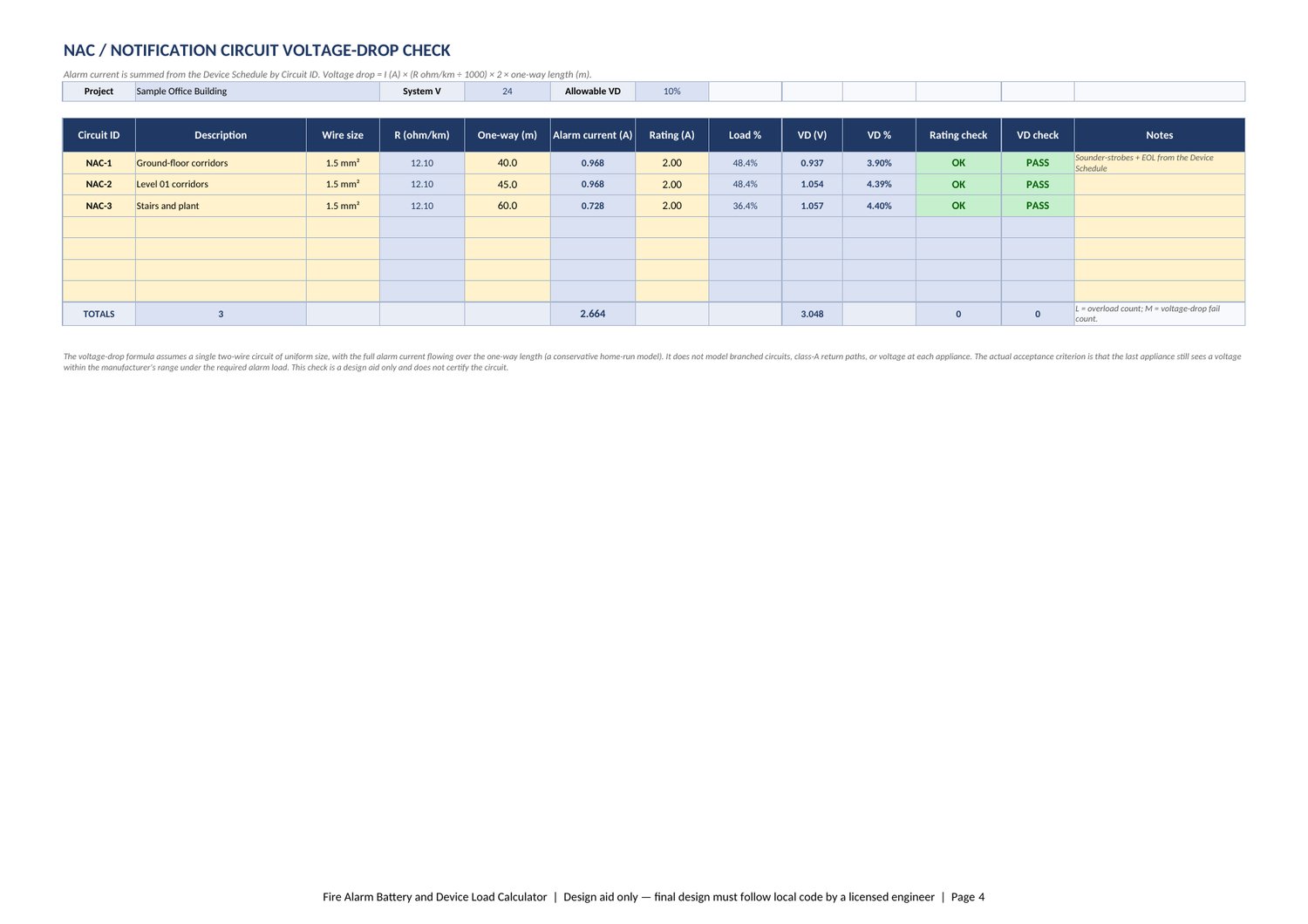
The Device Schedule lists devices by type and circuit, with quantity, standby and alarm current per device, Circuit ID and circuit type. Row totals and system totals update automatically. The NAC Voltage Drop sheet sums alarm current by Circuit ID, looks up conductor resistance, and calculates voltage drop as I × (R/1000) × 2 × one-way length, with a rating check and a pass/fail against the allowable drop.
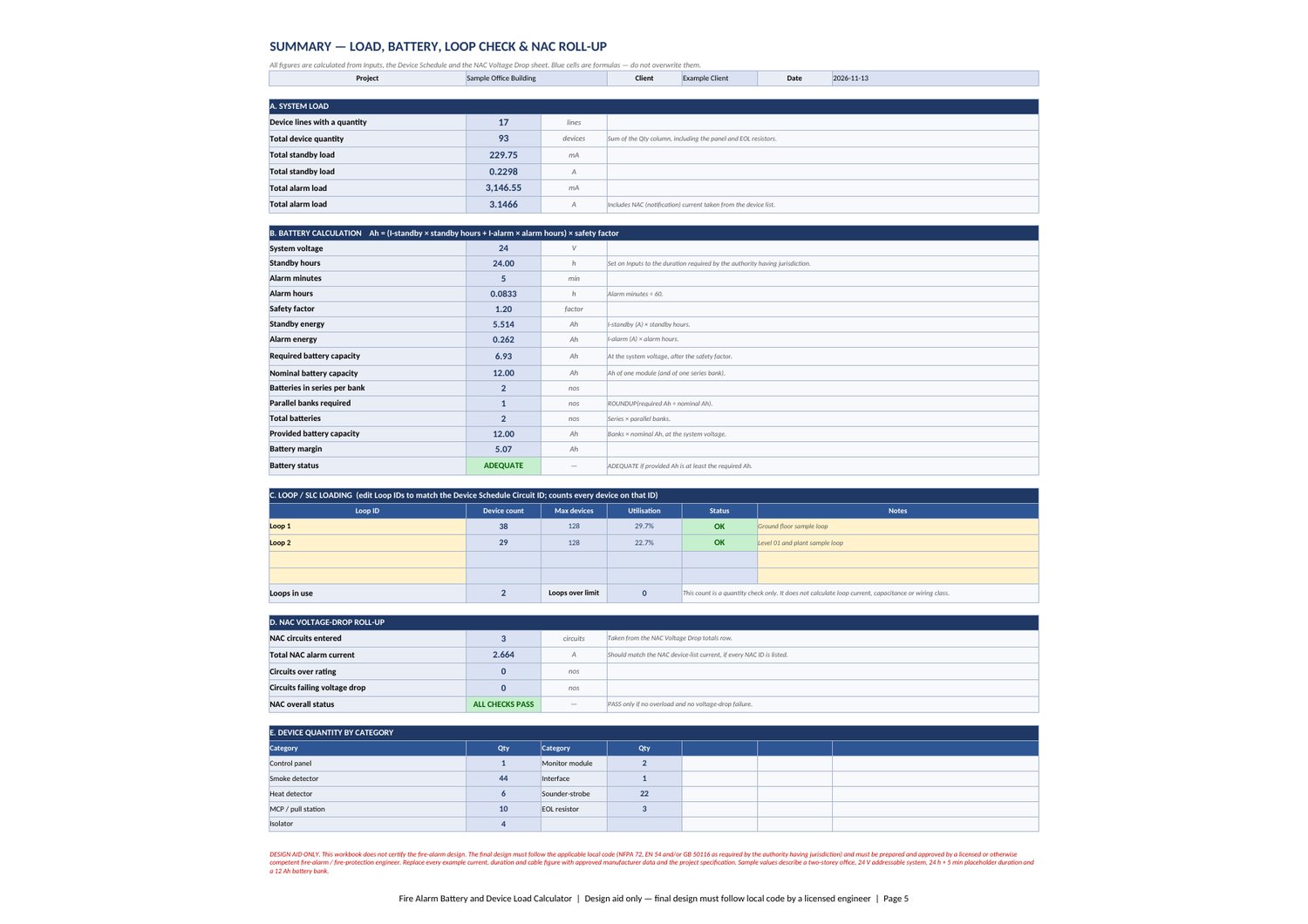
The Summary sheet shows total standby and alarm load, the battery calculation (I-standby × standby hours + I-alarm × alarm hours, then × safety factor), recommended series/parallel batteries and margin, loop-loading checks, a NAC pass/fail roll-up and device quantities by category.
Yellow cells are inputs; blue cells are formulas. No macros. Works in Microsoft Excel, LibreOffice Calc, Google Sheets and WPS. Sample currents and a two-storey office example are placeholders only.
IMPORTANT — this is a design aid, not a certified fire-alarm design and not a code review. The final design, device spacing, cause-and-effect, battery selection, cable size and installation must follow the applicable local code (including NFPA 72, EN 54 and/or GB 50116 as required by the authority having jurisdiction) and must be prepared and approved by a licensed or otherwise competent fire-alarm / fire-protection engineer. Confirm every current, duration, ageing or efficiency factor, voltage-drop limit and battery type against approved manufacturer data and the project specification.
Prepared by Chen Yu, an ELV / intelligent-building engineer with 25+ years of design, BoQ and commissioning experience.