
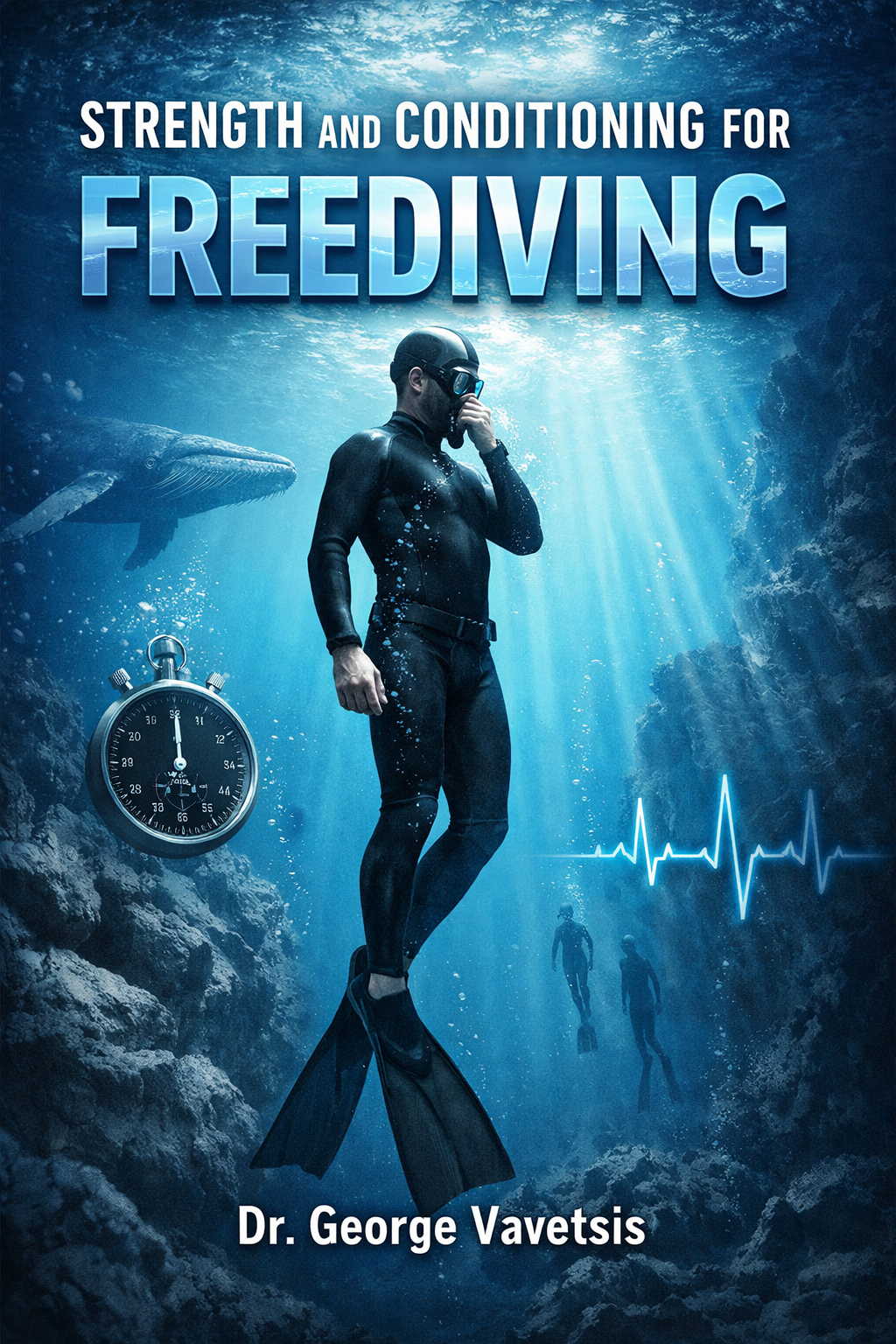
Strength and Conditioning for Freediving
Pages: 602
Freediving represents one of the most physiologically demanding and intellectually intriguing expressions of human performance. Unlike conventional sport disciplines that rely on continuous oxygen availability, breath-hold diving challenges the organism to operate within a closed metabolic system—where oxygen conservation, carbon dioxide tolerance, and neuromuscular efficiency determine both performance and survival. Within this extreme biological context, the role of the strength and conditioning coach evolves beyond traditional paradigms of force production and energy system development, extending into the domain of integrative physiology, neuroregulation, and metabolic restraint.
At its core, freediving is not merely a test of how long an individual can sustain apnea, but rather a multidimensional interplay between cardiovascular modulation, respiratory mechanics, cellular adaptation, and behavioral control. The athlete must orchestrate a precise balance between oxygen utilization and conservation, while simultaneously managing rising levels of carbon dioxide and the associated urge to breathe. This dynamic is governed by a complex network of physiological mechanisms, including the mammalian dive reflex, peripheral vasoconstriction, splenic contraction, and central nervous system adaptations to hypoxia and hypercapnia .
From a strength and conditioning perspective, this creates a unique challenge: performance is not enhanced by increasing metabolic output, but by strategically minimizing it. Movement economy, neuromuscular efficiency, and the suppression of non-essential muscular activity become critical determinants of success. The athlete must learn to reduce oxygen cost at every level of performance—from motor unit recruitment patterns to biomechanical execution and psychological state regulation. This represents a paradigm shift from traditional high-performance models, where greater output is typically associated with improved results.
The scientific foundation of freediving highlights the importance of cardiovascular and autonomic regulation. The induction of bradycardia, a hallmark of the dive reflex, reduces cardiac oxygen demand, while peripheral vasoconstriction redistributes blood flow toward vital organs such as the brain and heart . These responses are not passive; they can be trained, potentiated, and strategically integrated into performance preparation. For the strength and conditioning coach, this introduces the concept of “reflex conditioning”—the deliberate training of autonomic responses to optimize physiological efficiency under hypoxic stress.
Equally important is the role of metabolic suppression. Elite freedivers demonstrate the capacity to reduce basal metabolic rate during apnea, thereby extending the duration of oxygen availability . This adaptation is supported by mitochondrial efficiency, substrate utilization shifts, and reductions in unnecessary muscular activation. From a programming standpoint, this requires the integration of low-intensity, high-control training modalities that emphasize relaxation, breath control, and neuromuscular precision. Traditional metrics such as power output or maximal strength must be complemented by indicators of efficiency, including oxygen cost per movement, heart rate variability, and apnea duration under controlled conditions.
The respiratory system also plays a central role in freediving performance. Lung volume, diaphragmatic control, and thoracic mobility directly influence oxygen storage capacity and gas exchange dynamics. However, beyond structural considerations, the athlete must develop an advanced level of respiratory awareness and control. The ability to manipulate breathing patterns, regulate ventilatory drive, and tolerate elevated levels of CO₂ is fundamental to extending breath-hold duration. Training interventions such as CO₂ tolerance tables, hypoxic exposure protocols, and breath-hold circuits become essential tools within the conditioning framework.
Another critical dimension is the adaptation of the central nervous system to hypoxia. Cerebral oxygenation must be preserved despite declining arterial oxygen levels, requiring efficient neurovascular coupling and metabolic flexibility. The brain’s ability to tolerate reduced oxygen availability without loss of function is a defining characteristic of elite freedivers. Monitoring technologies such as near-infrared spectroscopy (NIRS) and heart rate variability (HRV) provide valuable insights into these adaptations, allowing coaches to individualize training and manage risk.
Safety remains a fundamental consideration in all aspects of freediving training. The physiological limits of hypoxia and hypercapnia are associated with significant risks, including loss of consciousness and long-term neurological impairment. Therefore, the application of strength and conditioning principles must be grounded in a thorough understanding of these boundaries. Progressive overload, a cornerstone of athletic development, must be carefully adapted to the context of breath-hold training, ensuring that exposure to physiological stressors remains within safe and controllable limits.
This book is designed to provide a comprehensive, scientifically grounded framework for understanding and applying strength and conditioning principles in the context of freediving. It integrates concepts from exercise physiology, biomechanics, neurobiology, and performance coaching to create a holistic model of athlete development. Each chapter is structured to bridge theory and practice, offering not only an in-depth exploration of physiological mechanisms but also actionable strategies for training design, monitoring, and progression.
Ultimately, freediving challenges our conventional understanding of human performance. It demands not only physical preparation but also a high degree of self-awareness, discipline, and control. For the strength and conditioning coach, it offers an opportunity to expand the boundaries of practice—moving beyond traditional metrics of strength and power toward a more nuanced understanding of efficiency, adaptability, and resilience.
In this context, performance is not defined by how much the athlete can produce, but by how effectively they can conserve, regulate, and sustain.