
Child-on-child abuse staff knowledge assessment
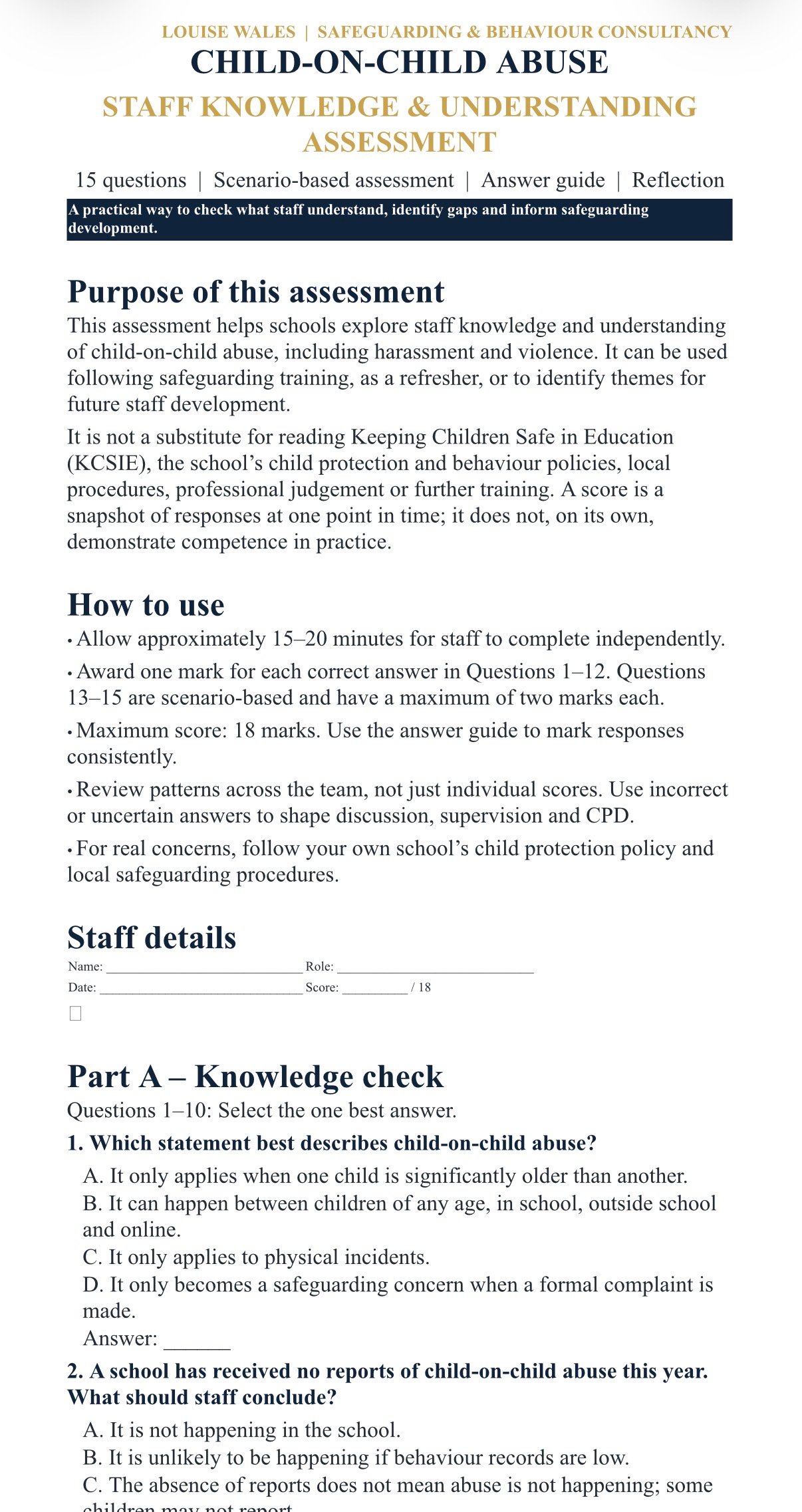
CHILD-ON-CHILD ABUSE – STAFF KNOWLEDGE & UNDERSTANDING ASSESSMENT
Can your school evidence what staff actually know and understand about child-on-child abuse?
Child-on-child abuse is a significant safeguarding responsibility for every member of school staff. But how confident are you that staff understand what it looks like, recognise potential indicators and know how to respond appropriately?
Having completed safeguarding training is one thing. Being able to demonstrate understanding is another.
This practical, ready-to-use assessment has been designed to help schools check staff knowledge, identify gaps and use the findings to inform future safeguarding training and CPD.
WHAT’S INCLUDED?
The assessment contains:
- 15 assessment questions covering key aspects of child-on-child abuse.
- Multiple-choice and true/false questions.
- Three realistic school-based scenarios to assess the application of knowledge.
- Individual scoring out of 18.
- A facilitator answer guide with explanations.
- Scenario marking guidance.
- A staff reflection sheet.
- Suggested score bands and follow-up actions.
- Team-level review questions to help identify common gaps and training needs.
WHAT CAN SCHOOLS USE IT FOR?
✔️ Checking staff knowledge following safeguarding training.
✔️ Identifying gaps and misconceptions in staff understanding.
✔️ Gathering measurable evidence of staff knowledge at a particular point in time.
✔️ Informing future safeguarding briefings and CPD.
✔️ Supporting safeguarding quality assurance and staff development.
✔️ Identifying themes that may require further discussion, guidance or supervision.
KEY AREAS COVERED
The assessment explores staff understanding of:
- Recognising different forms of child-on-child abuse.
- Bullying, sexual harassment and physical abuse.
- Online abuse and incidents occurring outside school.
- Responding to disclosures and safeguarding concerns.
- Consent and sexual activity involving children.
- The safeguarding needs of all children involved.
- Recording and reporting concerns appropriately.
WHY USE THIS RESOURCE?
Safeguarding training should lead to understanding, confidence and effective practice.
This assessment provides a practical opportunity to move beyond recording that training has taken place and explore what staff have actually understood.
Training completed. Knowledge checked. Gaps identified. Development informed.
Format: Editable Word document – ready to download and use within your school.
Please note: This assessment is a knowledge check, not a formal measure of professional competence. Results should be considered alongside training, supervision and safeguarding practice.
An independent resource informed by Keeping Children Safe in Education 2026. Not affiliated with or endorsed by the Department for Education or Ofsted.
Louise Wales | Safeguarding & Behaviour Consultancy
See the child. Hear their story. Change their future.