
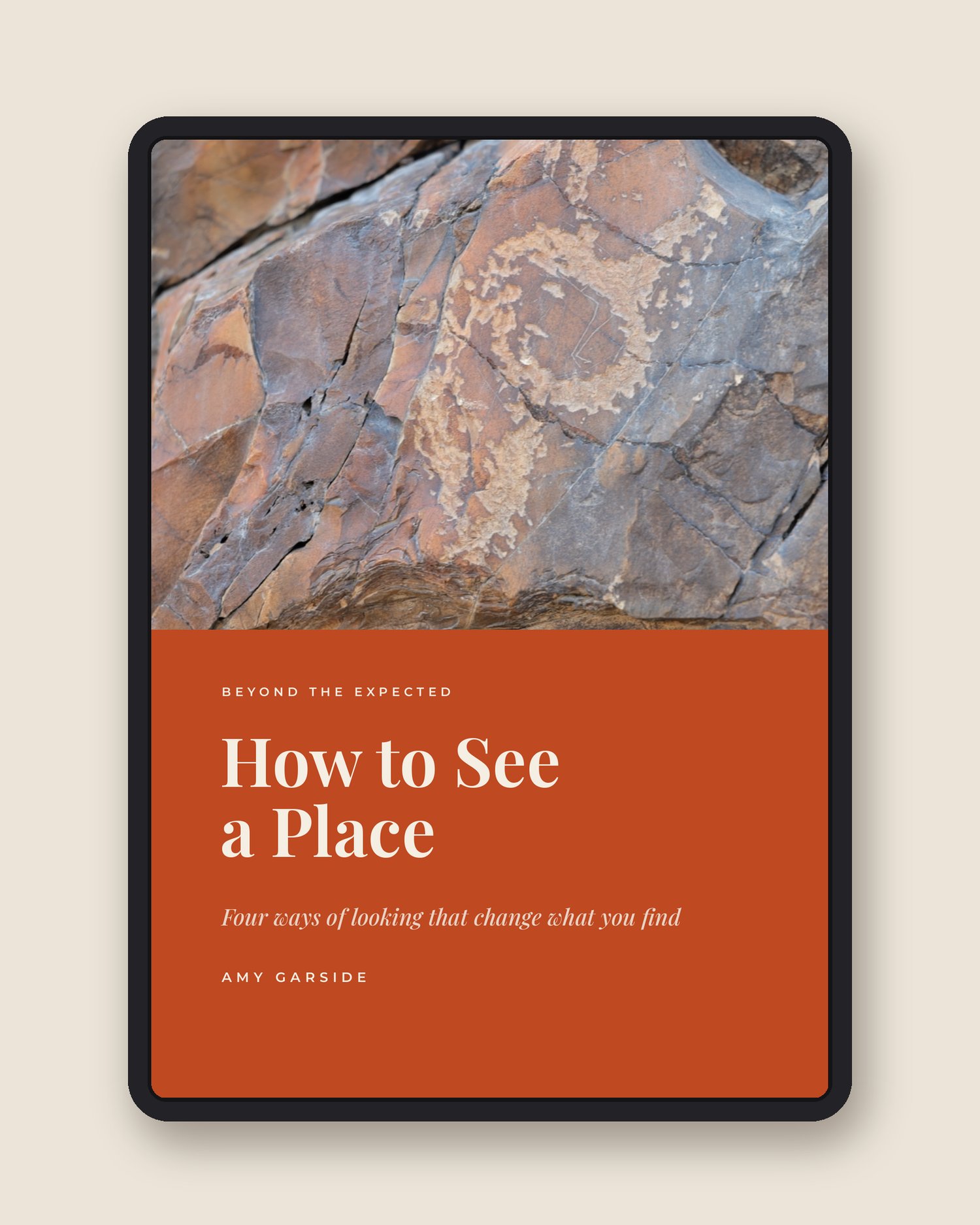
How to See a Place: A Slow Travel Guide to Noticing More
Now includes The Seeing Journal, a fillable companion you can type into on any device or print and write by hand.
There is a particular disappointment that arrives about twenty minutes after you reach somewhere you have wanted to see for years. The place is exactly as the photographs promised. And yet you are only confirming what you already knew. The guidebooks and the grids did the looking for you before you arrived.
This is a short guide to looking differently. Not being more grateful or more present, but a practical, learnable skill: paying a particular kind of attention so that ordinary places start giving up what most people walk straight past.
It works through four lenses. Traces, what remains when the thing itself has gone. Layers, what is sitting underneath what you can see. Scale, what changes when you shift your distance. Stillness, what only becomes visible when you stop moving. Each one is a question you carry with you, and each works anywhere, a backstreet, a mountain path, a village everyone drives through on the way to somewhere else.
The second half puts the lenses to work across three real places: a Bronze Age petroglyph in the mountains of Fujairah, a castle on an eroding Northumberland coast and the gap on Hadrian's Wall where a famous tree used to stand. In each one, what most people came to see was hiding what was actually there.
The guide ends with one exercise and one question. The journal then gives you somewhere to keep doing it: twelve entries, one place at a time, with space to work through each lens wherever you happen to be. Fill it in on screen or print it and write by hand.
No special equipment, no unusual amount of free time. Just a willingness to slow down and look at ordinary things slightly longer than feels comfortable.
Instant download. Two PDFs, the guide and the fillable journal. For anyone who travels, or simply walks, and suspects there is more to see.