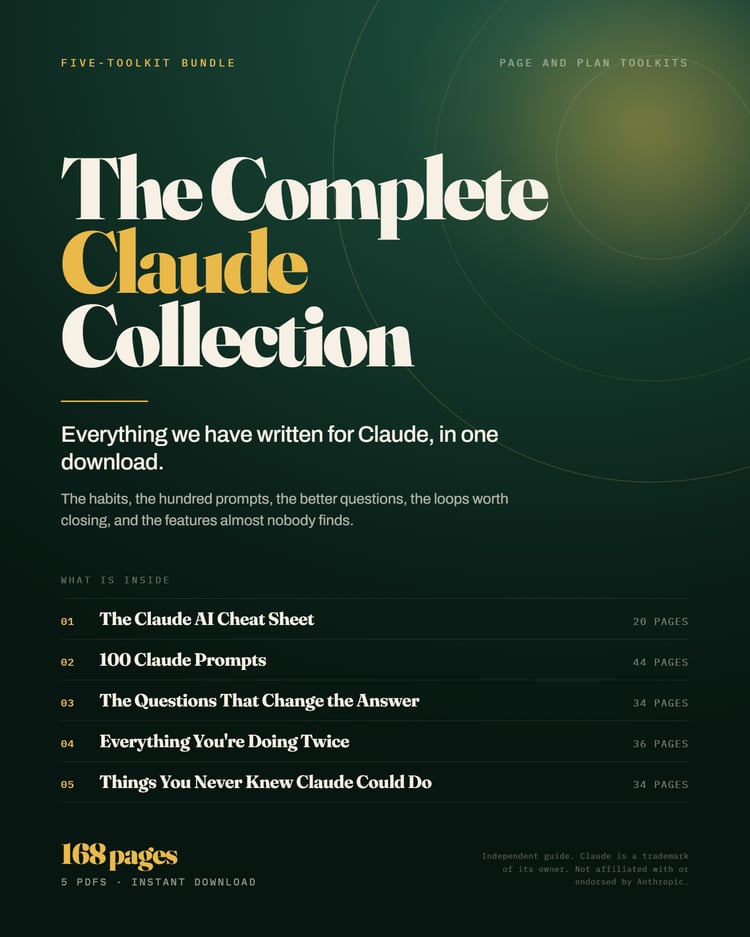



The Questions That Change the Answer: 42 Before & After Claude Prompt Examples (PDF)
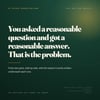
You asked a reasonable question and got a reasonable answer. It was competent. It was tidy. It was not what you were after, and you could not quite say why.
So you rewrote the request. You added detail. You got something slightly different and slightly the same, and after ten minutes you took the tidy version because you had other things to do.
That gap is not a prompt-writing problem, and no amount of clever wording closes it. You asked for the output. What you needed was the question underneath the output.
HERE IS WHAT THAT LOOKS LIKE IN PRACTICE
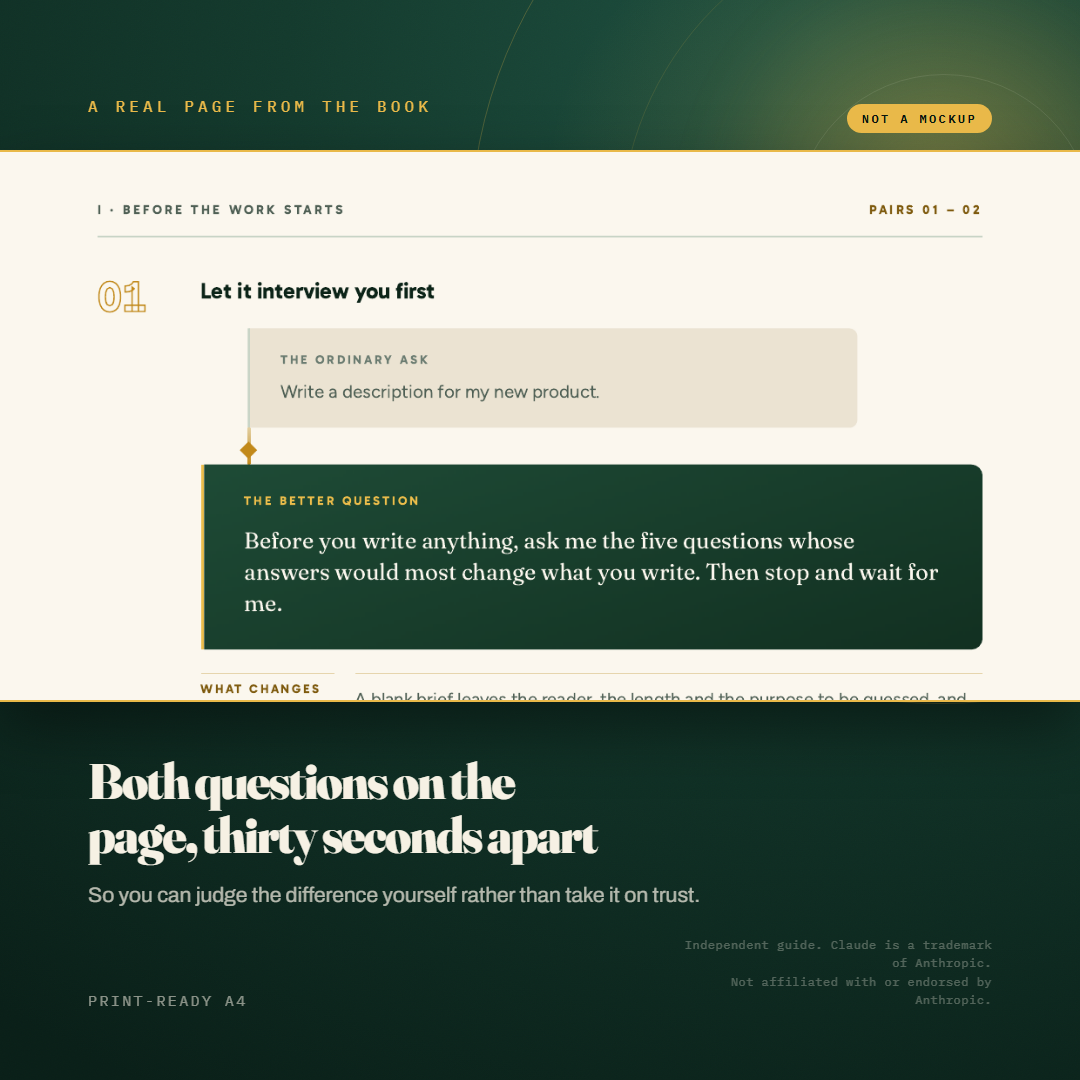
Most people type: Rewrite this so it flows better.
The better question is: Mark the exact sentences where this loses momentum, and say why for each one. Do not rewrite anything yet.
The first one licenses a rewrite, which is why rewrites come back smoother and less like you. The second keeps every one of your sentences on the page and hands you a list you can act on selectively. Same draft, same tool, thirty seconds apart, and a completely different kind of usefulness.
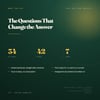
This book is forty-two of those, shown side by side.
HOW IT IS BUILT
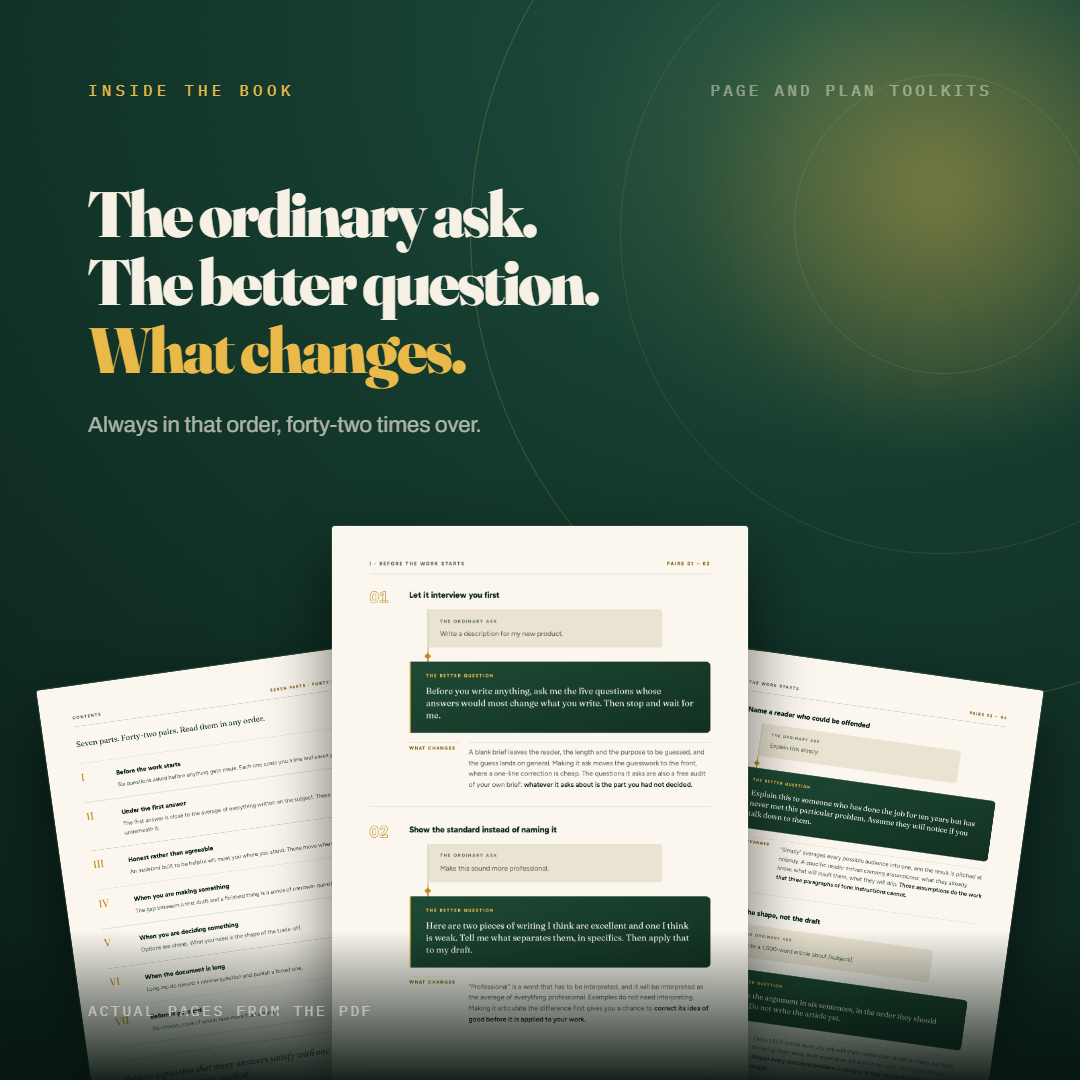
Every entry has three parts, always in the same order.
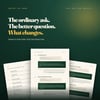
The ordinary ask. What most people type. It is not a straw man. It is the sensible thing to type, which is exactly why the gap is worth showing rather than describing.
The better question. What to ask instead, written so you can paste it as it stands. Square brackets mark the only parts you fill in.
What changes. Why the second one produces a different kind of answer. This is the part that lets you build your own questions afterwards.
Nothing here is a trick, a jailbreak or a magic phrase. Every pair is a small shift in what you are actually asking for, and the reason it works is written underneath it so you can judge for yourself rather than take it on trust.
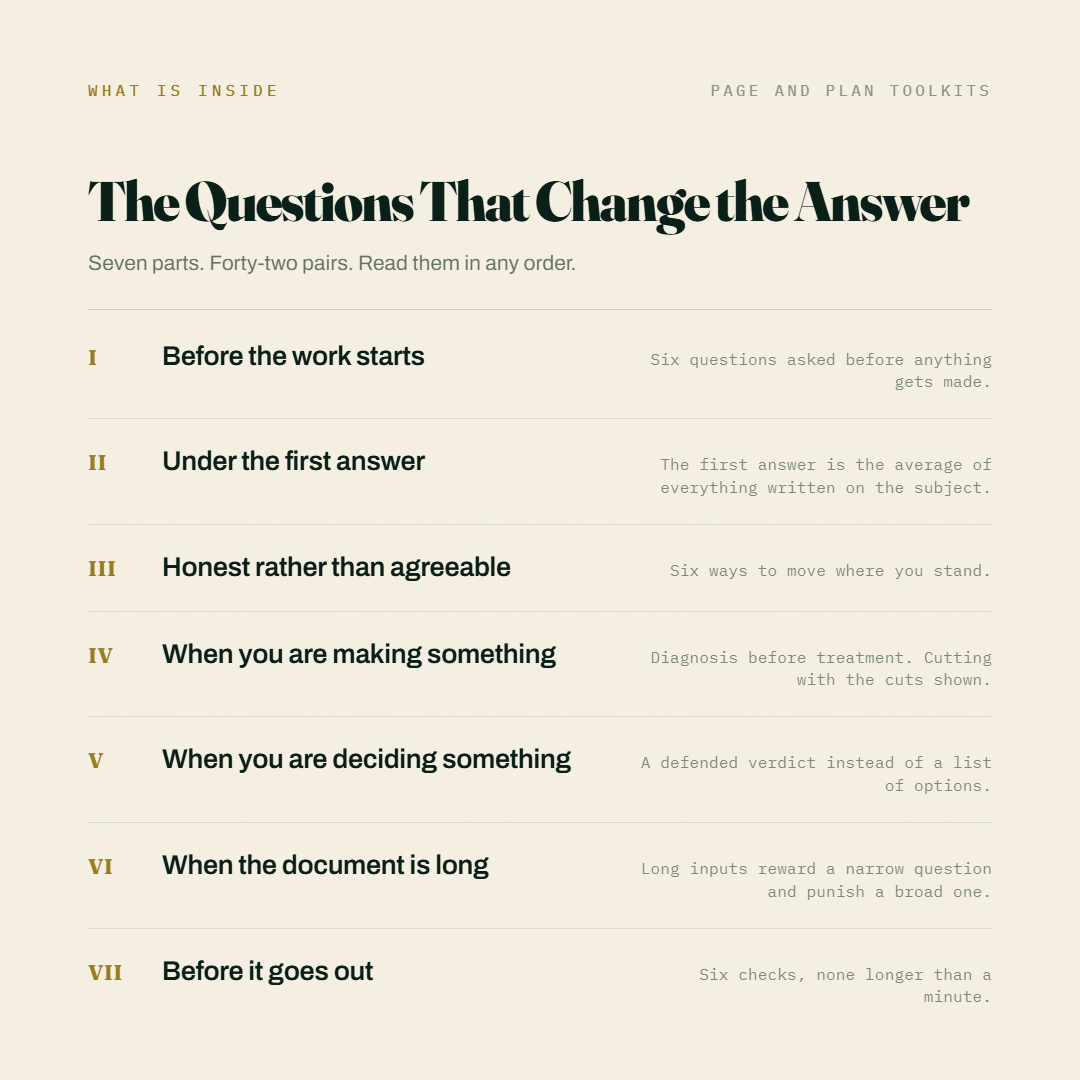
THE SEVEN PARTS
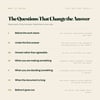
One. Before the work starts. Six questions asked before anything gets made. Letting it interview you first. Showing the standard instead of naming it. Asking for the shape rather than the draft.
Two. Under the first answer. The first answer is close to the average of everything written on the subject. How to set the obvious answer aside on purpose, ask for the boring middle of a plan, and find out what got cut.
Three. Honest rather than agreeable. An assistant built to be helpful will meet you where you stand. Six ways to move where you stand, including the one-line change that stops your own plan being read as something that needs supporting.
Four. When you are making something. Diagnosis before treatment. The line a critic would quote. Cutting with the cuts shown, so an irreversible edit becomes a reversible one.
Five. When you are deciding something. Options are cheap. How to get a defended verdict, a second-order answer, a written account of the failure, and the smallest test that produces evidence instead of encouragement.
Six. When the document is long. Long inputs reward a narrow question and punish a broad one. Finding the turns before the summary. Asking what is not in the contract. Sorting your notes instead of letting the gaps get filled in for you.
Seven. Before it goes out. Six checks, none longer than a minute, because a confident sentence and a correct sentence look identical on the page.
Then, write your own. The last pages name the six moves underneath all forty-two, and the single test for any question you write yourself.
WHO IT IS FOR
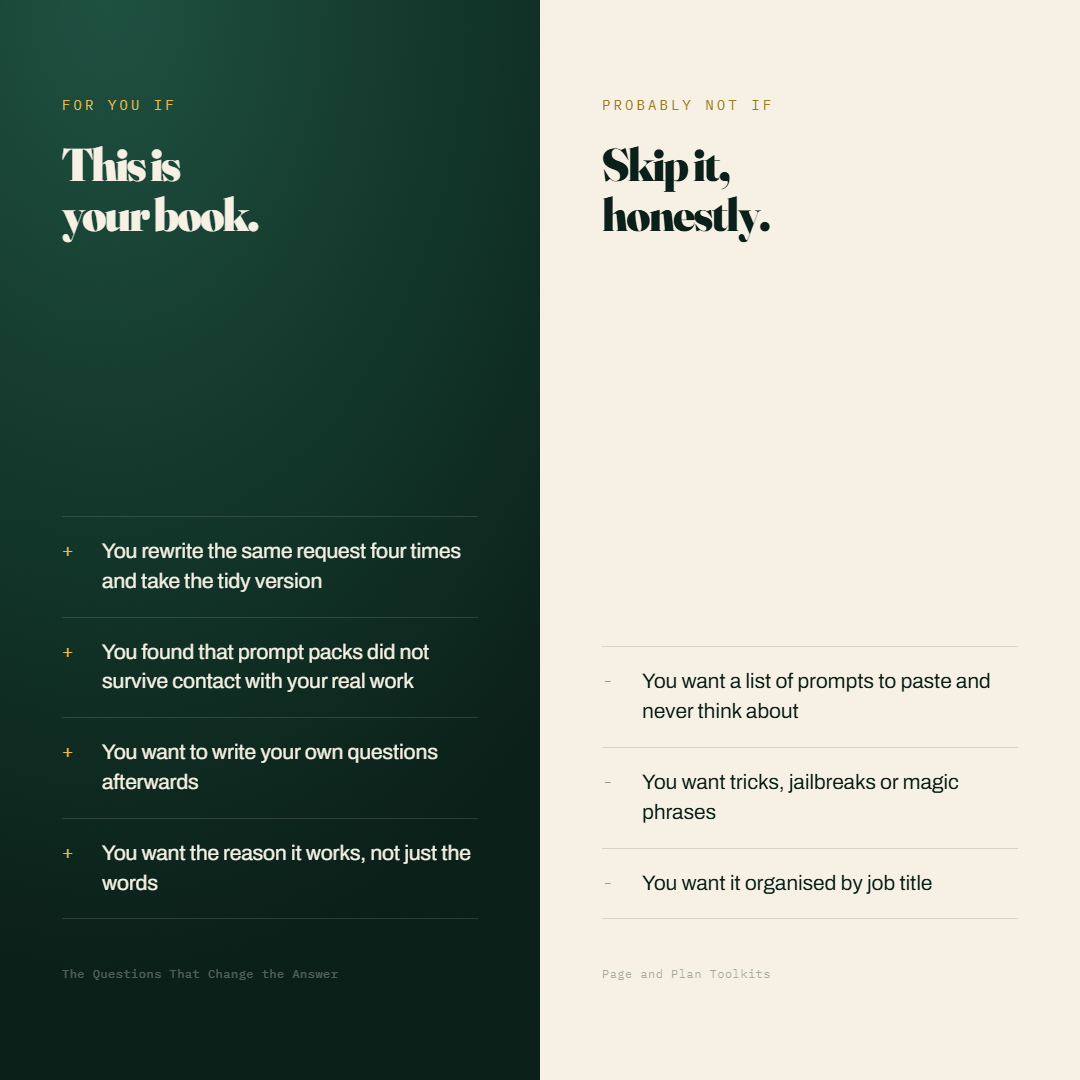
Anyone who already uses Claude and suspects they are getting a fraction of it. No code, no jargon, and nothing that assumes you know what a token is. It is not organised by job title or industry, because the question underneath a rewrite request is the same whether you are editing a sales page, a thesis or a difficult email.
If you have already read a prompt pack and found the prompts did not survive contact with your actual work, this is the other half of that. It is not a list of prompts. It is the thinking that produces them.
WHAT CHANGES AFTER YOU READ IT
You stop rewriting the same request four times and start changing what you ask for. You can tell, in the moment, when you have asked for the output instead of the thing underneath it. You get feedback that is ranked and specific rather than balanced and polite. And you have a method for writing your own questions, which outlasts any list.
FORMAT
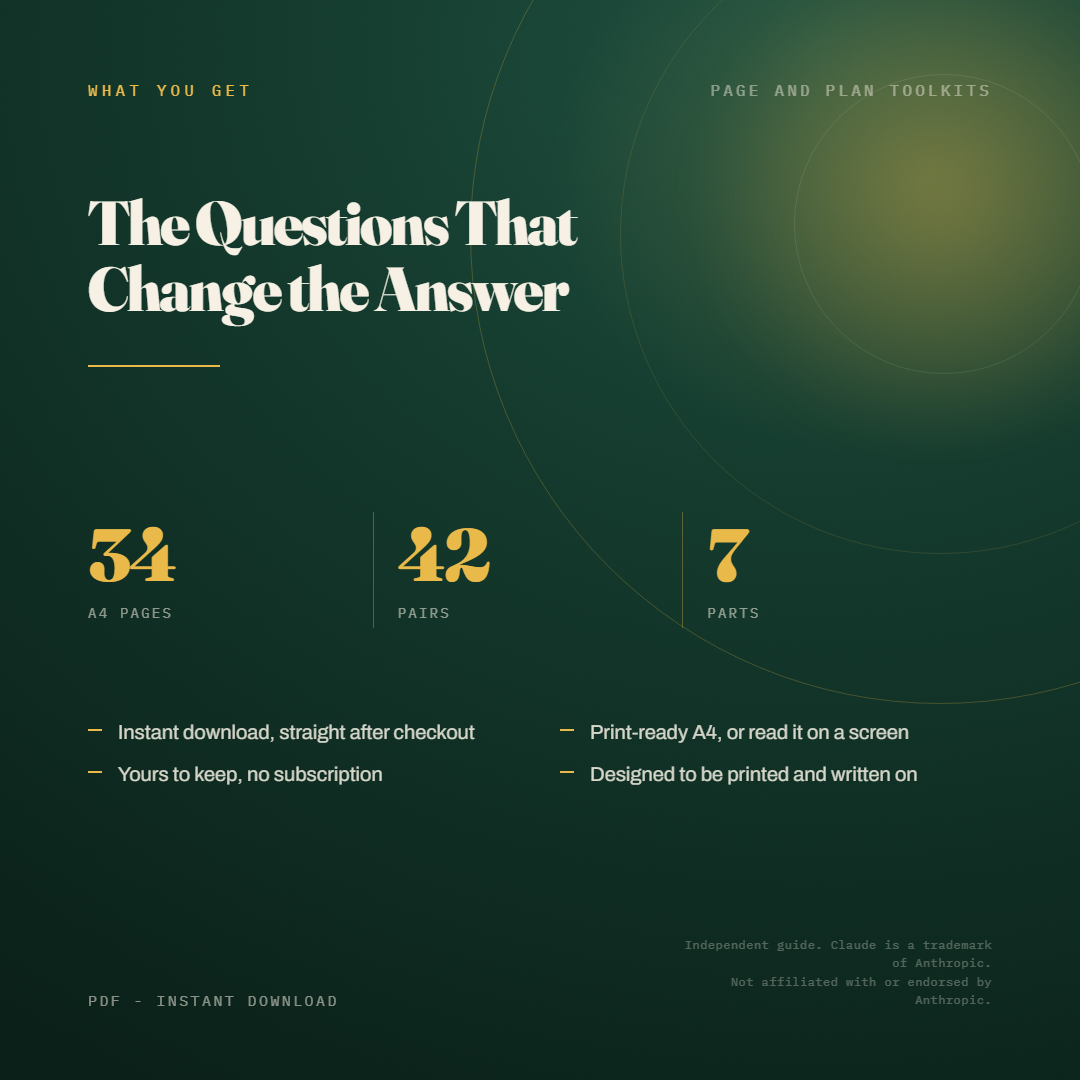
34 pages, A4, print-ready PDF. Designed to be read on screen or printed and kept beside you. Instant digital download, yours to keep, no subscription.
THE HONEST BIT
The questions are written for Claude and work anywhere you are asking a capable assistant to do real work. Nothing in here depends on a plan, a setting or a feature, so nothing in here goes out of date when the interface moves.
Independent guide. Claude is a trademark of its owner. This product is not affiliated with, endorsed by, or sponsored by Anthropic. Instant digital download, so all sales are final once the file has been downloaded.
Page and Plan Toolkits