
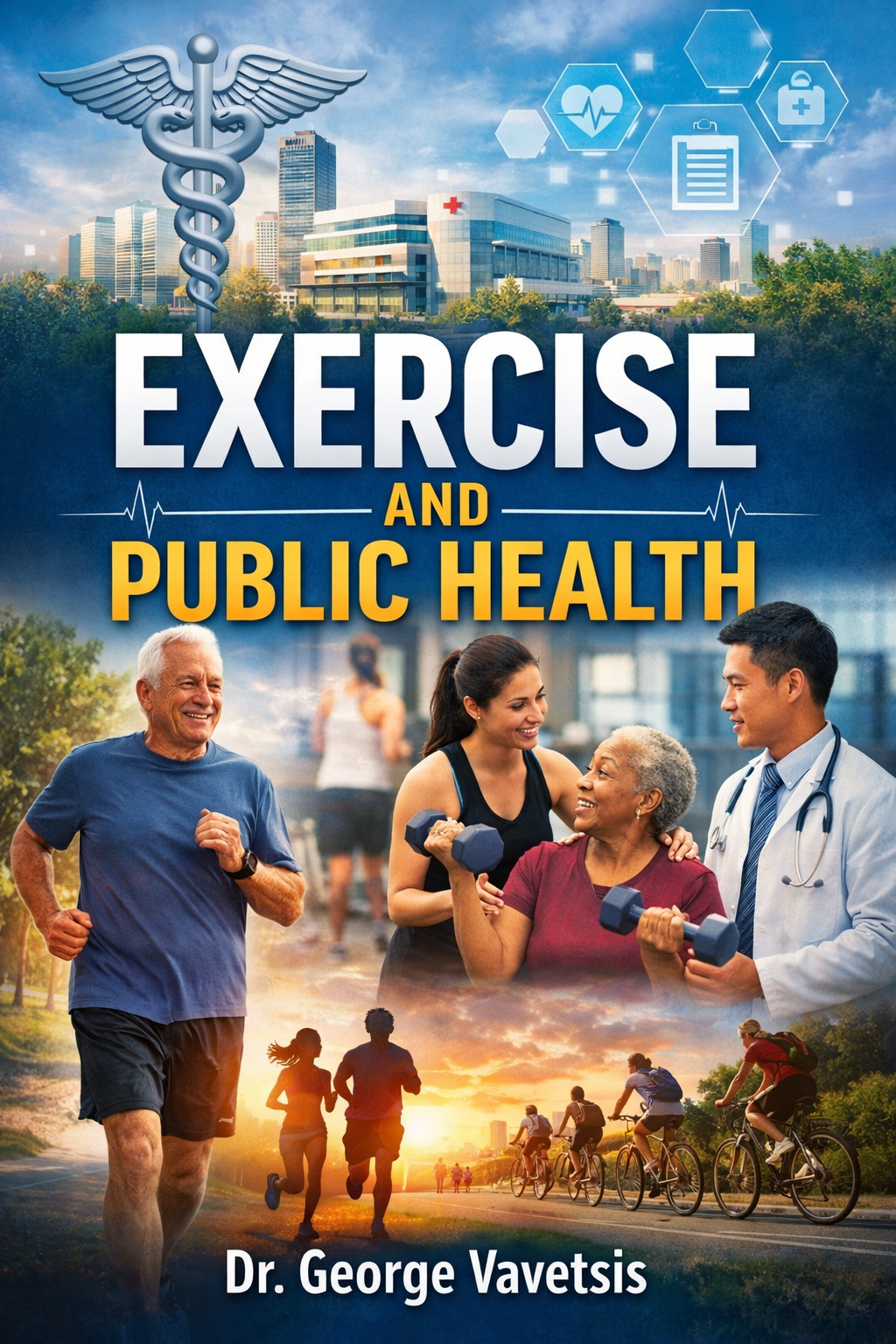
Exercise and Public Health
Pages: 714
The intersection of physical activity and public health represents one of the most powerful, yet underutilized, domains in modern preventive medicine. As global health systems confront an escalating burden of non-communicable diseases (NCDs), the necessity of integrating structured exercise into population-wide strategies is no longer optional—it is imperative. This book emerges from that necessity, offering a scientifically rigorous and practically actionable framework that redefines exercise not merely as a lifestyle choice, but as a foundational pillar of public health architecture.
Over the past decades, the epidemiological landscape has undergone a profound transformation. The shift from infectious diseases to chronic, lifestyle-related conditions has exposed critical limitations in traditional healthcare models that prioritize treatment over prevention. Within this context, physical inactivity has surfaced as a primary modifiable risk factor, contributing significantly to morbidity, mortality, and healthcare expenditure worldwide. It is now well established that insufficient physical activity is associated with a 20–30% increase in all-cause mortality, while appropriate exercise interventions can reduce the incidence of major chronic diseases by up to 40% . These findings alone demand a paradigm shift—from reactive medicine to proactive, movement-based health systems.
This book is designed to operationalize that paradigm shift. It synthesizes evidence from epidemiology, clinical physiology, behavioral science, and policy development to construct a multi-level model of exercise integration. At its core lies the recognition that public health is not a singular discipline but a coordinated system of interventions spanning individual behavior, community infrastructure, and national policy. Exercise, therefore, must be embedded across all these levels—prescribed in clinical settings, facilitated within communities, and supported through systemic policy frameworks.
A central theme throughout this work is the concept of exercise as medicine, an approach that positions structured physical activity alongside pharmacological interventions in the prevention and management of disease. This perspective is supported by extensive clinical and epidemiological data demonstrating that adherence to recommended physical activity levels—typically ≥150 minutes of moderate-intensity exercise per week—can significantly improve functional capacity, reduce disease risk, and enhance quality-adjusted life years (QALYs) . Importantly, these benefits extend beyond physiological outcomes, encompassing psychological well-being, cognitive function, and social engagement.
However, the translation of scientific evidence into population-level impact remains a major challenge. Despite clear guidelines and widespread awareness, a substantial proportion of the global population fails to meet minimum physical activity recommendations. This disconnect underscores the need for more sophisticated intervention strategies—ones that address not only biological determinants, but also behavioral, environmental, and socioeconomic factors. Public health must therefore evolve into a systems-based discipline, capable of integrating exercise into healthcare pathways, urban design, and cultural norms.
In response to this need, the book adopts a systems approach to physical activity promotion. It explores models such as referral-to-exercise schemes, where healthcare professionals prescribe structured exercise programs tailored to individual risk profiles. These models represent a critical bridge between clinical medicine and community-based interventions, enabling scalable and cost-effective solutions to the inactivity epidemic. By linking patients to exercise professionals and structured programs, such systems enhance adherence, optimize outcomes, and reduce long-term healthcare costs.
Another key dimension addressed in this work is the dose–response relationship between physical activity and health outcomes. Unlike many medical interventions, exercise demonstrates a clear gradient of benefit: even small increases in activity levels yield measurable improvements, while higher doses confer greater protection against disease. The identification of minimum effective thresholds—typically in the range of 500–1000 MET-minutes per week—provides a practical framework for designing interventions that are both achievable and impactful . This principle is fundamental to the development of individualized and population-based exercise prescriptions.
Equally important is the recognition that physical activity behavior is shaped by a complex interplay of determinants. Biological factors such as genetics and age influence physiological response to exercise, while behavioral factors—including motivation, self-efficacy, and habit formation—govern adherence. Environmental and social determinants, such as access to facilities, urban design, and socioeconomic status, further modulate participation levels. Effective public health strategies must therefore adopt a multi-level perspective, addressing these determinants simultaneously to create environments that support and sustain active lifestyles.
The integration of digital technologies represents a promising frontier in this domain. Wearable devices, mobile applications, and data analytics platforms are transforming the way physical activity is monitored, prescribed, and evaluated. These tools enable real-time feedback, personalized interventions, and large-scale surveillance of population activity patterns. When combined with behavioral coaching and policy support, they offer unprecedented opportunities to enhance engagement and optimize health outcomes.
Ultimately, this book is not merely an academic exercise; it is a call to action. It challenges practitioners, policymakers, and researchers to rethink the role of exercise within the broader health system and to embrace a more holistic, preventive approach to healthcare. By aligning scientific evidence with practical implementation, it aims to bridge the gap between knowledge and practice, transforming exercise from an adjunct therapy into a central component of public health strategy.
In doing so, the work aspires to contribute to a future in which physical activity is seamlessly integrated into daily life, healthcare delivery, and societal infrastructure—a future where movement is not prescribed as an afterthought, but embedded as a fundamental human necessity.