
Gloria Nocturna: Player's Handbook
Enter a World Where Faith Is Power—and Darkness Is Alive
The year is 1776—but this is not our world.
Across the forest-covered world of Sylva, black-powder empires struggle for power beneath the spreading shadow of the Gloom. Haunted ruins bleed corruption into the earth. Goblins, vampires, hags, trolls, cultists, and stranger horrors stalk roads illuminated only by lanternlight. Villages disappear overnight. Ancient relics whisper forbidden truths. Human wickedness does not merely damage society—it feeds an alien darkness capable of reshaping the land itself.
Standing against it is the Black Order, a religious military organization whose soldiers serve as investigators, mercenaries, monster hunters, bodyguards, healers, priests, assassins, engineers, and agents of divine judgment.
You are one of them.
Gloria Nocturna is a late-18th-century dark fantasy tabletop role-playing game powered by Jack’s Cinematic d12 (JCd12)—a universal tabletop role-playing game rules system designed to make every session feel less like moving pieces across a board and more like directing a dangerous, unpredictable action film.
This Player’s Handbook contains the complete core rules needed to create characters, resolve actions, portray dramatic social encounters, survive brutal combat, confront supernatural corruption, wield magic, recover from trauma, and advance from an inexperienced recruit into a legendary member of the Black Order.
What Is It Really Like to Play a Religious Zealot?
What happens when faith is not merely part of a character’s biography, but something that produces measurable consequences?
What does it mean to play a priest whose prayers can change the course of battle? A prophet burdened by visions that may save a city—or destroy their mind? An assassin convinced that killing one wicked ruler will prevent a thousand deaths? A healer required to preserve life while serving beside soldiers trained to take it?
Can a righteous character remain merciful after witnessing genuine supernatural evil? Can a corrupt character justify one more compromise when the Gloom begins offering real power?
And what happens when the darkness realizes that one member of the detachment can be tempted?
Gloria Nocturna treats religion as a serious role-playing framework rather than decorative background. The fictional faith of the Black Order draws inspiration from the ancient Israelite world while existing within its own gothic fantasy setting. Players are invited to wrestle with duty, conscience, loyalty, sacrifice, temptation, repentance, divine favor, and the moral cost of survival.
This is not a sermon or Bible study. It is a game of gothic horror, military adventure, personal conviction, and difficult choices.
Powered by Jack’s Cinematic d12
Jack’s Cinematic d12 is built around one twelve-sided die and a straightforward resolution system:
1d12 + Attribute PRISM + Skill versus a Realism Target Number
Rather than forcing players through dense calculations, JCd12 asks the Game Master to consider the actual circumstances of the scene. Darkness, rain, wounds, preparation, superior equipment, unstable footing, emotional pressure, and tactical positioning modify how difficult an action truly is.
The result is fast adjudication grounded in cinematic realism.
Firing a musket at a stationary target may be easy. Firing it while wounded, running through smoke, and protecting a terrified child is another matter entirely.
Roll a 12, and the die explodes (meaning: you can roll again and add the result), allowing seemingly impossible feats. Roll two consecutive 12s, and Divine Intervention may alter the scene. Roll three 12s, and Heaven itself appears to have touched the battlefield.
Roll a 1, however, and the result is an Epic Fail whose severity reflects the danger of what was attempted.
No Hit Points
Gloria Nocturna does not reduce human survival to a reservoir of abstract Hit Points. Characters suffer Physical Wounds and Mental Trauma. Gunshots, blades, falls, disease, explosions, and monster attacks inflict specific levels of bodily harm. Fear, exhaustion, torture, supernatural exposure, grief, moral injury, and witnessing atrocities damage the mind.
Wounds matter after combat ends.
A character may survive a gunfight but require weeks of medical treatment. Another may escape a haunted ruin physically untouched yet remain mentally unstable. Recovery depends upon medicine, living conditions, companionship, faith, meaningful rest, and what the character does between missions.
Where a character sleeps, what they eat, who cares for them, and whether they can afford treatment directly influence their survival. Poverty, comfort, friendship, romance, prayer, confession, and restitution are not flavor text—they can become part of the healing process.
Your character does not simply “rest until fully healed.” Your character lives with what happened.
Five Action Points. Countless Possibilities.
During an Action Scene, characters receive 5 Action Points to spend upon combinations of:
- 🟡 Flair Actions
- 🟠🟠 Swift Actions
- 🔴🔴🔴🔴 Starring Actions
Move, aim, fire, grapple, reload, take cover, disarm an opponent, treat a wound, interrupt an enemy, perform a cinematic maneuver, or attempt something the rules never explicitly anticipated. JCd12 is built to reward decisive action, teamwork, preparation, tactical competence, and creative problem-solving. Combat is designed to feel fast, intense, and lethal. Characters can overcome incredible odds—but even an experienced hero may not survive to the final scene.
Twelve 💪Attributes, Five 🌈Attribute PRISMs, and Twenty-Four Broad 🛠Skills
Characters are defined by 12 Attributes:
Spirit, Discipline, Intelligence, Perception, Wisdom, Charisma, Attractiveness, Strength, Stamina, Agility, Speed, and Dexterity.
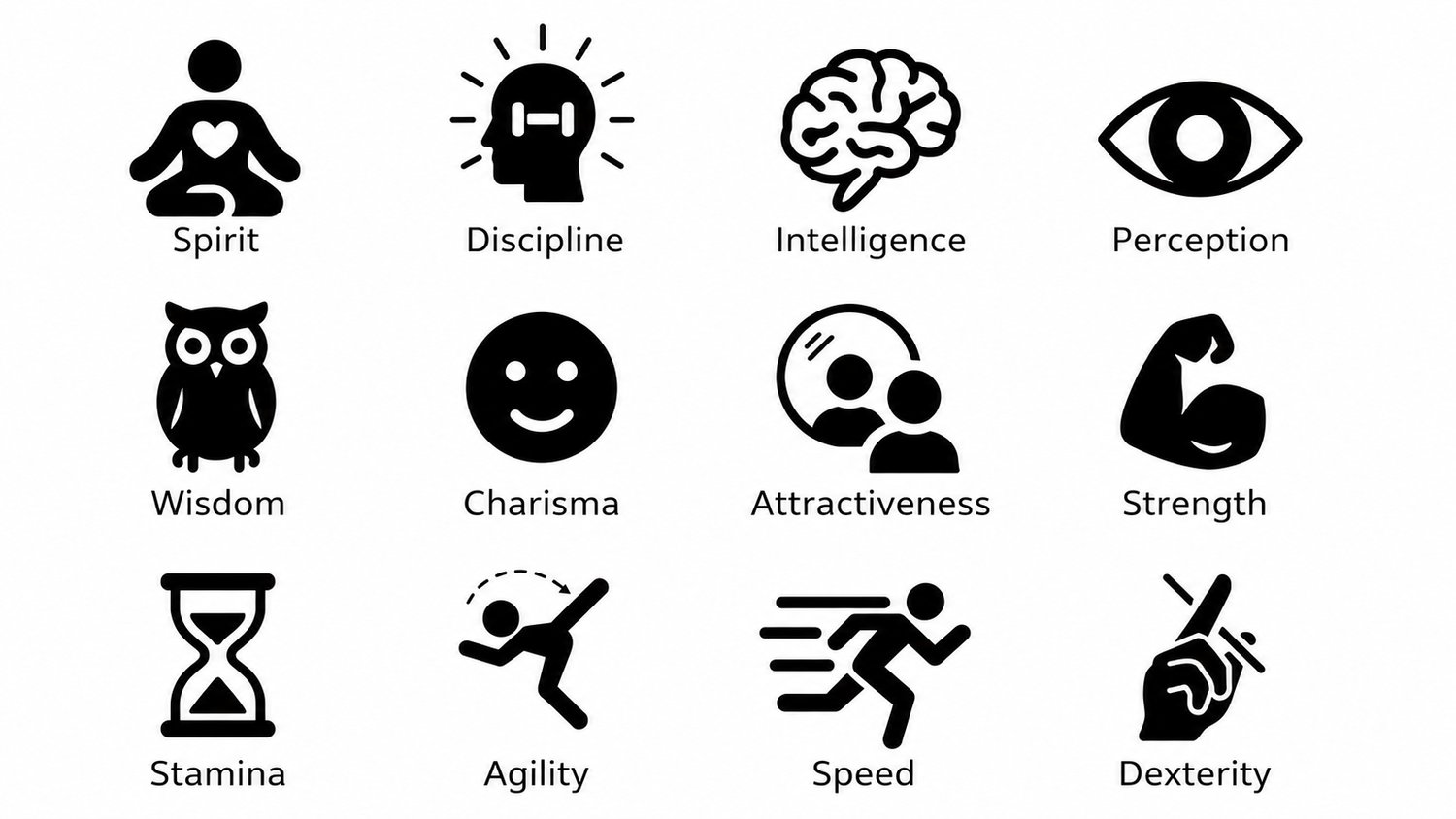
These Attributes combine into 5 Attribute PRISMs representing practical fields of capability:
Physical Performance, Reflexes, Influence & Allure, Spirituality, and Mental Performance.
Characters then develop 24 broad Skills, eliminating the need to search through enormous lists of hyper-specific abilities. Skills cover everything from firearms, armed combat, stealth, medicine, investigation, survival, technology, alchemy, engineering, animal handling, social influence, criminal contacts, and spiritual practice to carriages, sailing, experimental aircraft, and dangerous machinery.
The rules distinguish natural talent from trained expertise while remaining quick enough to resolve at the table.
Choose One of Twelve Core Classes
Every character serves within a Black Order Special Detachment—a small, balanced team assigned to investigate and confront threats that ordinary armies, constables, and clergy cannot handle.
Choose from 12 core character classes:
Infantryman — A disciplined black-powder soldier trained to march, fight, endure, and hold the line.
Wrestler — A Giant Human shock trooper who transforms mass, momentum, and close-combat mastery into a living siege weapon.
Sapper — An engineer, miner, climber, builder, and demolitions specialist capable of reshaping the battlefield.
Driver, or Ace — A master of carriages, wagons, armored transport, high-speed pursuit, battlefield mobility, and mechanical modification.
Assassin — An infiltrator, spy, poisoner, saboteur, and precise instrument of sanctioned death.
Beast Master — A handler whose animal companions scout, track, defend, carry messages, and fight beside the detachment.
Minstrel — A soldier of morale who uses music, rhythm, sacred performance, and supernatural harmony to strengthen allies and resist despair.
Scroll Master — The detachment’s magician, scholar, keeper of written power, and master of disciplined spellcraft.
Alchemist — A scientist-sorcerer who creates medicines, explosives, antidotes, experimental compounds, and bottled miracles.
Prophet or Prophetess — A divinely burdened combat magician who receives visions, interprets supernatural events, and channels sacred authority.
Healer — A field surgeon, herbalist, exorcist, and defender of life trained to mend both bodily injury and spiritual corruption.
Priest — A warrior-shepherd, teacher, ritual authority, and spiritual commander standing between humanity and the abyss.
Classes establish identity, training, favored Attributes, starting equipment, and access to specialized magical paths—but they do not imprison characters within narrow mechanical roles. A soldier may awaken as a Martial Adept. An Infantryman may become a Lord of War. An Assassin may follow the Shadowborne path or train as a supernatural Ninja. An Alchemist may become a Keeper of the Garden. A Priest may develop inherited sacred power. A corrupt character may receive magic from something far less benevolent.
Three Human Types
Rather than conventional fantasy “races,” Gloria Nocturna presents three Human Types, each representing a different expression of humanity:
Anashim—Standard Humans
Balanced, numerous, adaptable, and capable of serving in nearly every profession.
Gibborim—Giant Humans
Towering humans generally standing between 6 feet 7 inches and 8 feet tall, defined by physical power, restraint, wisdom, and the burden of living in a world built for smaller people.
Qetanim—Little Humans
Small humans generally standing between 3 and 4½ feet tall, distinguished by intellect, perception, diplomacy, precision, ingenuity, and physically delicate builds.
Each Human Type affects Attributes, social experience, available classes, physical limitations, cultural identity, and role-playing opportunities. These are not cosmetic selections. Being a Giant Human changes how the world accommodates—or fears—you. Being Qatan changes how you fight, travel, hide, negotiate, and survive in spaces designed for larger bodies.
Morality Has Mechanical Consequences
The world exists in tension between Tranquility and the Gloom, also called the Arafel. Tranquility grows where people pursue justice, mercy, divine order, restoration, and righteousness. Crops flourish. Communities recover. The world becomes brighter, safer, and closer to what it was meant to be. The Gloom feeds upon cruelty, despair, exploitation, corruption, betrayal, and prolonged moral decay. As it strengthens, light dims, communities deteriorate, monsters emerge, and the physical environment begins reflecting the spiritual condition of those who inhabit it.
Characters who repeatedly embrace wickedness accumulate Gloom Pact Points. Corruption begins quietly. The Game Master may privately offer Temptation Missions: betray a witness, abandon the helpless, frame an innocent person, conceal evidence, or commit some useful cruelty. Eventually, the Gloom may offer supernatural power. Accepting that power can transform a character into a terrifying magician—but the strength does not belong to them. It fills the hollow space left after their Spirit has been damaged.
Corruption may produce betrayal, monstrosity, redemption, martyrdom, or the eventual transformation of a former player character into an NPC the rest of the party must hunt down.
Evil is possible.
It is also expensive.
Social Scenes Carry Real Weight
Dialog Scenes use structured opposed tests for persuasion, negotiation, seduction, intimidation, deception, interrogation, criminal dealings, spiritual discernment, and detecting lies. Relationships, leverage, privacy, attraction, fear, reputation, prior evidence, social status, exhaustion, emotional pressure, and the value of an offer all matter.
An NPC is not persuaded merely because a player rolled well, nor can a Game Master arbitrarily decide that an important character is immune to influence. The mechanics create a contest of personality, authority, preparation, and circumstance. Words can prevent a battle, expose a traitor, begin a romance, destroy an alliance, save a prisoner, or condemn an entire village.
Characters Grow Through Accomplishment
Gloria Nocturna uses 5 Action Star Levels and a strict advancement economy. Characters earn Experience Points by completing missions and accomplishing meaningful objectives. Those points are invested directly into Attributes and Skills, creating a visible record of how each adventure changed the character. Advancement is deliberately limited. Characters may become exceptional, but the system prevents them from growing so powerful that danger and dice rolls become meaningless. This is not an endless numerical treadmill. It is the story of a mortal person gradually becoming a legend.
Create More Than a Combat Build
Character creation asks who your character was before joining the Order and who they are becoming now. Record convictions, loyalties, relationships, languages, fears, duties, spiritual condition, living standards, trauma, physical wounds, moral compromises, and personal ambitions in a Character Bible. The objective is not merely to assemble bonuses. It is to create someone capable of changing—and being changed by—the story.
What This 293-Page Book Contains
This digital Player’s Handbook contains approximately 110,000 words across 293 pages, including rules for:
- 12 Attributes
- 5 Attribute PRISMs
- 24 broad Skills
- 3 Human Types
- 12 core Classes
- Magical Character paths and focuses
- Character creation
- Experience and advancement
- 5 Action Star Levels
- Favor Points and prayer
- Realism Target Numbers
- Advantage and Disadvantage
- Exploding d12 rolls
- Epic Fails and Divine Intervention
- Dialog Scenes
- Interrogation and lie detection
- Initiative and Action Points
- Firearms and melee combat
- Tactical movement and cinematic actions
- Physical Wounds
- Mental Trauma
- Healing and Standards of Living
- Magic and spiritual consequences
- The Animus and astral existence
- Tranquility and Gloom Domains
- Moral corruption and Gloom Pacts
- Temptation Missions
- Repentance and redemption
- Simplified NPC Plot Ratings
- Religion within the setting
- Guidance for rebuilding Gloria Nocturna in other worlds
The average reader can understand the game’s fundamentals within approximately two hours, while a complete cover-to-cover reading offers enough depth to support long-term campaigns.
One of Seven Core Gloria Nocturna Books
Gloria Nocturna is supported by a seven-book core line:
- Gloria Nocturna — The Player’s Handbook and complete core rules.
- Mercatus et Commercium Sylvae — Weapons, armor, equipment, trade, services, mounts, and the economy.
- Codex Arcanum — The complete spellbook used by compatible JCd12 game worlds.
- Codex Monstrorum Arcanum — Monsters, horrors, animals, and supernatural adversaries.
- Sylva — The world book covering geography, history, cultures, religions, factions, and lore.
- Outpost Ravenholm — The Game Master’s Guide and introductory campaign setting.
- Codex Fraternitatis — The Black Order’s membership manual and an expansion for players and Game Masters.
Most players require only the Gloria Nocturna Player’s Handbook to learn the rules and create a non-spellcasting character. Players will also need Mercatus et Commercium Sylvae to purchase weapons, armor, tools, mounts, and other equipment, while spellcasters will want Codex Arcanum, which contains the complete spell descriptions. These books are intentionally published separately so multiple players can reference rules, equipment, and spells at the same time instead of passing a single massive rulebook around the table.
The monster manual, world book, Game Master's guide, and much of the remaining line are primarily intended for the Game Master, although players who wish to explore the lore of Sylva and the Black Order may enjoy them as well.
A Universal System Beyond Gloria Nocturna
Jack’s Cinematic d12 was designed as more than the engine for one world. The same central rules can support radically different settings, including:
- Gloria Nocturna — Late-18th-century religious dark fantasy
- No Quarter — Gritty medieval fantasy
- RIVET — Post-apocalyptic science-fiction horror
- Shadowrun JCd12 — The famous cyberpunk fantasy adapted to JCd12
- Other original or homebrewed campaign worlds
Learn the core logic once and carry it into other genres.
This Edition
This is the playtesting edition of the Gloria Nocturna Player’s Handbook. Rules, wording, balance, presentation, and specific mechanics may be revised as the system receives further testing and development. Purchasing this edition supports the continued development of Gloria Nocturna and Jack’s Cinematic d12. Purchasing this digital version entitles you to all further updates of the digital edition of this book.