

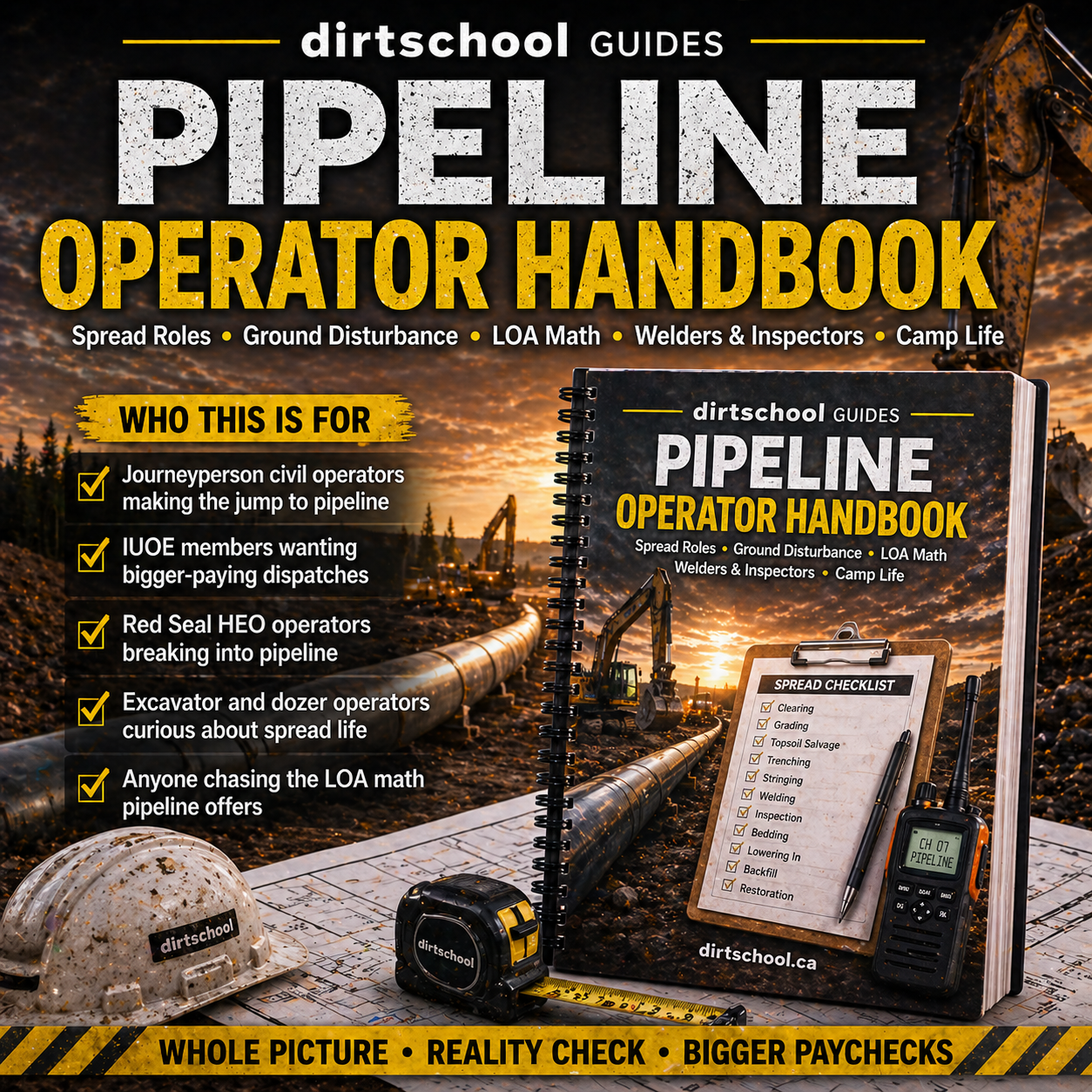
Pipeline Operator Handbook — Spread Roles, LOA Math, and the $40–70k Civil-to-Pipeline Pay Jump
A journeyperson HEO on an Alberta civil job makes $42/hr. Same operator, same ticket, on a Coastal GasLink-class spread runs $48–55/hr base — but the LOA ($200/day, tax-free), 12-hour shifts at time-and-a-half past 8, travel pay, and 20-and-10 rotations push the take-home to $14,000+ per rotation. Run 10 rotations a year and you're netting $143k after tax. That's a $210k civil job equivalent.
So why isn't every civil operator on a spread?
Because pipeline isn't "civil with bigger distances." It's a different industry running on different rules. The welders set the tempo — every operator behind them is a feeder for the weld gang, and a delayed ditch costs the contractor $50k a day. There's H2S country where the gas pools in the trench you're digging. Ground Disturbance 201 isn't a checkbox — it's the difference between hand-digging at 1m and hitting a fiber line that costs millions. Camps run 20-and-10. Welders run the show. Environmental monitors can shut you down for the day. Civil guys who show up thinking their skills carry over burn out in their first rotation.
This handbook is the translation layer.
What's inside (10 sections + reference):
- Pipeline 101 — sectors (gas mainline, oil, gathering, facility, distribution), geographic concentration in BC/AB/SK, project life cycle from pre-con to demob
- Getting your first dispatch — the four routes (IUOE hall, direct contractor, ROW services, referral), prerequisites, financial readiness ($3–5k cash buffer for the 6–8 week paycheck gap)
- The spread — chain of command, every operator role on a spread (grading, topsoil, ditch, bedding, sideboom lowering-in, backfill, restoration), the welder-paced tempo
- ROW work — clearing, topsoil salvage (the most underrated and most-failed task on the spread), grading, environmental compliance, watercourse buffers
- Working with the pipe gang — stringing without damaging coating, the weld sequence (root/hot/fill/cap), bedding crew rules, why welders get special treatment
- Ground Disturbance 201 — one-call numbers for every province, the color code, the 1m hand-dig rule, foreign crossings, what to do if you strike a utility
- H2S country — concentration ladder, personal monitor protocol, alarm response, sour gas operator rules
- Camp life — rotation patterns (14/7, 20/10, 21/7), daily routine, dry-camp rules, staying sane on rotation
- LOA + per diem + paystub math — base rate tables (union vs non-union by machine class), OT structure, a full worked example showing $18,608 gross / $14,346 net per 30-day rotation
- After the spread — staying dispatchable, building your reputation, career paths (lead hand, foreman, owner-op support truck)
- Reference section — full glossary, required tickets list, camp packing checklist, pre-dispatch and after-rotation checklists
Who this is for:
- Journeyperson civil operators making the jump to pipeline
- IUOE members wanting bigger-paying dispatches
- Red Seal HEO operators breaking into pipeline
- Excavator and dozer operators curious about spread life
- Anyone chasing the LOA math pipeline offers
Who this isn't for:
Tradesmen who already have 5+ pipeline seasons. You know this stuff. Pass this to the green operator on your crew instead.