
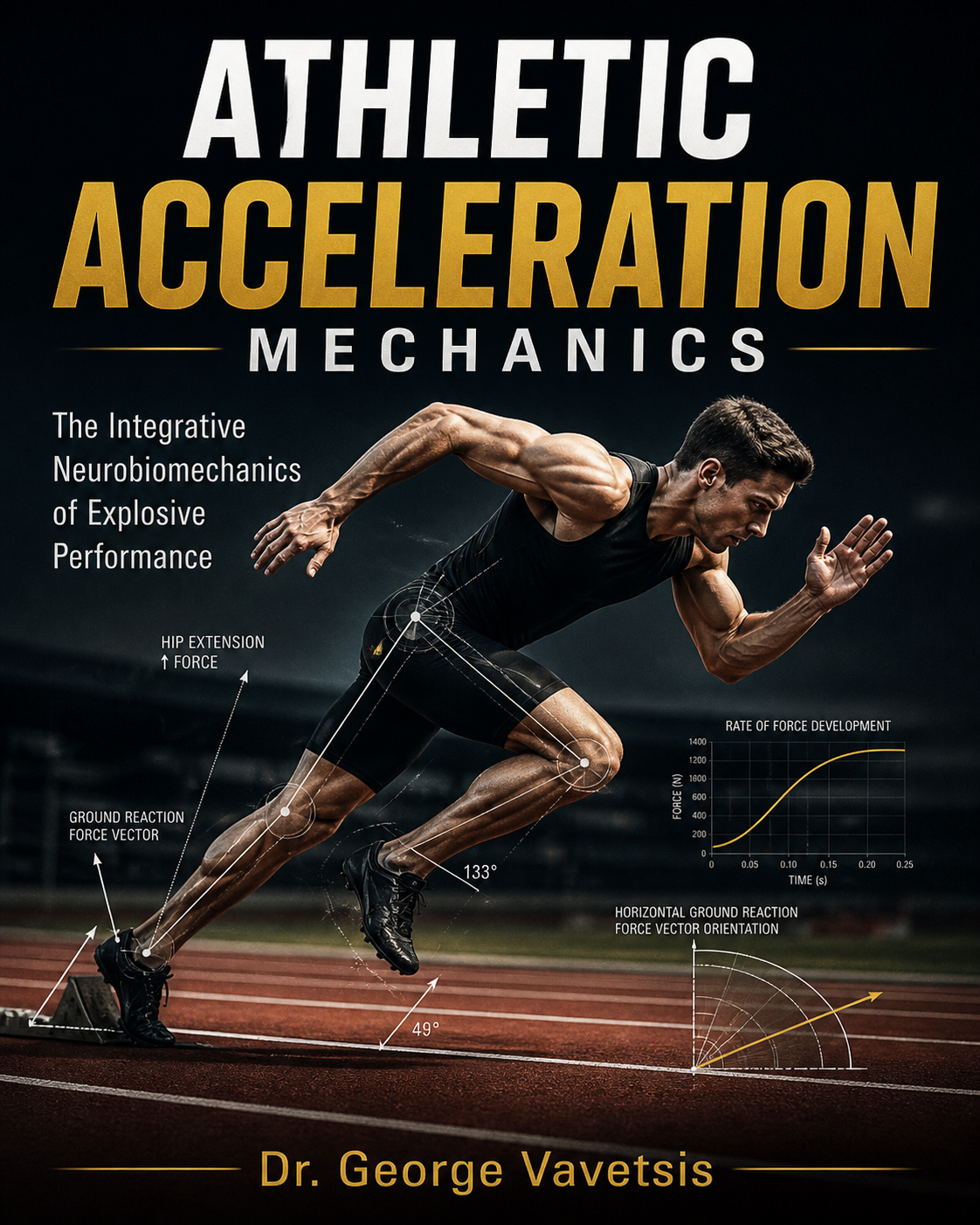
Athletic Acceleration Mechanics
Pages: 1347
Athletic acceleration represents one of the most complex and decisive expressions of human movement performance. Across nearly every competitive sport environment—from sprinting and football to basketball, rugby, combat sports, and multidirectional field-based activities—the capacity to rapidly project the body from inertia into purposeful locomotion frequently determines tactical superiority, positional dominance, and competitive success. Yet despite its universal relevance, acceleration has often been oversimplified within traditional coaching and scientific paradigms as merely a product of strength, speed, or power alone. This reductionist interpretation fails to acknowledge the profound neuromechanical, biomechanical, metabolic, coordinative, and neurophysiological interactions that govern explosive locomotor behavior.
Athletic Acceleration Mechanics was conceived as an advanced scientific exploration of the mechanisms that regulate horizontal propulsion, force-vector orientation, intersegmental momentum transfer, neuromuscular synchronization, and dynamic force transmission during acceleration tasks. Rather than viewing acceleration as an isolated sprinting skill, this text approaches acceleration as an integrated systems phenomenon emerging from the interaction of the nervous system, musculotendinous architecture, skeletal mechanics, metabolic energetics, and environmental constraints. The objective is not only to analyze movement, but to understand the underlying principles that permit elite athletes to produce efficient, repeatable, and sport-transferable acceleration strategies under competitive conditions.
The scientific foundations presented throughout this work are rooted in integrative neurobiomechanics, locomotor energetics, applied motor control, force-vector theory, and kinetic-chain dynamics. Particular emphasis is placed on how the body organizes movement under high mechanical demand while simultaneously maintaining stability, directionality, and energetic efficiency. Within this framework, acceleration is not interpreted merely as linear displacement over time, but rather as a continuous regulation of force orientation, impulse distribution, projection mechanics, and intersegmental coordination.
One of the central themes of this book is the concept of horizontal propulsive dominance. Elite acceleration is not simply the ability to produce force, but the ability to direct force effectively relative to the center of mass and intended trajectory. High-performing athletes consistently demonstrate superior orientation of the ground reaction force vector, more efficient trunk projection mechanics, refined timing of triple-extension sequencing, and optimized stiffness regulation across the lower extremity. These characteristics permit the athlete to transform muscular output into effective horizontal propulsion while minimizing momentum leakage and unnecessary vertical oscillation.
Equally important is the role of the nervous system in regulating acceleration performance. Athletic movement is constrained not only by muscular capabilities, but also by neural control strategies governing motor-unit recruitment thresholds, intermuscular synchronization, reflex modulation, co-contraction strategies, and segmental timing precision. The athlete’s acceleration profile therefore emerges from the interaction between biomechanical potential and neural permissibility. Throughout this text, acceleration is examined through this neuromechanical lens, recognizing that elite performance depends heavily upon the nervous system’s ability to coordinate force production under extreme temporal constraints.
Another defining component of this work is the emphasis on intersegmental momentum transfer and whole-body kinetic integration. Human acceleration cannot be understood solely through isolated joint actions or single-muscle analyses. Instead, propulsion emerges from the coordinated transmission of energy throughout the kinetic chain. The pelvis, trunk, upper extremities, and lower limbs collectively contribute to the propagation and redirection of mechanical momentum. Sequential torque coupling, proximal-to-distal velocity transfer, rotational energy redistribution, and dynamic stabilization mechanisms all contribute to acceleration efficiency. This systems-oriented perspective provides coaches, sports scientists, biomechanists, and rehabilitation specialists with a more complete understanding of locomotor performance.
The practical implications of acceleration mechanics extend far beyond sprint performance alone. In modern sport environments, acceleration ability underpins reactive agility, transitional movement efficiency, deceleration tolerance, change-of-direction performance, tactical separation capacity, and resilience against injury mechanisms associated with high-force locomotion. Consequently, the scientific principles outlined in this book have direct applications for strength and conditioning programming, sprint coaching, rehabilitation progression, return-to-play protocols, force diagnostics, athlete monitoring, and movement optimization.
A major intention of this text is to bridge the gap between theoretical biomechanics and applied performance coaching. Scientific complexity has little value if it cannot eventually inform practical intervention. Therefore, while the material presented is intentionally advanced and academically rigorous, the underlying objective remains highly applied: to improve the capacity of practitioners to evaluate, interpret, and enhance athletic acceleration performance across diverse sporting contexts.
Readers will encounter extensive discussion surrounding topics such as:
- Horizontal ground reaction force orientation
- Neuromuscular timing of triple extension
- Early-step rate of force development
- Posterior-chain activation strategies
- Dynamic trunk projection
- Propulsive stiffness regulation
- Mechanical effectiveness ratios
- Torque–velocity relationships
- Projection-angle modulation
- Center-of-mass displacement mechanics
- Sequential momentum propagation
- Whole-body impulse transmission efficiency
- Multi-joint force integration
- Reactive stabilization during high-speed contacts
Collectively, these concepts form an integrated framework for understanding acceleration as a multidimensional performance phenomenon rather than a simplistic speed variable.
This work is intended for advanced practitioners, researchers, sport scientists, biomechanists, physiotherapists, rehabilitation specialists, and strength and conditioning professionals seeking a deeper understanding of elite locomotor mechanics. It is particularly suited for those who wish to move beyond conventional sprint terminology and engage with acceleration through a more sophisticated scientific perspective grounded in contemporary neurobiomechanical theory.
The development of this book was also motivated by the recognition that acceleration research continues to evolve rapidly. Emerging technologies such as force-platform integration, high-frequency motion capture, wearable inertial sensors, electromyographic mapping, and AI-assisted biomechanical analysis are reshaping how acceleration is quantified and interpreted. As these technologies continue to advance, the importance of possessing a coherent theoretical framework becomes even greater. Without such a framework, data collection risks becoming descriptive rather than meaningful.
Ultimately, acceleration is a manifestation of organized movement intelligence. It reflects the body’s ability to coordinate force, timing, posture, stiffness, momentum, and intent within fractions of a second. The athletes who accelerate most effectively are not simply stronger or faster; they are mechanically organized, neurologically synchronized, and dynamically efficient.
It is my hope that this book contributes meaningfully to the scientific understanding of athletic acceleration while simultaneously providing practical value to professionals responsible for developing elite human performance.