
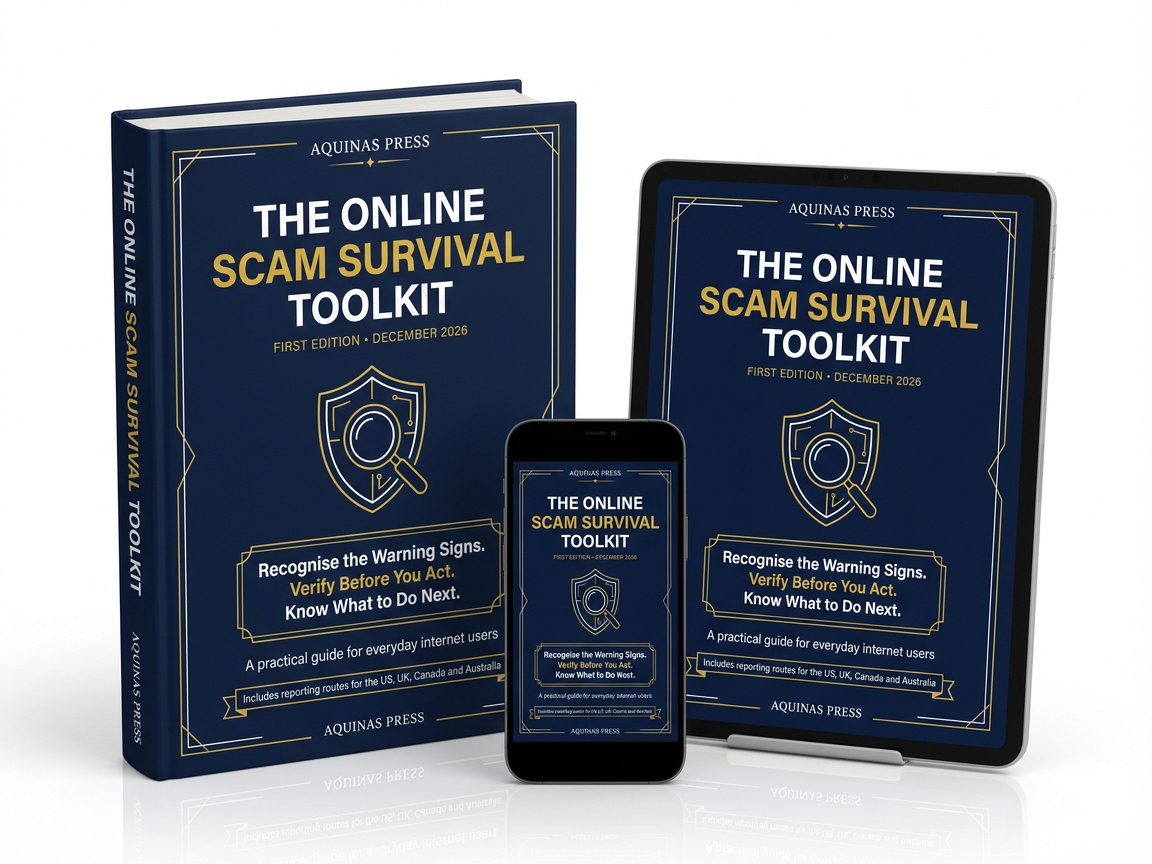
The Online Scam Survival Toolkit: A Practical Guide to Scam Prevention, Detection and Recovery
The Online Scam Survival Toolkit
Recognise the Warning Signs. Verify Before You Act. Know What to Do Next.
A practical guide for everyday internet users
The internet makes it easier to shop, find employment, communicate and manage everyday activities. But it also gives scammers more opportunities to impersonate trusted organisations, advertise fake jobs, promote fraudulent investments and send convincing messages designed to make people act without checking.
Sometimes the warning signs are obvious. Other times, a message looks professional, an offer seems believable or the person contacting you sounds familiar.
The important question is not simply whether something looks genuine. It is whether you have independently verified it before acting.
The Online Scam Survival Toolkit gives you a practical way to approach that decision.
What you will learn
This guide explores five common scam situations:
- Investment offers and giveaways: Recognise unrealistic returns, fake investment platforms, withdrawal-fee demands and suspicious prize offers.
- Impersonation and voice cloning: Understand how scammers imitate relatives, banks, government agencies and trusted organisations, including the use of AI voice-imitation technology.
- Job and recruitment offers: Identify suspicious remote-work opportunities, fake recruiters, advance-fee requests and attempts to misuse your personal information.
- Online shopping and marketplaces: Learn what to check before buying from an unfamiliar seller or responding to an attractive online offer.
- Phishing, delivery and payment alerts: Understand how unexpected messages and payment requests can be used to obtain personal information or money.
A practical method you can use
The guide introduces CLEAR, an original five-step educational framework:
- C — Check the claim.
- L — Look it up yourself.
- E — Examine the evidence.
- A — Assess the pressure.
- R — Respond safely.
Instead of relying on appearances, you learn to pause, investigate independently and make a more informed decision.
If something has already gone wrong
Not every reader will be checking a suspicious message before acting. Some may already have sent money, shared personal information or lost access to an account.
The guide explains practical next steps, including contacting the relevant bank or service through a trusted route, securing affected accounts, preserving evidence, documenting incidents and reporting what happened.
It also highlights the risk of follow-up recovery scams targeting people who have already lost money.
Reporting information for four countries
The guide includes reporting routes and relevant support organisations for:
- United States
- United Kingdom
- Canada
- Australia
It explains what selected reporting services do and some of their limitations. It also provides general direction for readers elsewhere.
Practical worksheets included
Your purchase includes four printable and fillable worksheets:
- Combined 60-Second & Message Check — a quick way to assess suspicious messages and requests.
- Shopping & Seller Check Sheet — a practical checklist for checking sellers and online purchases.
- Family Safety Checklist — a shared family plan for safer digital decisions.
- Incident Record Log — a place to document events, evidence, actions and reporting references.
You can print the sheets or type into supported PDF fields. Compatibility depends on the PDF reader being used.
Who is this guide for?
This toolkit is suitable for everyday internet users who:
- Shop through websites, social media and online marketplaces.
- Search for remote jobs and other online opportunities.
- Receive unexpected payment requests, delivery alerts and account notifications.
- Want to understand investment and giveaway warning signs.
- Help relatives or friends make safer digital decisions.
- Want practical guidance on what to do after a suspected scam.
You do not need technical or cybersecurity experience to use it.
What you receive
- One downloadable PDF ebook.
- 23 pages of educational guidance and practical resources.
- Five core scam scenarios.
- The original CLEAR verification framework.
- Guidance on responding to suspected scams.
- Reporting information covering four countries.
- Four printable and fillable worksheets.
Format: Digital PDF
Publisher: Aquinas Press
Edition: First Edition — November 2026
A note about this guide
This publication is for general educational purposes. It is not legal, financial, investment or professional advice. CLEAR is an educational method, not an official certification or a guarantee of protection. No guide can identify every scam or guarantee that money will be recovered.
Reporting services, contact details and procedures can change. Check the current official information before acting.
Make your next online decision a more informed one.
You do not need to become a cybersecurity expert to develop safer online habits.
Start with a pause. Check independently. Understand your options before you act.
Get your copy of The Online Scam Survival Toolkit today.
Published by Aquinas Press.