



Message To Humanity Audio
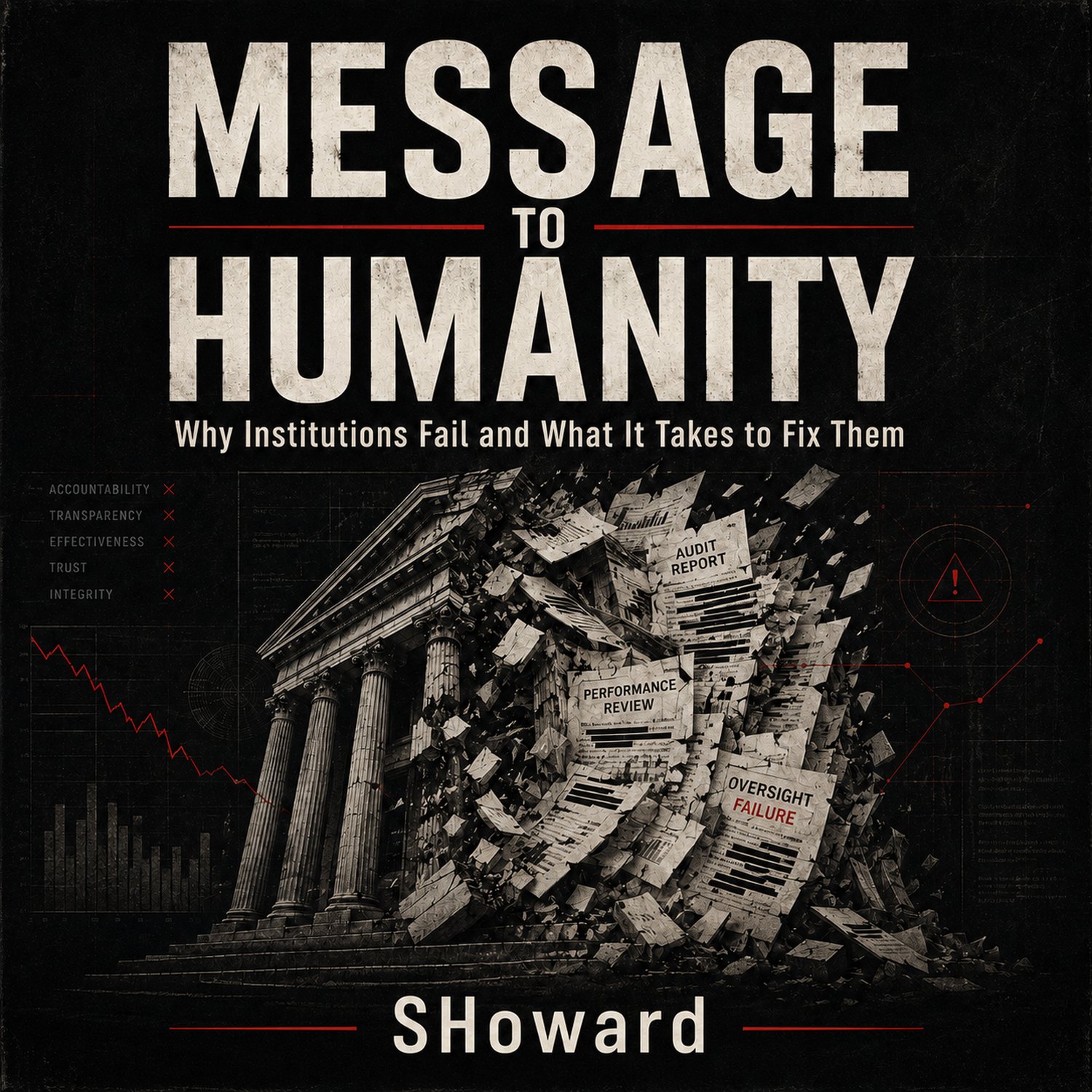
**MESSAGE TO HUMANITY**
**Why Institutions Fail and What It Takes to Fix Them**
**We do not rise to the level of our ideals. We fall to the level of our systems.**
This is not a book about bad people or good intentions. It is a structural diagnosis of why institutions produce the opposite of what they publicly claim — and why that outcome is the predictable output of their design, not a failure of character.
The mechanism is consistent across aviation, pharmaceuticals, spaceflight, banking, criminal justice, healthcare allocation, and AI deployment:
- Declared purpose
- Proxy metric that diverges from it
- Incentives aligned around the proxy
- Warning signals processed without overriding the objective function
- Drift normalized
- Harm scaled
**Boeing 737 MAX** produced two crashes and 346 deaths inside a certification structure that honored a no-new-simulator-training commercial commitment over independent safety review.
**Purdue Pharma** sustained aggressive opioid volume incentives through a 2007 federal conviction and Corporate Integrity Agreement, then continued the same logic until a second federal resolution in 2020.
**NASA Challenger** reversed an engineering recommendation against launch in one teleconference because the burden of proof had been inverted: safety had to prove impossibility rather than management proving safety.
**Wells Fargo** generated 3.5 million potentially unauthorized accounts because product count was the operational objective and customer need was rhetorical.
**COMPAS, Optum, and Meta** demonstrate the same proxy failure now automated and scaled: contested fairness definitions rendered technical, cost standing in for clinical need, engagement standing in for connection.
The aligned cases — **AlphaFold**, **IDx-DR**, and **GraphCast** — prove the inverse. When the target is tighter, validation is external, uncertainty is legible, and correction loops run faster than harm can scale, the machine produces what it claims.
**The three redesign moves** that reverse the pattern are not slogans. They are extracted directly from the cases:
1. Invert the core metrics — replace the convenient proxy with something closer to the declared purpose.
2. Raise the cost of drift — make normalization expensive at the point where it begins, not after catastrophe.
3. Shorten the feedback loops — build correction into the operating rhythm so the system cannot outrun its own signals.
**Appendix C** gives you the four-question Operational Test you can apply to any system before deployment, renewal, or defense.
**Who this book is for**
Leaders who want to stop being surprised by outcomes their systems were designed to produce.
Regulators who want to move from after-the-fact punishment to structural prevention.
Builders and technologists who want to wire alignment into the objective function instead of bolting it on later.
Anyone who has watched institutions absorb scandal, fines, and reform without changing what they actually reward.
**What you receive**
- The complete 13-chapter analysis with primary-source citations (DOJ statements, accident reports, Board investigations, FDA De Novo materials, congressional records).
- Mechanism maps for every major case.
- The Operational Test and Objection Reference appendices.
- Secondary case studies (Volkswagen defeat device, 2008 credit rating agencies, No Child Left Behind, Amazon recruiting tool).
- EPUB and PDF formats for immediate use.
**The primary threat to institutional stability is no longer incompetence alone.**
It is architectural failure.
A system that rewards concealment will produce concealment at scale.
A system that punishes truth-telling will lose access to the signals required for survival.
A system organized around preserving appearances will sacrifice legitimacy to protect the appearance.
Pressure does not create character in institutions.
Pressure reveals design.
The world is entering an era defined by AI acceleration, institutional distrust, information warfare, governance instability, narrative fragmentation, economic pressure, psychological exhaustion, and hyper-scaled perception systems. Most leadership models were built for a slower environment. Most institutions are still reacting to symptoms instead of redesigning the architecture that generates them. That gap will define the next decade.
Human beings often assume collapse arrives dramatically.
It usually arrives administratively — incentive by incentive, compromise by compromise, exception by exception — until the institution no longer remembers what it was built to protect.
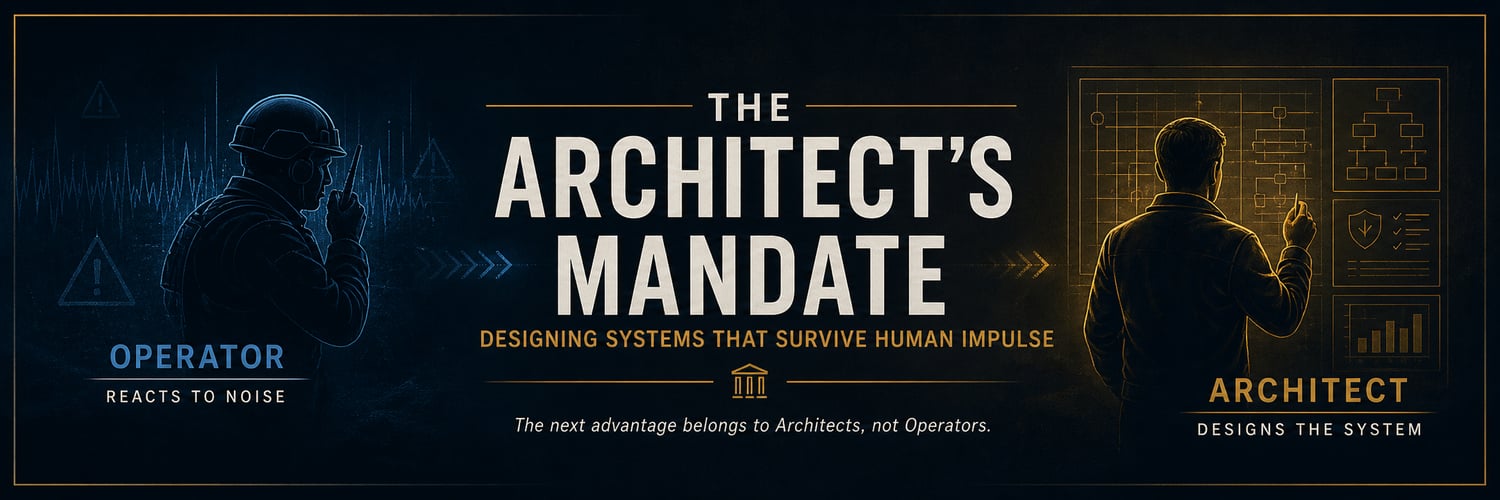
That is why architecture matters.
Not because systems are perfect.
Because humans are not.
**Buy MESSAGE TO HUMANITY now on Payhip.**
Read it. Apply the test. Redesign what you control.