
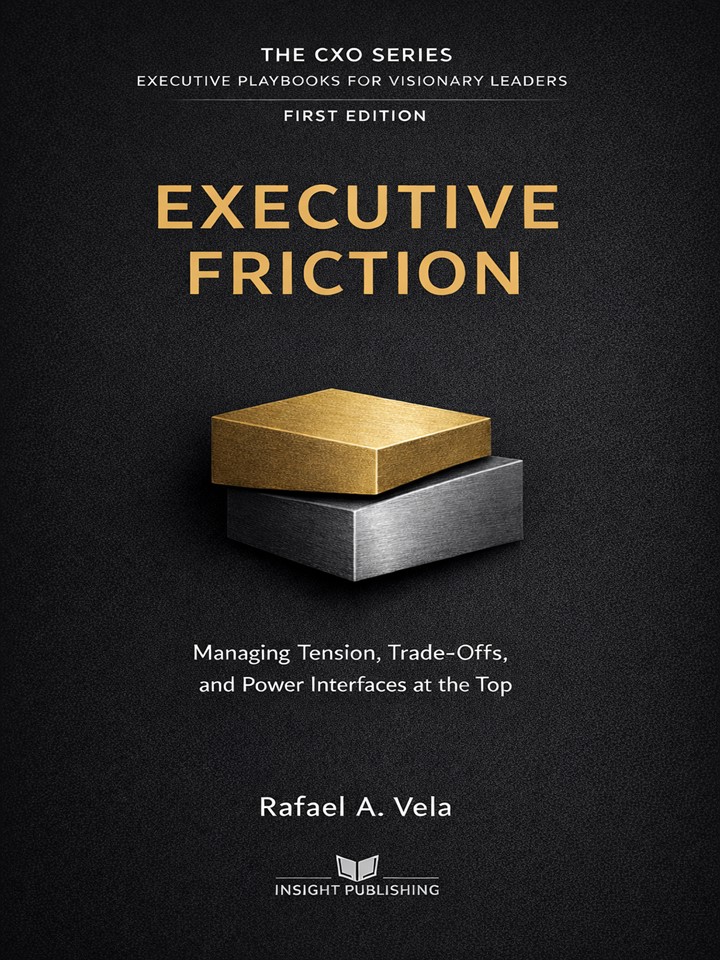
Executive Friction - Managing Tension, Trade-Offs, and Power Interfaces at the Top
At the executive level, breakdowns rarely come from lack of intelligence or experience. They come from friction.
Not operational friction. Executive friction. The tension created by authority, accountability, power, and unavoidable trade-offs at the top of the organization.
This book examines how those forces quietly distort judgment, slow decisions, and weaken execution in otherwise strong enterprises.
It helps senior leaders recognize the difference between productive and destructive tension, navigate power interfaces without escalation or paralysis, and make trade-offs explicit instead of allowing them to erode trust and momentum. The objective is not harmony. It is disciplined leadership under pressure.
Written for CEOs, COOs, CFOs, CIOs, board-level leaders, and executives operating in complex, high-stakes environments, this book speaks directly to those whose decisions carry consequence.
There is no motivational language and no generic leadership models. Only clear executive logic, judgment-driven analysis, and a realistic treatment of how authority and power actually operate at the top.
EXECUTIVE FRICTION is part of the CXO Series, a collection of executive literature focused on judgment, authority, risk, and decision architecture.
Strong organizations do not eliminate friction. They learn to manage it.
TABLE OF CONTENTS
Part I — Understanding Executive Friction
Chapter 1 — Friction Is Not Dysfunction. It Is Energy - 17
· Why alignment without tension is an illusion - 17
· The difference between productive and destructive friction - 19
· Why eliminating friction weakens execution - 20
Chapter 2 — Where Friction Really Comes From - 23
· Structural overlap, not personality conflict - 23
· Competing mandates and incompatible success metrics - 25
· Why friction increases as organizations mature - 27
Chapter 3 — The Cost of Unmanaged Executive Tension - 31
· How friction turns into delay, dilution, and silent resistance - 31
· Decision paralysis disguised as consensus - 33
· Why organizations stall without open conflict - 34
Part II — Power Interfaces in the C-Suite
Chapter 4 — Authority, Influence, and Informal Power - 39
· Why titles do not determine real power - 39
· How informal veto points emerge - 41
· The danger of invisible authority - 43
Chapter 5 — The Fault Lines Between CXO Roles - 47
· CEO–CFO tension over risk and performance - 47
· COO, CSCO, and the struggle for operational primacy - 48
· CMO ambition versus organizational capacity - 49
Chapter 6 — When Incentives Pull the C-Suite Apart - 51
· How well-designed incentives create misalignment - 51
· Local optimization at the executive level - 53
· Why friction often reflects rational behavior - 54
Part III — Governing Trade-Offs and Tension
Chapter 7 — Trade-Offs Are the Executive’s True Work - 59
· Why strategy is the discipline of choosing loss - 59
· How unresolved trade-offs fuel ongoing conflict - 61
· Making trade-offs explicit before they become political - 63
Chapter 8 — Decision Rights as Friction Regulators - 67
· How unclear authority amplifies tension - 67
· Designing clean decision boundaries - 69
· Why shared ownership often increases conflict - 71
Chapter 9 — Escalation Without Erosion - 73
· When escalation protects the enterprise - 73
· When it undermines executive trust - 75
· Designing escalation paths that preserve authority - 77
Part IV — Turning Friction into Execution Power
Chapter 10 — Governing Without Forcing Alignment - 81
· Why forced alignment creates compliance, not commitment - 81
· Creating space for disagreement without fragmentation - 83
· Maintaining unity of action amid divergence of views - 85
Chapter 11 — Signals, Silence, and Executive Behavior - 89
· What executives signal when they avoid tension - 89
· How silence becomes a strategic act - 91
· Why unresolved friction always leaks into the organization - 93
Chapter 12 — Building a Resilient Executive System - 97
· Embedding healthy friction into governance routines - 97
· Designing leadership teams that withstand pressure - 100
· Why strong organizations institutionalize tension rather than suppress it - 101
Conclusion — Friction as Executive Stewardship - 107
· Appendix A: Executive Friction Diagnostic - 110
· Appendix B: CXO Interface Map - 116
. Appendix C: Executive Trade-Off Governance Checklist - 123