
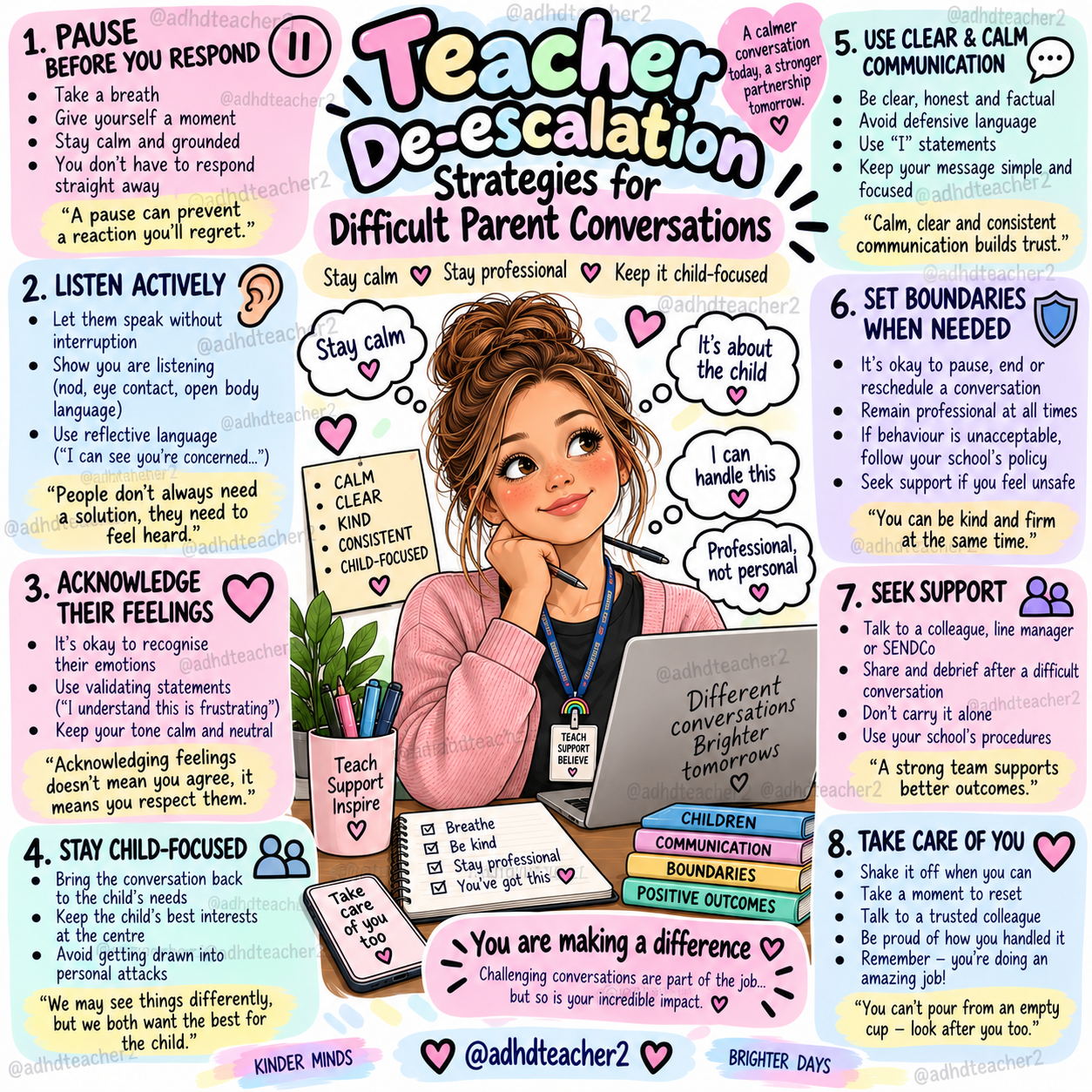
De-escalating Parents
💗 Teacher De-escalation Strategies for Difficult Parent Conversations
Because sometimes the person you need to de-escalate isn’t a child… it’s an adult. 😅
Difficult conversations with parents and carers can be one of the most challenging parts of working in education. When someone is upset, frustrated or angry, it can be hard to know what to say, how to respond and when to set a boundary — especially when you’re trying to remain professional.
This printable Teacher De-escalation Guide is designed to give education staff quick, practical reminders for handling challenging parent conversations with confidence, empathy and professionalism.
🌈 The guide covers:
💗 Pause Before You Respond — regulate yourself before reacting
👂 Listen Actively — help someone feel heard without immediately trying to solve everything
💬 Acknowledge Their Feelings — validate emotions without necessarily agreeing
🧒 Stay Child-Focused — bring the conversation back to the child’s needs
🗣️ Use Clear & Calm Communication — simple, factual and professional language
🛡️ Set Boundaries When Needed — being compassionate doesn’t mean accepting unacceptable behaviour
🤝 Seek Support — know when to involve colleagues or school leadership
☕ Take Care of You — difficult conversations can affect us too
✨ Perfect for:
Teachers • Teaching Assistants • SEN/SEND staff • ECTs • Pastoral teams • SENCOs • Support staff • School leaders • Education professionals
Print it for your staffroom, classroom, office or teacher planner, or keep a digital copy somewhere accessible for a quick reminder before a challenging meeting or phone call.
💬 One important reminder:
You can acknowledge someone’s feelings without agreeing with everything they’re saying.
You can be empathetic and have boundaries.
You can be kind and firm.
And when conversations become inappropriate or you feel unsafe, follow your setting’s policies and seek support.
Ultimately, the aim isn’t to win a difficult conversation. It’s to lower the temperature, protect professional boundaries and bring the focus back to what everyone hopefully has in common:
Supporting the child. 💗
Created by @adhdteacher2
Digital download only — no physical product will be shipped.
This resource provides general educational guidance. Always follow your school or organisation’s safeguarding, communication and behaviour policies.