
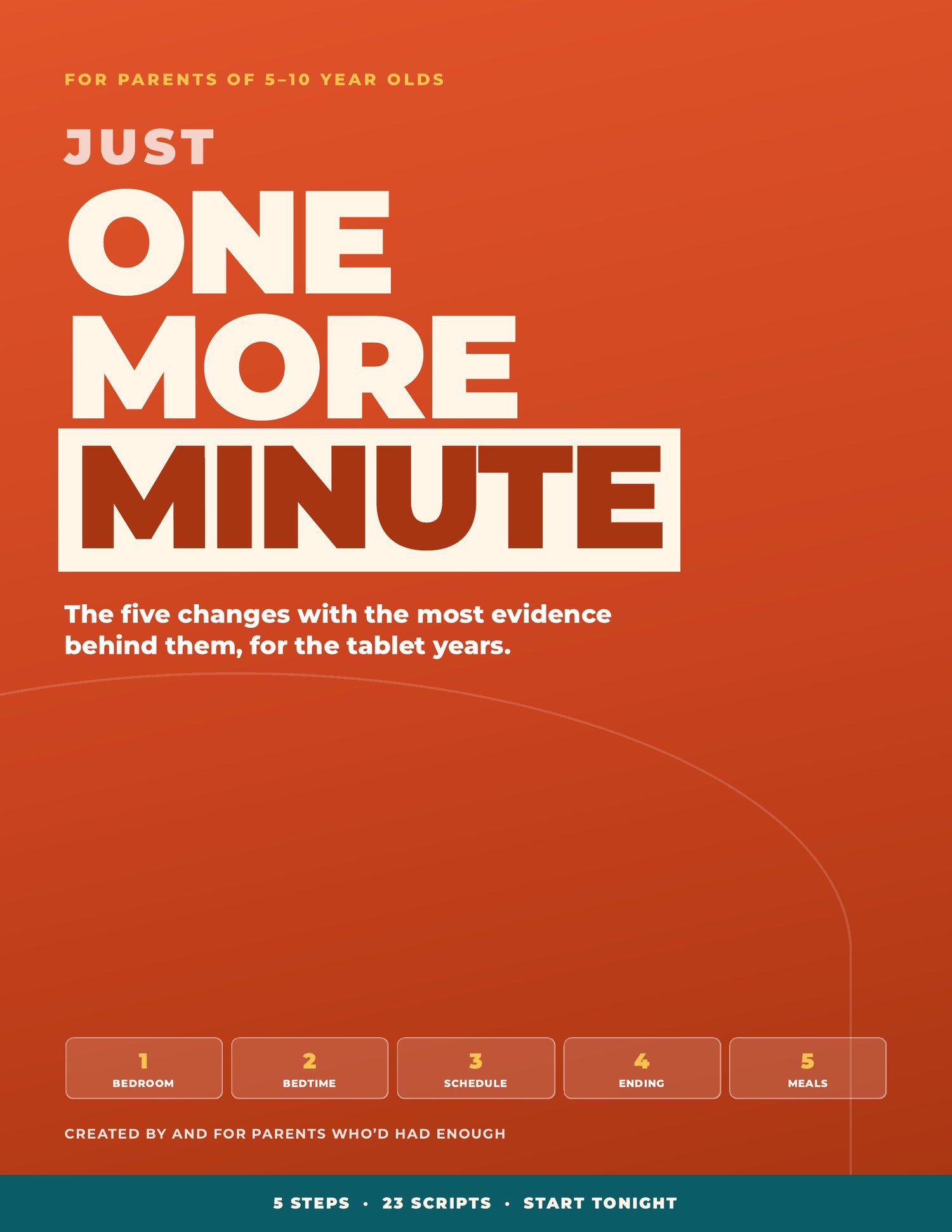
Just One More Minute
For parents of 5–10 year olds. The tablet years.
Every parenting book tells you to give a two-minute warning before screen time ends.
University of Washington researchers logged every screen transition across 28 families for two weeks. The two-minute warning was associated with worse transitions, not better. In the lead researcher's words: "every way we sliced it, the two-minute warning made it worse." Things went best when the content itself ended — the episode finished, the level was done.
That's one of five steps, and it's the kind of thing this book is built on: what has actually been measured, ranked by how much it moves.
The five steps
- The tablet sleeps outside the bedroom
- Screens stop an hour before bed — that hour matters more than the daily total
- Set times, never on request — this is the one that ends the asking
- End at a natural stopping point — and drop the two-minute warning
- No screens at the table
The anchor is a 2025 meta-analysis of 41 randomized controlled trials covering 14,514 children. Inside it, the programs that went straight at screen time performed far better than the ones that folded it into general health advice.
It also tells you what it left out. "Model it yourself, put your own phone down" is in every parenting guide. For this age the evidence is thinner than you'd expect, and the book says so on page 3 rather than quietly including it anyway.
23 scripts for the "just one more minute" fight — the meltdown, the public meltdown, the sibling who starts too, and the night you're about to cave.
16 pages · 5 steps · 23 scripts · ten minutes to learn.
If it isn't useful, reply to your receipt within 30 days for a full refund.
Educational only. Not medical or psychological advice.