
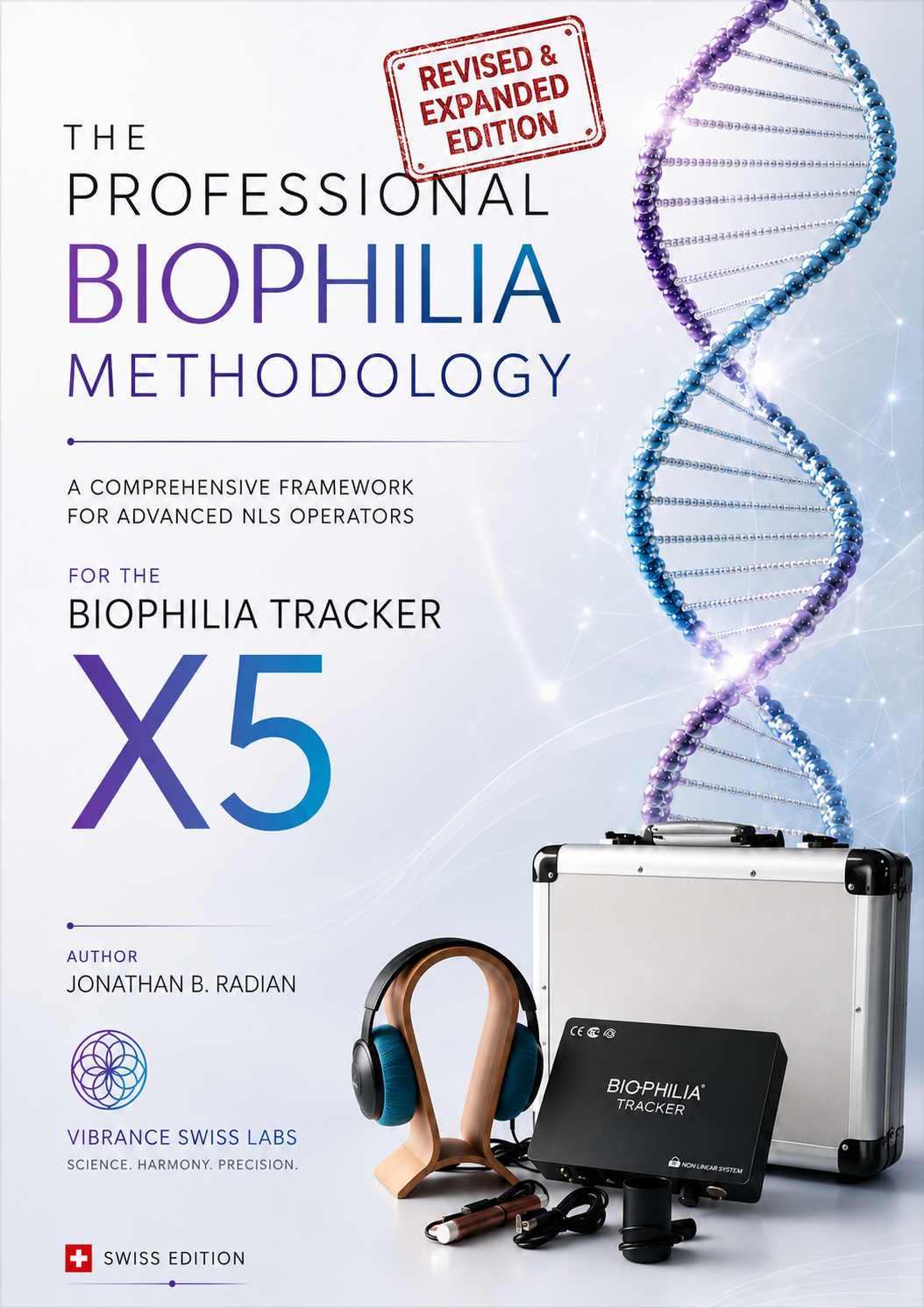
The Professional Biophilia Tracker Ultra X5 Methodology
The Professional Biophilia Methodology
A Comprehensive Framework for Advanced NLS Operators
Revised and Extended Edition
ERRATUM
Clarification Regarding Chapter Numbering
During the final editing, restructuring, and layout of this revised edition, several sections originally intended as separate chapters were incorporated into adjacent chapters. Although their complete content remains present in the book, the corresponding chapter numbers were inadvertently omitted during the editorial process.
As a result, the visible numbering moves from Chapter 27 to Chapter 31. A similar editorial omission occurs before the section entitled “Radionics,” beginning on page 156, where the Chapter 35 designation does not appear before the numbering resumes with Chapter 36.
No chapters, pages, illustrations, or analytical material are missing. The apparent gaps concern chapter numbering only; all intended content has been retained and appears in its correct reading order within the book.
This editorial oversight does not affect the continuity, methodology, or substance of the publication. The chapter numbering will be corrected in the next revised edition.
The Author
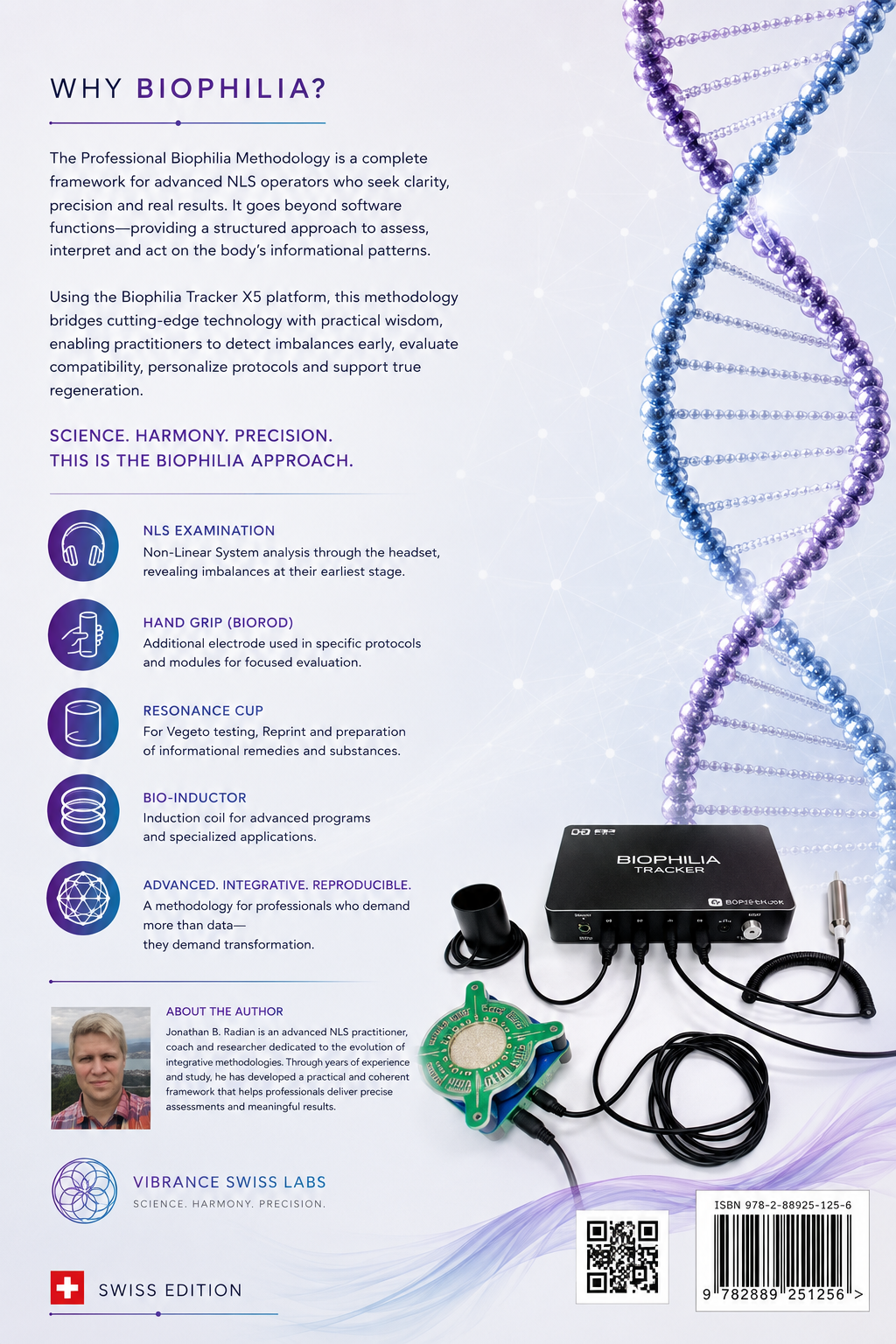
The Professional Biophilia Methodology is not a conventional software manual, and it was never intended to be one.
This revised and extended edition was written for practitioners who want to understand the logic behind the Biophilia Tracker X5, not simply learn where functions are located or how to move from one screen to another. Its real subject is the analytical process itself: how information is gathered, how different findings are compared, how patterns begin to emerge, and how professional judgement develops when the practitioner stops looking for isolated answers and begins to understand relationships.
The book starts from the foundations of the method and gradually builds toward complete practical use. It explores biological information, resonance, systems biology and the idea of the human organism as an interconnected network, then moves into the practical environment of the Biophilia platform: preparing the workstation, preparing the patient, creating the first record and performing a Research Session under consistent conditions.
From there, the reader is guided into the analytical core of the system.
The TEST module is examined in detail, together with the different Etalon libraries and the reasoning behind their use. The book explains how to work with Anatomy, Organopreparations, Pathomorphology, Microorganisms, vitamins, minerals, heavy metals and other reference libraries without turning the examination into an indiscriminate search through hundreds of entries.
Particular attention is given to one of the central ideas of the methodology: analytical convergence.
A single unusual coefficient may be interesting, but it is rarely enough to justify an interpretation. Greater confidence begins to develop when several independent analytical pathways repeatedly point toward the same functional direction. The graphical presentation, coefficients, Virtual Testing, Entropy Analysis, Organopreparations and other reference libraries are therefore not treated as isolated sources of information, but as different perspectives that may gradually support, challenge or refine the same working hypothesis.
The revised edition develops this approach through practical examples and worked cases, showing how an experienced practitioner may move from a broad Research Session toward a more focused examination of selected organs and systems. Instead of beginning with a diagnosis in mind, the practitioner learns to follow the information carefully, compare findings, recognise repeated tendencies and decide what deserves closer investigation.
The book also provides a detailed discussion of Entropy Analysis, Auto Model, Auto Scan and Comparative Analysis, explaining not only how these functions are used, but where they belong within the analytical sequence and what their limitations are. Comparative Analysis is explored as a way of following the same patient and the same structures over time, allowing the practitioner to observe direction rather than relying on a single snapshot.
Only after the analytical picture has been allowed to develop does the book move into Meta-Therapy. Here again, the emphasis remains on methodology rather than automation: therapy should emerge from a coherent examination, not from one attractive Etalon or one isolated software suggestion. The reader is taken through the logic of constructing a Meta-Therapy session and through the practical sequence of applying it within the Biophilia workflow.
Several later chapters broaden the discussion into the historical and complementary disciplines that have influenced informational practice, including Radiesthesia, Radionics and the Tesla Oscillator. These subjects are presented within their methodological and historical context, with clear distinctions between analytical practice, complementary theory and established medical science.
Professional communication is treated with equal importance. The book addresses reporting, documentation, ethics, patient communication and the responsibility of presenting findings clearly without confusing informational analysis with medical diagnosis.
By the final chapters, the individual components are brought together into a complete professional workflow: preparation, Research, NLS Analysis, TEST, Virtual Testing, Entropy Analysis, Auto Model, Comparative Analysis, Meta-Therapy, documentation and follow-up.
The result is a book intended to help practitioners become more structured, more consistent and more thoughtful in the way they work.
It is particularly suited to Biophilia Tracker X5 users who already own the system and feel that the official training material explains the functions but does not fully explain the reasoning behind them. It will also be valuable to experienced NLS and bioresonance practitioners who want to refine their analytical method, as well as to integrative practitioners interested in understanding how nonlinear informational systems may be approached within a broader professional framework.
Readers should not expect a catalogue of diagnoses or a collection of rigid protocols. The purpose of this work is different.
It is to teach a way of thinking.
By the end of the book, the reader should have a much clearer understanding of how to approach a Research Session from beginning to end, how to decide which findings deserve attention, how to compare different analytical modules, how to recognise meaningful repetition, how to avoid premature conclusions and how to build an interpretation that can be explained, documented and revisited over time.
The software remains important, but throughout this book it is never treated as the final authority.
The practitioner remains responsible for the reasoning.
That is the central idea behind The Professional Biophilia Methodology.
Digital Product & Refund Policy
The Professional Biophilia Methodology – Revised and Extended Edition is supplied as a digital product and is made available for access/download immediately after successful payment.
Because digital content cannot be physically returned once access has been granted or the file has been downloaded, all purchases are considered final and non-refundable, except where a refund is required by applicable consumer law.
Please review the book description, intended audience and product information carefully before completing your purchase. By purchasing this digital edition, you acknowledge that you are purchasing electronic content rather than a printed book and agree to the terms applicable to its immediate digital delivery.
Refunds will not normally be provided because of a change of mind, accidental purchase, failure to read the product description, incompatibility with personal expectations, or because the purchaser decides that the material is no longer required.
If a genuine technical problem prevents you from accessing or downloading the purchased file, please contact us so that we can assist you in obtaining the product you purchased.
Copyright & Personal Use
Your purchase provides a personal, non-transferable licence to access and use the digital book.
The book may not be resold, redistributed, shared publicly, uploaded to file-sharing platforms, reproduced for commercial purposes, or supplied to third parties without the author's prior written permission.
All text, illustrations, methodology and original material remain protected by applicable copyright and intellectual property law.
By completing your purchase, you confirm that you have read and accepted this Digital Product & Refund Policy.
© 2026 Jonathan B. Radian. All rights reserved.