Random Forest Intelligence Lab
RANDOM FOREST INTELLIGENCE LAB
Master Hotel Occupancy Forecasting with Machine Learning
Turn Hotel Data into Forecasts. Turn Forecasts into Better Business Conversations.
Learn how to use Random Forest concepts to forecast hotel occupancy, evaluate prediction accuracy, and communicate analytical insights in a way hotel managers can understand and use.
The Random Forest Intelligence Lab is an interactive, browser-based learning experience designed for hospitality professionals, aspiring hotel analysts, revenue management teams, and students who want to build practical forecasting skills.
Go beyond theory. Explore an interactive forecasting environment, test your understanding, measure prediction errors, and practice presenting your findings with confidence.
Learn the workflow. Understand the numbers. Explain the results.
GET INSTANT ACCESS TO THE INTELLIGENCE LAB
Interactive learning · Practical exercises · Downloadable resources
Forecast Hotel Occupancy with Greater Analytical Confidence
Hotel occupancy forecasting is about more than predicting how many rooms will be occupied. It is about understanding patterns, evaluating uncertainty, and translating information into meaningful operational insights.
This learning lab introduces you to the Random Forest approach and shows you how to explore the factors that can influence hotel occupancy forecasts.
What You Will Learn
Understand Random Forest Forecasting
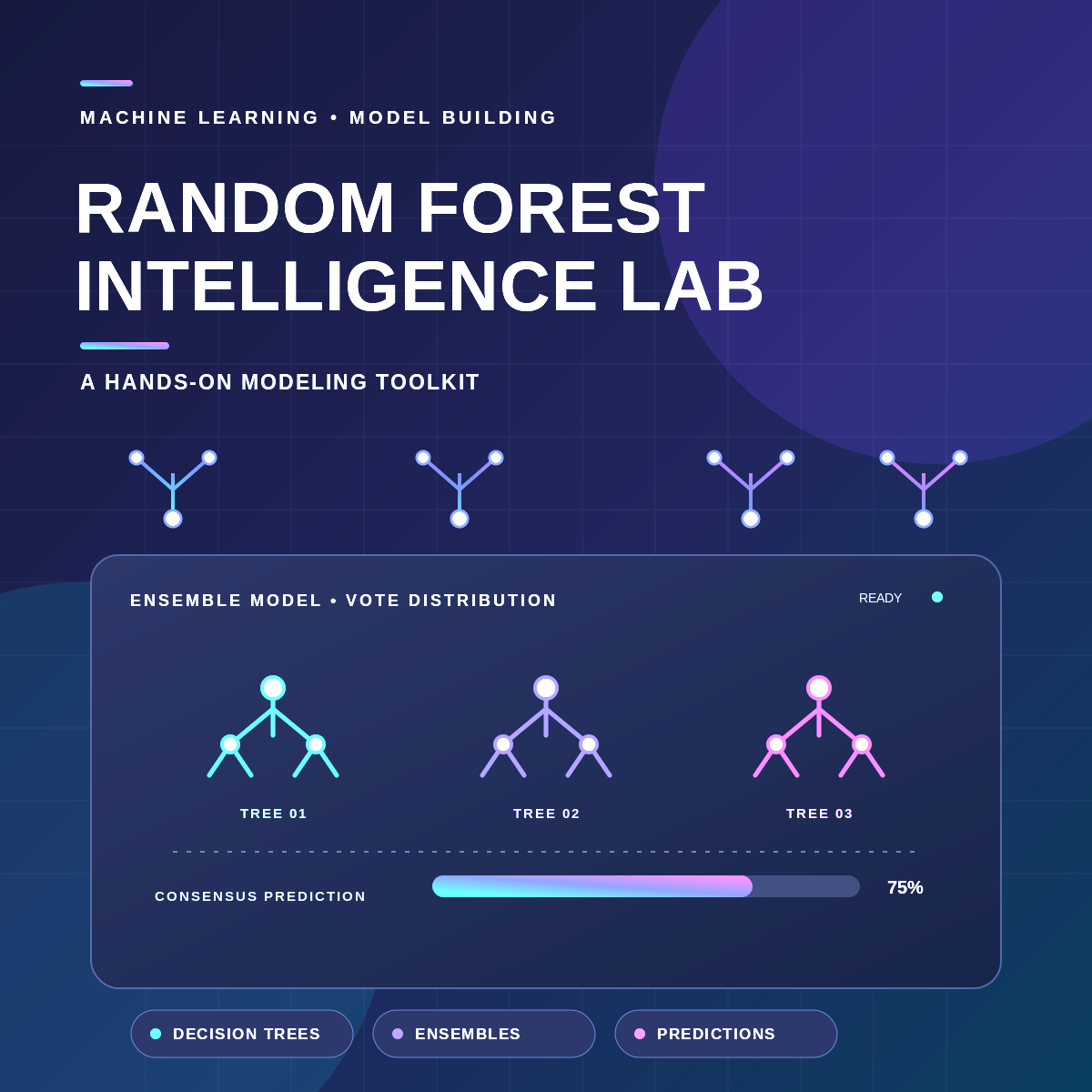
Discover how an ensemble of decision trees can work together to produce predictions, and understand the principles behind this widely used machine-learning technique.
Explore Hotel Demand Patterns
Learn how historical occupancy, booking pace, cancellations, seasonality, and events can contribute to a forecasting workflow.
Measure Forecast Accuracy
Compare predictions with actual outcomes and learn to interpret Mean Absolute Error (MAE) and Root Mean Squared Error (RMSE).
Recognize Common Modeling Mistakes
Understand overfitting, data leakage, and misleading performance results so you can evaluate forecasts more critically.
Communicate Insights to Hotel Leadership
Practice explaining forecast results, uncertainty, and operational implications in clear business language.
Your Complete Hotel Forecasting Learning Toolkit
This is more than a collection of lessons. It brings together interactive learning, practical exercises, downloadable resources, and presentation materials in one educational package.
1. Interactive Browser-Based Course
Work through structured lessons at your own pace. Explore forecasting concepts, complete quizzes, and track your learning progress.
2. Hotel Occupancy Simulator
Experiment with forecasting concepts using synthetic teaching data. Explore how the inputs and assumptions in a model can influence the results.
3. Interactive Forecasting Spreadsheet
Practice with a spreadsheet that includes:
- A night-by-night occupancy calculator.
- A booking-pace calendar.
- An experiment log for recording and comparing forecasting exercises.
4. Printable Forecasting Cheat Sheets
Keep essential concepts and forecasting evaluation reminders close at hand as you work through the material.
5. General Manager Presentation Kit
Use editable briefing templates to practice communicating occupancy forecasts, performance indicators, and analytical findings to hotel leadership.
6. Interview and Career Preparation Pack
Prepare for hospitality analytics opportunities with practice questions, résumé prompts, and a portfolio checklist.
7. A Practical 30-Day Action Plan
Follow a structured plan designed to help you move from your first forecasting exercise toward a scored presentation of your analytical work.
Designed for Hospitality Professionals and Aspiring Analysts
The Random Forest Intelligence Lab is particularly useful for:
Hotel Revenue Management Professionals
Develop a stronger understanding of forecasting methods and how to discuss model performance with colleagues and management.
Hotel Operations Managers
Build familiarity with occupancy forecasting concepts and the analytical information that can support operational planning.
Aspiring Hotel Data Analysts
Develop practical knowledge of a machine-learning workflow and create materials to help demonstrate your learning.
Hospitality Students and Recent Graduates
Bridge the gap between machine-learning theory and hospitality-focused analytical exercises.
Professionals Preparing for Analytics Interviews
Practice explaining forecasting methods, evaluating model performance, and presenting analytical findings in a business context.
No matter where you are starting, the objective is to build a clearer understanding of how forecasting works and how to communicate its results responsibly.
Learn at Your Own Pace. Practice as You Go.
Getting started is straightforward.
Step 1 — Access the Lab
Open the course in your browser. No software installation is required for the browser-based learning experience.
Step 2 — Explore the Concepts
Work through the lessons and learn the fundamentals of Random Forest forecasting, hotel demand patterns, and model evaluation.
Step 3 — Experiment with the Tools
Use the simulator and forecasting spreadsheet to explore examples, record experiments, and compare predictions with outcomes.
Step 4 — Evaluate Your Results
Practice interpreting MAE and RMSE, identifying modeling pitfalls, and thinking critically about forecast reliability.
Step 5 — Present Your Findings
Use the presentation templates and action plan to practice communicating your work in a clear, structured, professional format.
What Makes This Learning Experience Different?
Practical Rather Than Theory-Only
Interactive exercises and supporting tools help you engage with forecasting concepts instead of relying entirely on passive reading.
Focused on the Hotel Industry
The examples center on hotel occupancy and relevant hospitality variables, making the learning experience more relatable to hotel analytics.
Built Around Responsible Forecasting
Learn to evaluate errors, recognize uncertainty, and question results that appear unusually accurate.
Designed for Business Communication
Forecasting skills are more useful when you can explain what the results mean. Presentation templates help you practice communicating your analysis to nontechnical stakeholders.
A Collection of Supporting Resources
Lessons, a simulator, quizzes, a spreadsheet, cheat sheets, presentation templates, and career-preparation materials support different stages of the learning process.
What You Will Have After Completing the Lab
By working through the material, you will have the opportunity to:
- Explain the fundamentals of Random Forest forecasting.
- Explore how hospitality-related variables can inform occupancy predictions.
- Compare forecasts with observed outcomes using common error metrics.
- Recognize important forecasting limitations and potential modeling mistakes.
- Practice communicating analytical results to hotel management.
- Assemble learning materials that can support your professional development and interview preparation.
The aim is not simply to produce a forecast. It is to understand how the forecast was developed, how its performance should be assessed, and how its limitations should be communicated.
Frequently Asked Questions
Do I need to install any software?
No installation is required for the browser-based course. The included spreadsheet requires a compatible spreadsheet application to use its functionality.
Is this suitable for beginners?
The lab is designed as a practical introduction to Random Forest hotel occupancy forecasting. It is suitable for people seeking to develop their understanding of the workflow, although some familiarity with spreadsheets and basic data concepts can be helpful.
Does the product include a trained machine-learning model?
No. This is an educational course and practice toolkit. It does not provide a production-trained forecasting model or a live hotel booking system.
Are the examples based on live hotel data?
The course uses synthetic teaching data for educational purposes. The examples are intended to help you explore concepts, not to represent the actual performance of a specific hotel.
Can I use the forecasts for actual pricing and staffing decisions?
The learning tools are not a substitute for a validated forecasting system. Real operational decisions should be based on appropriate real-world data, proper model validation, and professional judgment.
What resources are included?
The package includes the interactive course, simulator, quizzes, progress tracking, printable forecasting cheat sheets, an occupancy forecasting spreadsheet, a 30-day action plan, a general-manager slide deck kit, and an interview and job-preparation pack.
How do I access the product?
Purchase the digital product through Payhip and access the downloadable course files through the platform's delivery process.
Build Your Hotel Forecasting Skills Today
The ability to interpret data, evaluate predictions, and communicate insights is a valuable skill in modern hospitality.
The Random Forest Intelligence Lab gives you a structured environment to explore these skills through hotel-focused examples and practical learning resources.
Learn the concepts. Experiment with forecasts. Practice evaluating accuracy. Build confidence in presenting your analysis.
Start Your Random Forest Intelligence Lab Today
An interactive introduction to machine learning for hotel occupancy forecasting.
GET INSTANT ACCESS
Digital educational product · Browser-based learning · Downloadable resources
Important Educational Disclaimer
This course uses synthetic data and is intended for educational purposes only. Forecasts are not guarantees and should not be used as the sole basis for real-world pricing, staffing, inventory, or revenue decisions. Validate any forecasting approach with suitable real-world data and professional judgment.