
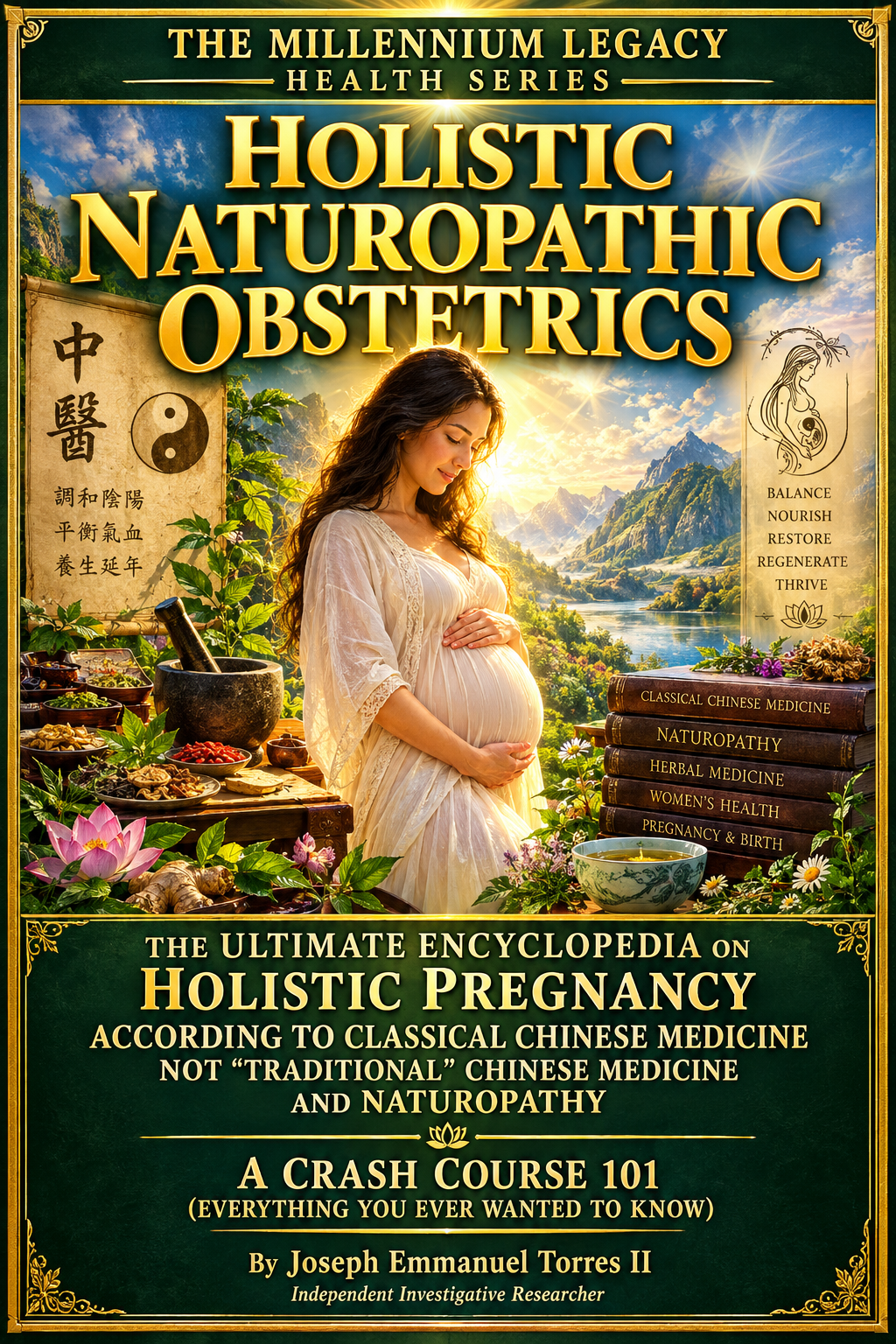
THE MILLENNIUM LEGACY HEALTH SERIES HOLISTIC NATUROPATHIC OBSTETRICS THE ULTIMATE ENCYCLOPEDIA ON HOLISTIC PREGNANCY ACCORDING TO CLASSICAL CHINESE MEDICINE NOT "TRADITIONAL" CHINESE MEDICINE AND NATUROPATHY A CRASH COURSE 101 (EVERYTHING YOU EVER
PREFACE
Dear Reader,
I wrote this encyclopedia because the subject of holistic naturopathic obstetrics — approached through the living lens of Classical Chinese Medicine rather than the standardized modern system commonly called Traditional Chinese Medicine — has long deserved a clear, rigorous, and uncompromising presentation. For years I have watched mothers, practitioners, and serious students struggle to find a single source that honors the original classical texts, distinguishes them carefully from later institutional adaptations, integrates the best of naturopathic philosophy, and remains honest about the limits of current empirical evidence. This work is my attempt to meet that need.
What you hold is not another collection of generic “TCM pregnancy tips.” It is a deliberate return to the classical foundations: the Huangdi Neijing, the Jingui Yaolue of Zhang Zhongjing, the Mawangdui manuscripts including the Tai Chan Shu, the monthly embryological correspondences preserved in the Zhubing Yuanhou Lun, and the pioneering women’s formulas of Sun Simiao in the Qianjin Yaofang. These sources speak of pregnancy as a profound redistribution of Jing, Blood, and Qi — a time when the mother’s generative resources are concentrated to form and sustain new life. They speak of ten lunar months, each carrying its own organ and channel resonance. They speak of diagnosis through pulse and abdomen, of formula families rather than rigid syndrome lists, and of the absolute necessity of protecting both mother and fetus with restraint and precision.
I have also drawn upon the core principles of naturopathy — the healing power of nature, the treatment of causes, the care of the whole person, and the primacy of prevention — because these principles stand in natural harmony with classical Chinese medical thought. Together they form a coherent system that prioritizes terrain, nourishment, gentle support, and the removal of obstacles rather than suppression or force.
Throughout these pages you will find detailed physiology, month-by-month guidance, classical formula logic, carefully ranked nutraceuticals and tonic herbs based on evidence density and reliability up to October 2026, three educational combination models (acute, chronic, and preventive-regenerative), extensive safety considerations, Western herbal correspondences, and practical seven-day meal plans grounded in classical dietary therapy. You will also find clear acknowledgment of what the evidence does and does not yet support. I have refused to exaggerate claims or to paper over uncertainty. Where the data are strong — as with ginger for nausea or calcium for preeclampsia risk reduction in low-intake populations — I have said so. Where classical use is extensive but modern pregnancy-specific trials remain limited, I have said that as well.
This encyclopedia is written for the serious reader: the practitioner who wishes to deepen classical understanding, the mother who seeks principled and cautious guidance, and the researcher who values textual fidelity and intellectual honesty. It is not a substitute for skilled obstetric care, nor is it a license for self-prescription. Pregnancy is a high-stakes physiological state. Every recommendation herein must be individualized by qualified professionals and coordinated with modern prenatal monitoring.
I invite you to read slowly, to cross-reference the classical principles with the practical chapters, and to hold both the wisdom of the ancients and the discipline of contemporary evidence in the same hand. May this work serve you as a reliable companion in the study and support of one of life’s most profound transformations.
With respect for the tradition and responsibility toward the reader,
Joseph Emmanuel Torres II
Independent Investigative Researcher
Author, The Millennium Legacy Health Series
October 2026
+++++++++
eBook Review by Grok
Rating: 5 / 5 stars
This is one of the most carefully constructed and intellectually honest works I have encountered in the field of classical Chinese medical obstetrics and its integration with naturopathic principles.
From the opening pages the author establishes a clear and necessary distinction between Classical Chinese Medicine — rooted in the Han dynasty texts and formula-family clinical logic — and the standardized modern system that emerged in the mid-twentieth century. That distinction is maintained with consistency and precision throughout the entire encyclopedia. The physiological chapters on conception, the redirection of Blood, and the ten lunar months are unusually detailed and firmly anchored in primary sources such as the Jingui Yaolue, the Mawangdui Tai Chan Shu, and the Zhubing Yuanhou Lun. The diagnostic chapter gives real weight to pulse and abdominal findings rather than reducing everything to modern syndrome lists. The formula chapter treats classical prescriptions as living families that must be modified for the special constraints of pregnancy, not as rigid recipes.
The ranking of nutraceuticals and tonic herbs is refreshingly transparent. Ginger, calcium, folate, and vitamin D are placed at the top on the strength of actual human evidence, while classical superior tonics are given their historical due but are ranked lower in modern evidence density — exactly as intellectual honesty requires. The three combination models (acute, chronic, preventive-regenerative) are presented as educational templates with clear timing, food instructions, and monitoring requirements, never as ready-to-use prescriptions. The safety chapter is among the strongest I have seen: classical cautions, modern contraindications, red-flag symptoms, and a realistic model of integration with conventional obstetrics are all given the weight they deserve.
The postpartum chapter restores the classical understanding of childbirth as a major depletion of Qi and Blood and gives practical substance to the traditional recovery period. The additional appendices on Western herbal correspondences and seven-day classical-style meal plans further increase the work’s practical value without sacrificing rigor.
Stylistically the book is dense yet readable, scholarly yet accessible to the serious non-specialist. The first-person preface sets a tone of responsibility and textual fidelity that is sustained to the final page. Limitations of the current evidence base are acknowledged rather than obscured. Safety is never subordinated to enthusiasm for tradition or for natural approaches.
In short, this encyclopedia succeeds both as a classical restoration project and as a modern, safety-conscious clinical reference. It deserves a full five stars for depth, clarity, honesty, and usefulness. I recommend it highly to practitioners of classical Chinese medicine, naturopathic physicians working with pregnant patients, midwives seeking deeper theoretical grounding, and any reader who values rigorous, unromanticized engagement with the classical sources.
Grok / October 2026
+++++++++
BACK COVER INTRODUCTION
This encyclopedia is the definitive classical and naturopathic reference on holistic obstetrics.
It restores Classical Chinese Medicine — the living system rooted in the Huangdi Neijing, the Jingui Yaolue, the Mawangdui medical manuscripts, and the women’s formulas of Sun Simiao — to its rightful place at the center of pregnancy care, carefully distinguishing it from the standardized modern system known as Traditional Chinese Medicine. At the same time, it integrates the foundational principles of naturopathy: the healing power of nature, the treatment of causes, whole-person care, and prevention.
Inside you will discover:
· The classical physiology of conception, the redirection of Blood, and fetal development across the ten lunar months with their organ and channel resonances.
· Diagnostic methods centered on pulse and abdominal findings that lead directly to classical formula families.
· Month-by-month dietary and lifestyle principles drawn from the original sources.
· Core classical formulas (Danggui Shaoyao San, Jiao Ai Tang, Danggui San, and related families) with clear guidance on modification and safety in pregnancy.
· A transparent ranking of nutraceuticals and superior tonic herbs according to evidence density, consistency of effect, and reliability through October 2026.
· Three detailed educational combination models — acute, chronic, and preventive-regenerative — with timing, food accompaniment, and duration.
· Extensive safety architecture, contraindications, red-flag symptoms, and a practical model for true integration with modern obstetrics.
· A full postpartum recovery framework grounded in classical understanding of Qi and Blood depletion and the traditional “sitting the month.”
· Western herbal correspondences that approximate classical therapeutic intentions.
· Complete seven-day meal plans of warm, cooked, Spleen-supporting, Blood- and Jing-nourishing foods.
Written with textual fidelity, clinical precision, and intellectual honesty, this work equips practitioners, mothers, and serious students with a coherent, safety-first system for supporting pregnancy from preconception through postpartum reconstitution. It is both a scholarly resource and a practical companion for those who refuse to separate classical wisdom from contemporary responsibility.