
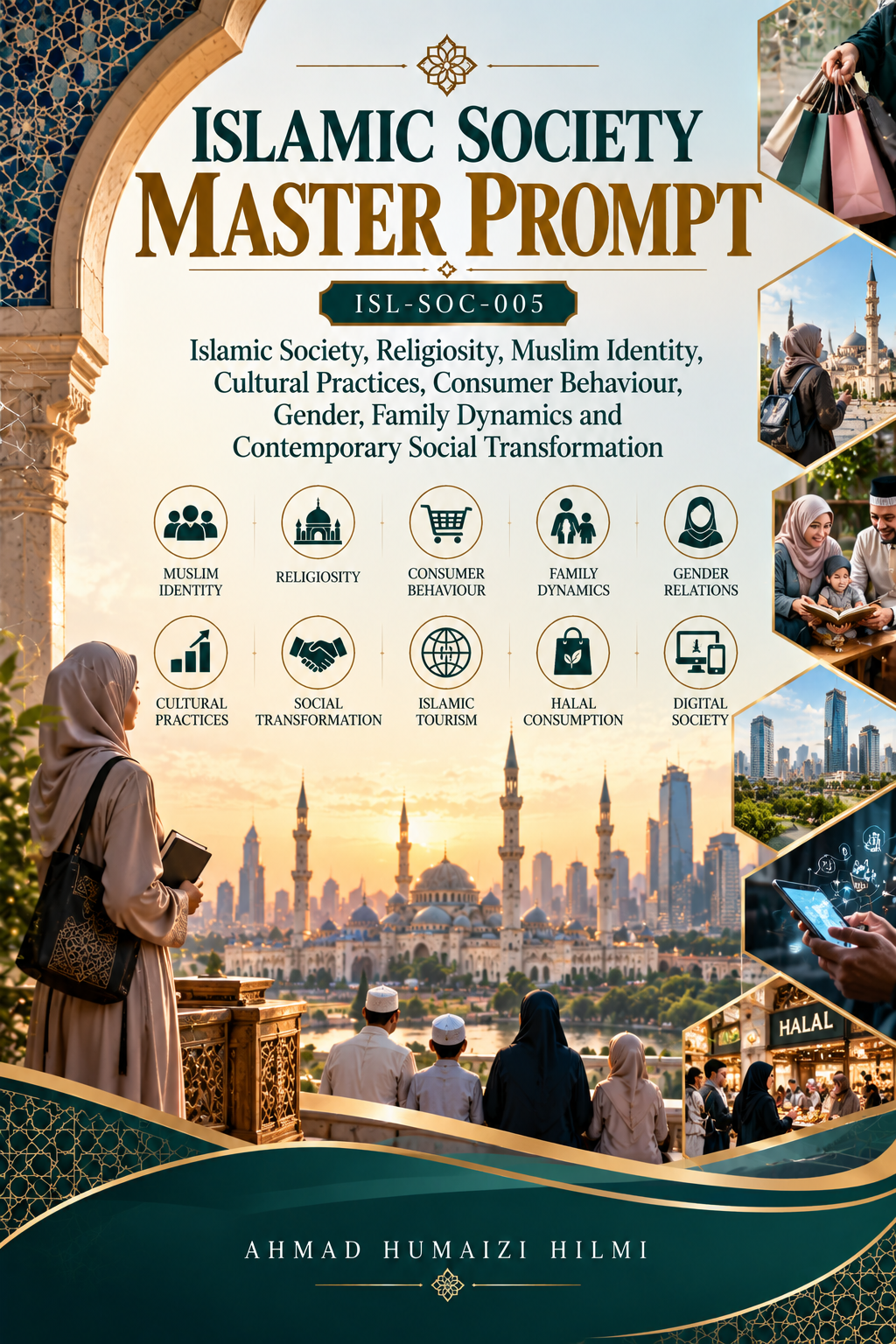
5. ISL-SOC-005 — Islamic Society, Religiosity, Muslim Identity, Cultural Practices, Consumer Behaviour, Gender, Family Dynamics and Contemporary Social Transformation
Description
This Master Prompt provides a comprehensive, systematic, interdisciplinary, and academically rigorous framework for conducting advanced research on Islamic society, Muslim religiosity, religious identity, cultural practices, consumer behaviour, gender relations, family dynamics, and contemporary social transformation. It examines the complex interactions among Islamic beliefs, religious commitments, social institutions, cultural traditions, psychological mechanisms, economic activities, digital environments, and everyday decision-making within diverse Muslim communities. The Master Prompt encompasses lived Islam, religious socialisation, individual and collective identity, cultural adaptation, social norms, halal consumption, Islamic branding, modest fashion, Islamic tourism, ethical purchasing, financial behaviour, entrepreneurship, family businesses, women's economic participation, social inclusion, and community development. It integrates relevant theoretical perspectives, including the Theory of Planned Behaviour, social identity theory, social cognitive theory, consumer behaviour models, religious commitment frameworks, acculturation theory, and other appropriate sociological and psychological approaches. Particular attention is given to the influence of digital media, globalisation, migration, urbanisation, socioeconomic change, generational differences, and institutional structures on Muslim identity and social practices. Researchers are guided through the complete academic research process, including problem identification, critical literature synthesis, theoretical and conceptual framework development, qualitative and quantitative research design, questionnaire development, ethnographic investigation, comparative analysis, measurement validation, statistical modelling, critical interpretation, and evidence-based recommendations. Emphasis is placed on methodological transparency, religious and cultural sensitivity, ethical participant engagement, diversity within Muslim communities, intersectional social analysis, responsible data interpretation, and the development of original, theoretically grounded, empirically defensible contributions to Islamic social research and contemporary Muslim studies.