

Cognitive Diffusion Techniques
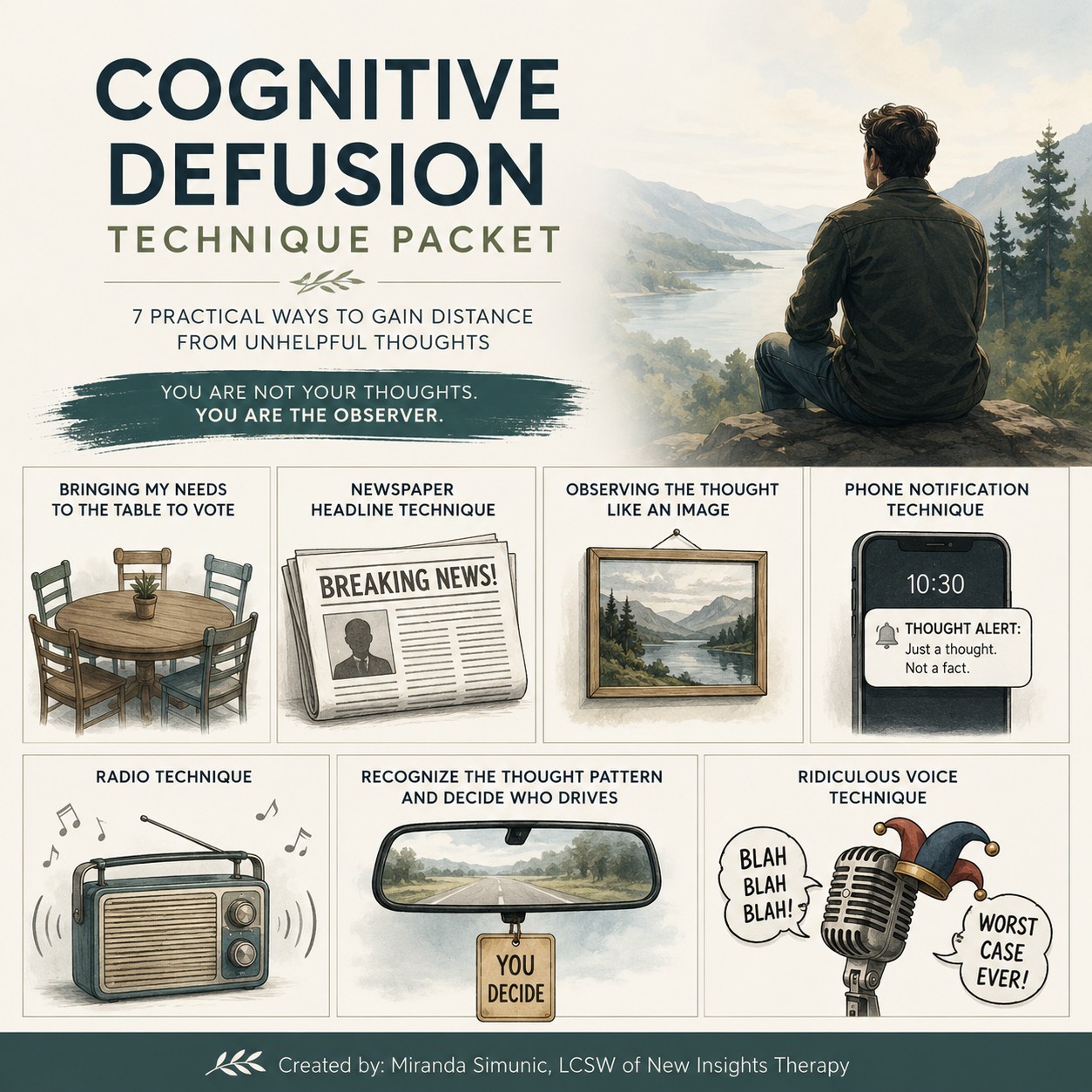
Cognitive Defusion Technique Packet
You are not your thoughts. You are the observer.
Help clients create space between themselves and unhelpful thoughts with this practical Cognitive Defusion Technique Packet.
Instead of trying to argue with, suppress, or eliminate difficult thoughts, these exercises teach clients to notice thoughts as thoughts and choose how they want to respond.
This packet includes 7 creative cognitive defusion techniques:
- Bringing My Needs to the Table to Vote
- Step back from competing thoughts, needs, and emotions and decide which deserve your attention.
- Newspaper Headline Technique
- Turn an overwhelming thought into a headline to create psychological distance.
- Observing the Thought Like an Image
- Practice viewing thoughts as mental images rather than absolute truths.
- Phone Notification Technique
- Imagine difficult thoughts as notifications that can be noticed without immediately being opened.
- Radio Technique
- Learn to recognize the “channel” your mind is broadcasting without feeling obligated to listen.
- Recognize the Thought Pattern & Decide Who Drives
- Identify recurring thought patterns and practice choosing whether to let them steer your behavior.
- Ridiculous Voice Technique
- Use humor and a silly voice to create distance from repetitive or unhelpful thoughts.
This resource can be used with clients experiencing:
- Anxiety and worry
- Overthinking
- Intrusive thoughts
- Self-criticism
- Perfectionism
- People-pleasing
- Fear of uncertainty
- Negative self-talk
- Rumination
- Cognitive rigidity
Why Therapists Will Love It
These techniques give clients something concrete to do with their thoughts. They are easy to explain in session, practical enough for homework, and adaptable for individual therapy, groups, teens, and adults.
A great addition to ACT, CBT, anxiety, trauma-informed, and mindfulness-based therapy resources.
Instantly downloadable. Use as a therapist handout, session activity, or between-session practice.
*Important Disclaimer*
These therapeutic resources are intended for educational and supportive purposes only. They are designed to provide general information, reflection prompts, psychoeducation, and therapeutic tools that may be used by mental health professionals or adapted for personal growth.
These materials are not a substitute for professional mental health treatment, diagnosis, medical care, crisis intervention, or individualized clinical judgment. Every client is different, and therapeutic interventions should be selected and adapted based on the individual's needs, circumstances, presenting concerns, developmental level, culture, risk factors, and treatment goals.
If you are a mental health professional, use your professional judgment when determining whether and how a resource is appropriate for a particular client. These resources do not replace appropriate assessment, supervision, consultation, documentation, ethical standards, or applicable laws and regulations.
If a person is experiencing a mental health crisis, is at risk of harming themselves or someone else, or requires immediate medical attention, they should seek appropriate emergency or crisis services rather than relying on these materials.
The creator does not guarantee any particular therapeutic outcome from the use of these resources and assumes no responsibility for how the materials are interpreted, modified, or applied.
For Professional Use:
These resources are educational tools and are not intended to replace the training, education, licensure, ethical responsibilities, or clinical expertise of a qualified mental health professional.
Copyright & Use:
These materials are provided for personal and/or professional use according to the terms of purchase. They may not be resold, redistributed, reproduced for commercial resale, uploaded to sharing platforms, or presented as the original work of another person without written permission.