

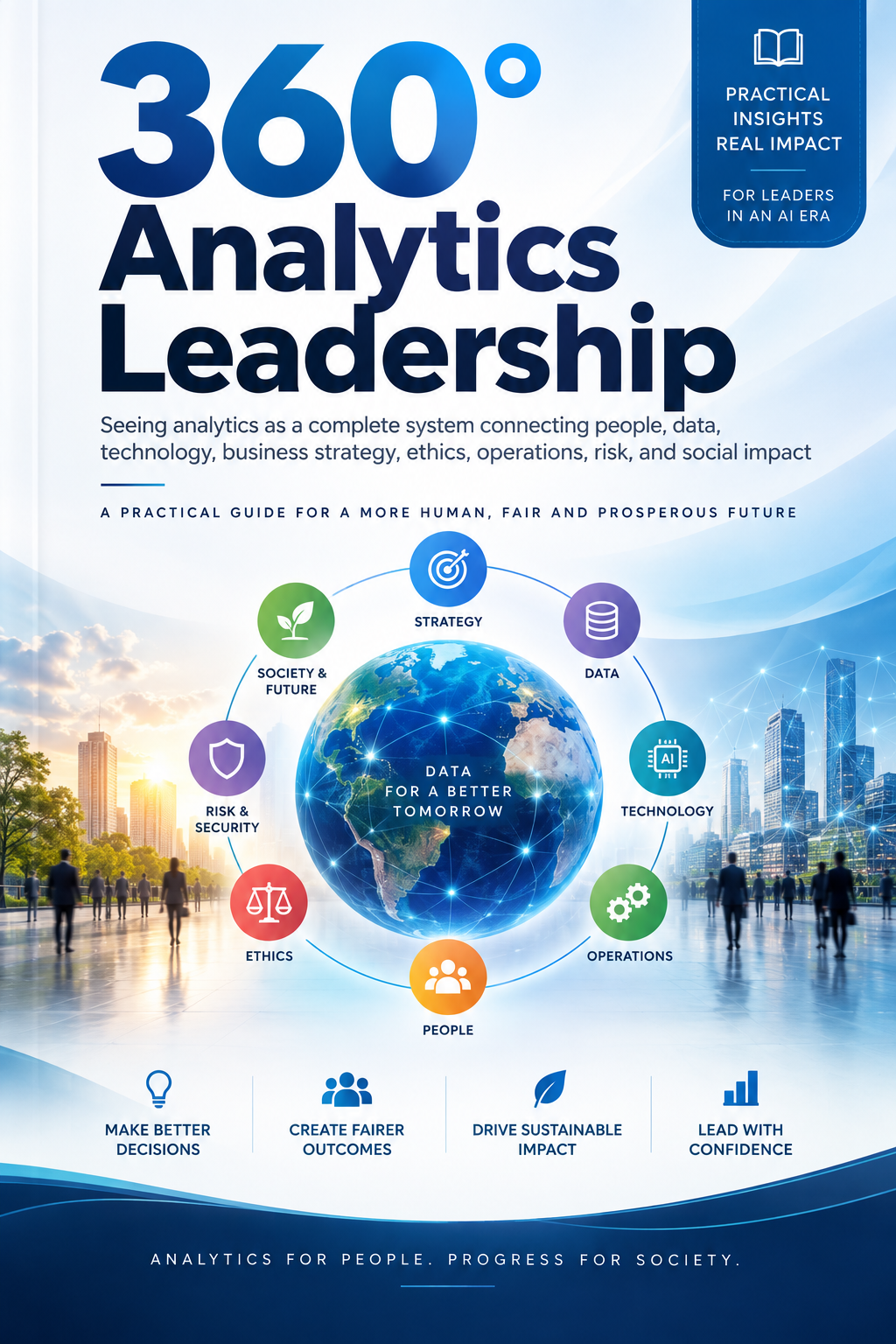
360° Analytics Leadership: Leading with Judgment
Artificial intelligence (AI) is transforming how organizations analyze information, make decisions, automate processes, and influence society. But greater analytical power also creates a greater need for judgment, accountability, ethics, and systems thinking.
360° Analytics Leadership is a practical guide for leaders, analysts, engineers, data scientists, managers, entrepreneurs, students, and professionals who want to look beyond algorithms and understand analytics as a complete decision-making system.
Rather than focusing only on models, dashboards, or technology, this guide explores analytics through eight interconnected leadership lenses:
Strategy — What are we actually trying to accomplish?
Data — Can the evidence be trusted?
Technology — What can analytics and AI realistically do?
Operations — Can the recommendation work in the real world?
People — How will humans respond?
Ethics — Should we do it?
Risk & Security — What could go wrong?
Society & Future — What happens when the solution scales?
The guide emphasizes that technically impressive analytics can still produce poor outcomes when the original problem is misunderstood. It also examines data literacy, human psychology, Goodhart's Law, technological solutionism, cybersecurity, governance, operational constraints, second-order consequences, and ethical responsibility.
Why this matters in the AI era
AI dramatically increases the scale, speed, and apparent intelligence of automated decision-making. A flawed human decision may affect a handful of people, while a poorly designed algorithm can influence thousands or millions.
That makes one resource increasingly valuable:
Human judgment.
The future advantage may therefore belong not simply to the person who knows the most, but to the leader who can integrate multiple perspectives and make wiser decisions. That is the central leadership principle developed throughout this guide.
Who this guide is for
This digital product is especially relevant for professionals working in data science, analytics, AI, engineering, business intelligence, operations, cybersecurity, technology management, public policy, entrepreneurship, and organizational leadership.
It can also serve students and emerging leaders who want to understand why responsible AI leadership requires much more than technical competence.
What you will gain
After reading the guide, you should have a stronger framework for evaluating analytical decisions from technical, organizational, human, ethical, operational, security, and societal perspectives—and for asking better questions before consequential AI-driven decisions are implemented.