
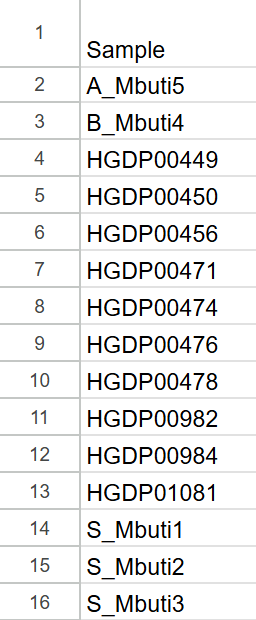
Mbuti oygmies 15 raw genomes 23andme format
The Mbuti Pygmies are one of the Indigenous hunter-gatherer peoples of the Congo Basin, primarily inhabiting the Ituri Forest in the northeastern Democratic Republic of the Congo.
Mbuti people are best known for their short stature, a defining feature of Central African Pygmy populations. Adult males average about 1.37 meters (4’6”), while females are slightly shorter. This reduced height is thought to be an evolutionary adaptation to tropical rainforest conditions, aiding thermoregulation, mobility through dense vegetation, and perhaps linked to diet and energy efficiency.
Historically, the Mbuti lived in egalitarian bands without centralized authority, relying on communal decision-making and cooperation. However, their autonomy has been repeatedly challenged. With the rise of Bantu-speaking agricultural societies surrounding the forest, the Mbuti became economically dependent on these farmers through systems of trade and sometimes exploitative patron-client relationships.
During the Belgian colonial era, the Ituri Forest was heavily impacted by colonial resource extraction. The Mbuti suffered from enslavement, displacement, and the imposition of taxes and forest regulations that restricted their mobility.
The Mbuti traditionally live as nomadic foragers, depending on the rainforest for most of their food. Their diet consists largely of wild yams, fruits, nuts, honey, mushrooms, and game such as antelope, monkeys, and wild pigs. Hunting is typically done using nets, bows and arrows, or spears, and women play a major role in gathering and setting hunting nets. They also trade forest products such as meat and honey for staple crops with neighboring Bantu farmers.
Their diet is low in carbohydrates but rich in protein and fiber, with a strong seasonal rhythm tied to the forest’s fruiting and game cycles. Honey in particular, holds great cultural and nutritional importance.
For this video I’ve gathered the raw genomes of 15 Mbuti pygmies from the Congo. I used academics tools, such as admixtools 1 and 2, which are developed by Harvard, but also amateur tools, such as the trait predictor and mageplot, both developed by me.