
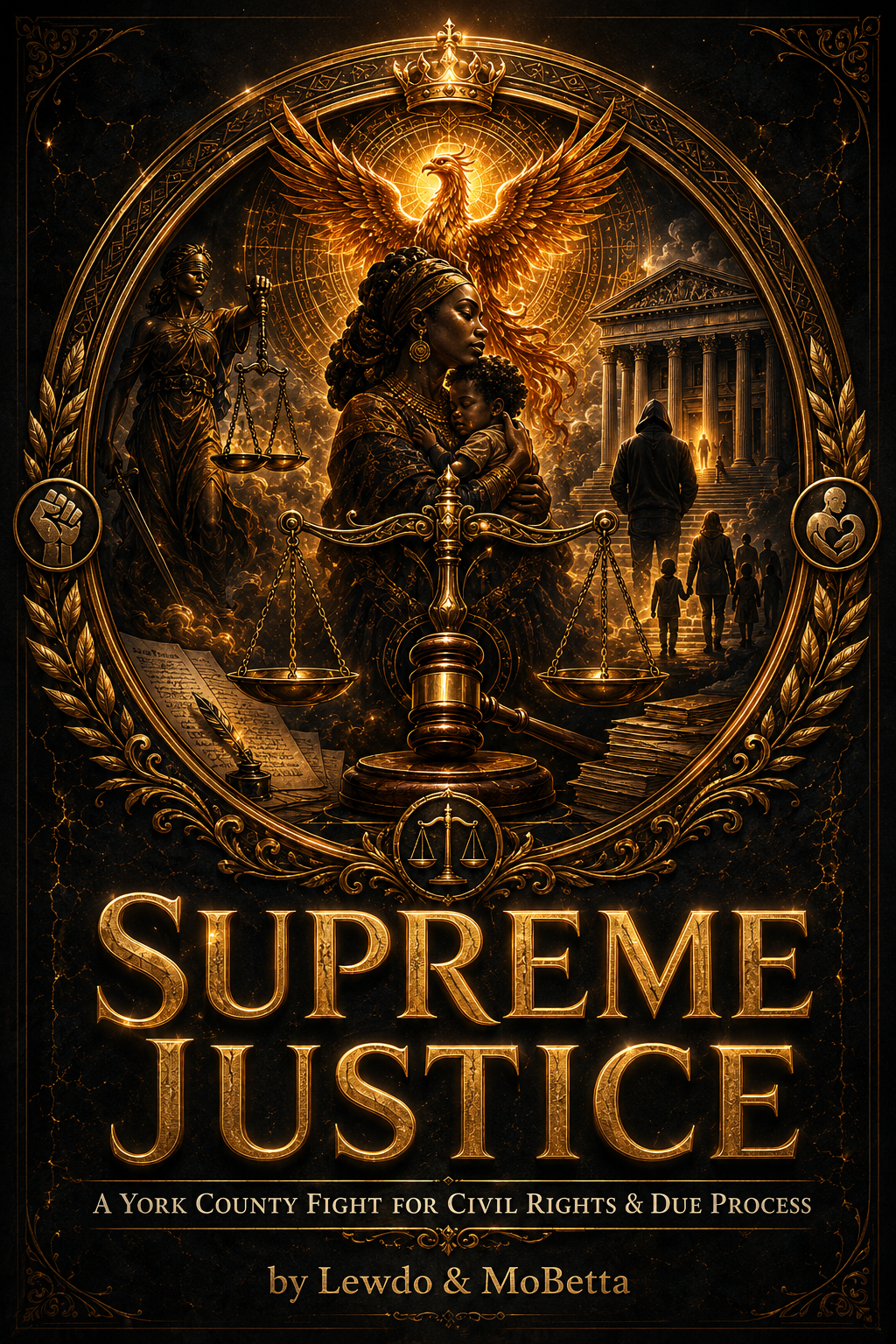
Supreme Justice: A York County Fight For Civil Rigths & Due Process
What happens when two ordinary citizens believe the very court process designed to protect constitutional rights has become the obstacle standing between them and justice?
Supreme Justice follows William Edgar Lewis, Jr., known as Lewdo, and Monique Naté Holmes, known as MoBetta, an engaged couple from York County, Pennsylvania, whose family dispute grew into a federal battle over civil rights, due process, constitutional protections, and access to the courts.
They allege the fight began with an extraordinary Christmas Day ex parte proceeding involving Case No. 2024-MI-000581. Their records, they contend, contain altered identifying information, metadata dated approximately twenty-two months in advance, and the name of a person on the official file who was not the individual they understand to have participated in the proceeding. Although court staff later confirmed the courthouse was closed that Christmas Day, paperwork nevertheless appeared in the judicial system. The judge ordered no relief and closure of the matter, yet Petitioners maintain that the case remains open in the system.
They further allege that subsequent Protection From Abuse paperwork – proceedings they still cannot locate or verify in the court system – was nevertheless treated as legally operative, resulting in the permanent removal of Holmes’ minor child, confiscation of Lewis’ lawfully owned firearms and firearms license, and interference with his Second Amendment rights.
Without attorneys, Lewis and Holmes researched federal law, prepared their own pleadings, preserved their record, appealed to the United States Court of Appeals for the Third Circuit, and prepared to seek review by the Supreme Court of the United States. Their fight raises questions involving 42 U.S.C. § 1983, judicial notice, state action, procedural due process, parental rights, firearm-related constitutional interests, government accountability, and judicial power.
Part documentary narrative and part constitutional chronicle, Supreme Justice asks a larger American question: When citizens claim they were never meaningfully allowed to access, verify, or defend against the process used to change their lives, where can they go to have that process examined?
William Edgar Lewis, Jr. (“Lewdo”)
Author | Black Swan Publishing
Email: Lewdo@Lewdo.com
Website: Lewdo.com
Monique Naté Holmes (“MoBetta”)
Author | AMMA Publishing
Email: MoBetta@MrsMoBetta.com
Website: MrsMoBetta.com