
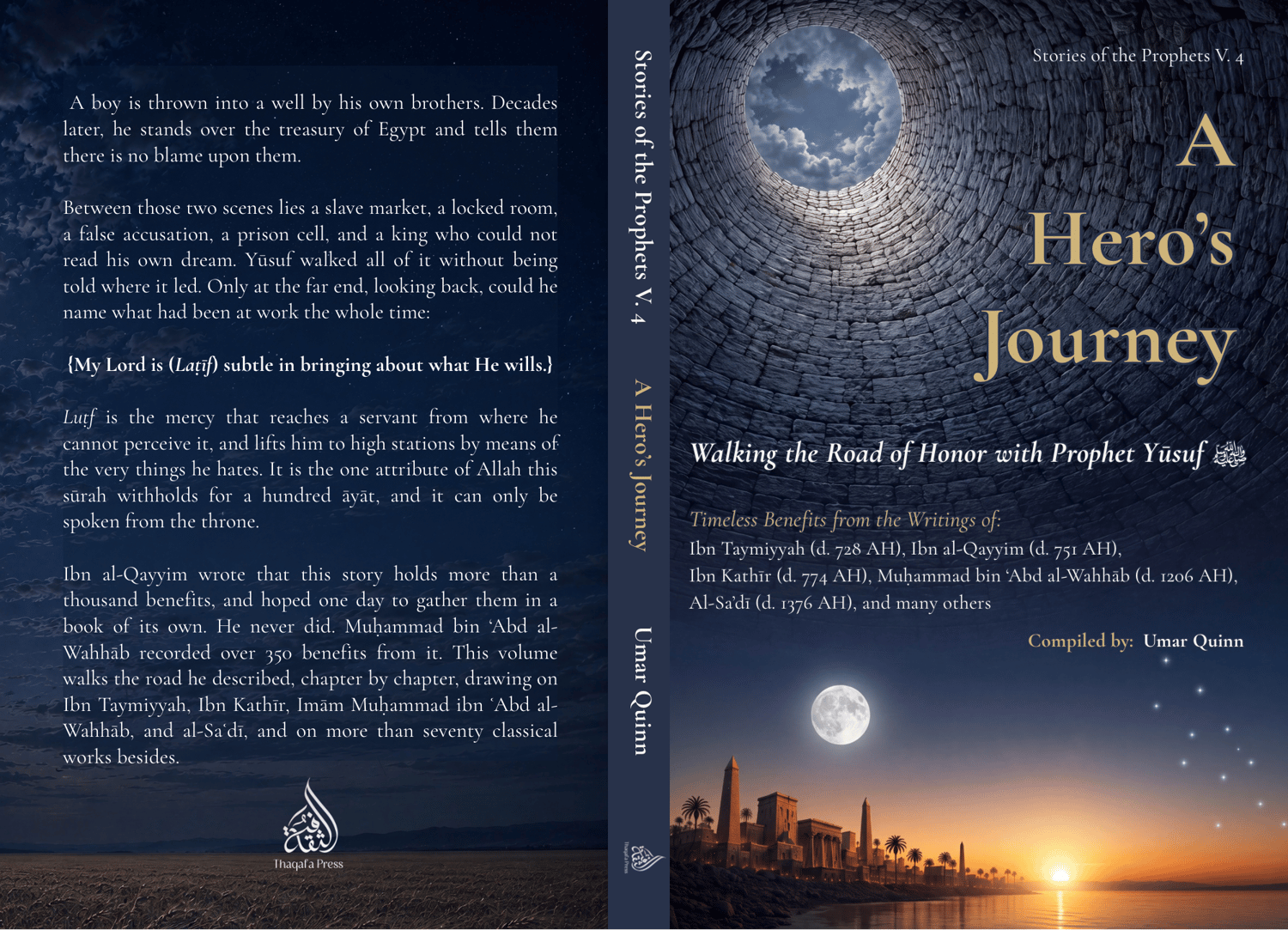
[Digital Edition] A Hero’s Journey - Walking the Road of Honor with Prophet Yusuf
A Hero's Journey Walking The Road of Honor with Prophet Yūsuf (ʿalayhi as-salām) Stories of the Prophets Series, Volume IV
My Lord is subtle in bringing about what He wills.
Yūsuf speaks that line from a throne in Egypt, a hundred āyāt after a boy was thrown into a well. It is the first time the sūrah names the attribute it has been demonstrating all along.
Luṭf is the mercy that reaches a servant from where he does not perceive it, and brings him to the high stations by means of the very things he dislikes. Al-Saʿdī puts it in a single line: He delivers His kindness to the servant from where the servant does not perceive it, and He brings him to the lofty stations by means of matters he hates.
Read the sūrah backward from that sentence and every scene reorganizes. A father's counsel to conceal a dream. Ten men at a well. A rope, and traders who wanted money. A house with a locked door. A cell, and a man who forgot. A king's dream about cows. Every one of them a matter he disliked, and every one a way station on the road. Not one of them legible as a road at the time, because luṭf is by definition the mercy you cannot see while it is operating.
That is why the name is spoken where it is: from the far end, looking back, by the man it was worked upon.
This book follows that spine from the tent in Canaan to the throne in Egypt. The well, the slave market, the locked room, the prison, the famine, and the reunion — read not as misfortunes that Allah's gentleness eventually overcame, but as the instruments of it.
Inside:
The descent. The dream and the command to conceal it. The conspiratorial council, the betrayed trust, the fake tears. Comfort at the bottom of a well. Drawn up in a bucket and sold for a price the Qurʾān calls paltry.
The trial. The locked doors and the run for the exit. A shirt torn from behind, and a household judged by the evidence of cloth. The talk of the town, the cut hands, and a man who preferred prison to what was offered him. Then calling to Allah inside that prison, and being forgotten by the man who owed him.
The elevation. The king's dream of seven. Waiting to be absolved rather than walking free under suspicion. Nominating himself for the treasury, and what it means that a prophet asked for an office.
The return. Recognizing brothers who did not recognize him. Full measure, separate gates, a planted cup, a judgment rendered on their own terms. A father weeping himself blind, complaining only to Allah, and refusing despair forty years after a wolf was reported. Then the pardon that reserved nothing, and a shirt that goes north carrying sight where the first went home carrying a lie.
Throughout, the reading of Imām Muḥammad ibn ʿAbd al-Wahhāb, alongside Ibn al-Qayyim, Ibn Kathīr, Imām al-Saʿdī, and others, with the Arabic set alongside the English and every citation documented. A full bibliography is included.
What you receive:
- EPUB for phones, tablets, and e-readers
- PDF at 6 × 9, matching the printed edition page for page, so study groups can work from either
- Detailed study guide, if included
The Arabic is fully vocalized and set in dedicated Arabic and ʿUthmānic typefaces, embedded in the file. It displays correctly on any device, including devices with no Arabic support installed.
Stories of the Prophets Series, Volume IV. First edition July 2026.