
AMOS-MED-008 — Mediation, Indirect Effects, Moderation and Conditional Structural Relationships
Description
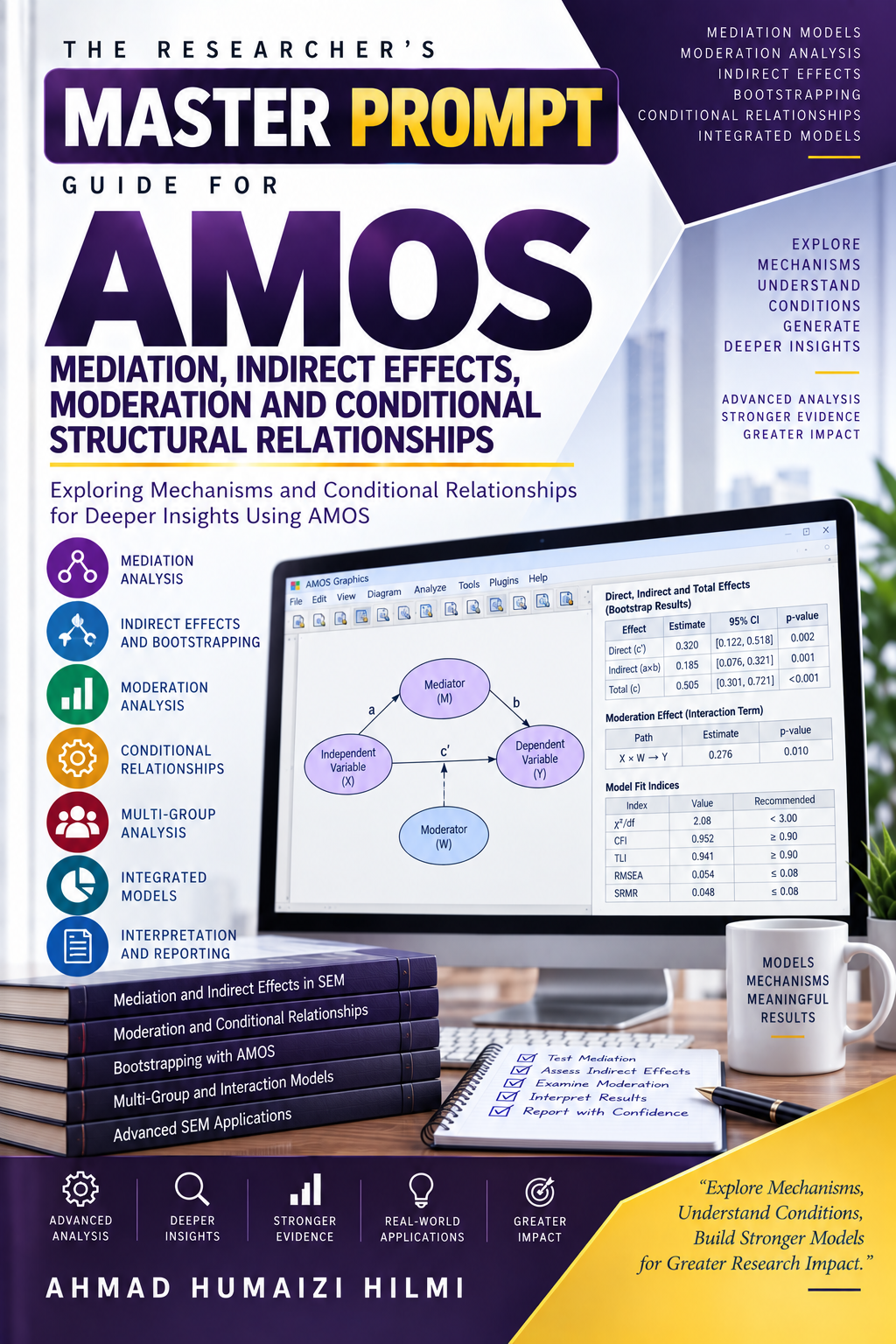
This Master Prompt focuses on examining mechanisms and conditional relationships that extend beyond simple direct-effect models in AMOS. It guides researchers through simple mediation, partial and full mediation, parallel mediation, serial or sequential mediation, decomposition of direct, indirect and total effects, bootstrap estimation of indirect effects, moderation through interaction terms, moderation through multi-group analysis, simple-slope interpretation and theoretically justified combinations of mediation and moderation.
A major emphasis is placed on interpreting mediation through indirect effects and bootstrap confidence intervals, rather than relying solely on the statistical significance of individual component paths. The uploaded literature provides several explicit examples. One AMOS study used 5,000 bootstrap resamples and 95% confidence intervals to examine green innovation as a mediator between corporate social responsibility dimensions and sustainability performance. Another study examined two parallel mediators and found significant indirect effects through both perceived social support and self-efficacy, while the direct path became nonsignificant; the same study also evaluated moderation through an interaction coefficient and simple slopes.
The uploaded literature also demonstrates sequential mediation, in which organizational climate and professional identity operate in a chain linking ethical leadership to presenteeism. Bootstrap results separately report direct, specific indirect, sequential indirect and total indirect effects. Moderation is represented through both interaction-based AMOS analysis and multi-group analysis; for example, the entrepreneurship study uses AMOS multi-group analysis to test whether gender changes the entrepreneurship education–entrepreneurial intention relationship.
The prompts therefore require researchers to distinguish how an effect occurs from when or for whom an effect changes, specify mediators and moderators from theory rather than data mining, report conditional mechanisms transparently, and avoid treating significant indirect or interaction effects as causal evidence when the research design does not support causal inference.