
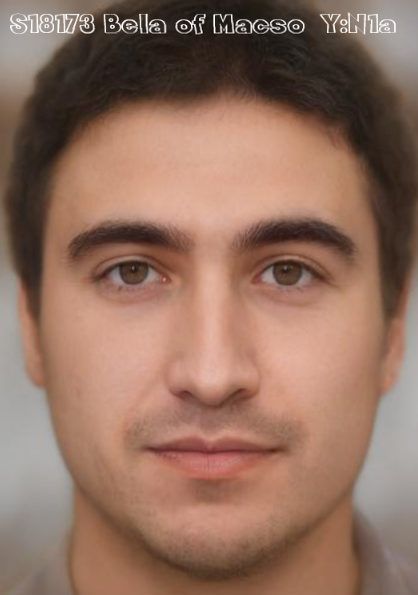
S18173 Duke Béla of Macsó 23andme format raw DNA
By the 1270s, the Kingdom of Hungary was in chaos following the decline of royal authority after the reign of King Béla IV. His death in 1272 left the throne to his son Stephen 5th, whose rule was immediately contested by powerful magnate families , particularly the Kőszegi and Gutkeled clans ,who wanted to control the young heir, Prince Ladislaus fourth, the Cuman.
Duke Béla of Macsó, being both a cousin of Ladislaus IV and a seasoned military leader with strong Rurikid ties, posed a real threat to the ambitions of these barons. He represented a potential alternative claimant or at least a rival center of power capable of restoring royal authority and curbing magnate influence.
The Kőszegis, led by Henrik Kőszegi, viewed Béla as the greatest obstacle to their control of the kingdom. Under the guise of a council meeting meant to discuss the regency and stabilize the realm, they invited Béla to Margaret Island, near Buda. Once he arrived, unarmed and trusting the royal summons , he was ambushed and murdered by Kőszegi’s men in cold blood.
Duke Béla of Macsó was no ordinary noble — his blood united three of medieval Europe’s greatest dynasties. The son of Princess Anna of Hungary and Rostislav Mikhailovich, Béla carried the legacy of the Árpáds, the ruling house of medieval Hungary; the Byzantine emperors, through his maternal ancestors; and the Rurikids, founders of Kievan Rus’.
When excavations in 1915 uncovered a young noble’s remains showing signs of violent death, historians suspected they had found Béla himself. Modern genomic analysis confirmed it — the DNA revealed a man of mixed Árpád, Rurikid, and Byzantine descent, linking together Central and Eastern Europe’s royal bloodlines in one remarkable individual.
For this video, I have gathered the raw genome of Duke Béla.
I ran his raw DNA through my tools such as Trait predictor and Betacalc, and Harvard tools like admixtools 1 and 2.