
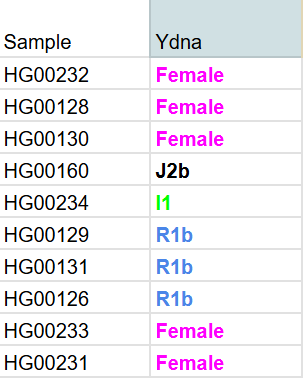
English.HO 23andme format
The English formed through successive migrations and conquests that reshaped Britain after the end of Roman rule. From the 5th century onward, Germanic-speaking Angles, Saxons, and Jutes migrated from what is now northern Germany and southern Denmark, laying the foundations of English ethnicity and culture. These Anglo-Saxons established kingdoms such as Wessex, Mercia, and Northumbria, ruled by figures like Alfred the Great, who resisted Viking expansion and promoted literacy.
From the late 8th century, Scandinavian Vikings—primarily Danes and Norwegians—raided, settled, and eventually ruled large parts of England known as the Danelaw. Viking leaders such as Guthrum, who converted to Christianity after defeat by Alfred, and later Cnut the Great, who ruled a North Sea empire encompassing England, Denmark, and Norway, left a deep imprint on English society. Norse influence is especially visible in place names ending in -by, -thorpe, or -thwaite, and in everyday English words like sky, egg, take, and they. In 1066, England was transformed again by the Norman Conquest, when William the Conqueror, a Norman duke of Viking ancestry who spoke French, defeated Harold Godwinson at Hastings. The Normans replaced much of the Anglo-Saxon elite and reshaped England’s aristocracy, administration, and culture.
The English language reflects this complex ancestry. English is a West Germanic language, most closely related to Frisian and more distantly to Dutch and German. Its core grammar and basic vocabulary—words like man, house, water, wife, and child—come from Old English, the language of the Anglo-Saxons. However, centuries of contact left clear layers: Old Norse contributed a significant number of common words and even influenced English grammar, helping simplify verb endings and pronouns. After 1066, Norman French flooded the language of law, governance, warfare, cuisine, and high culture, introducing words like court, judge, army, beef, and beauty. Today, roughly 25–30% of modern English vocabulary is of French origin.
Despite this heavy Romance influence, the everyday spoken core of English remains overwhelmingly Germanic. When you count the most frequently used words—pronouns, verbs, prepositions, and basic nouns—over 70% are Anglo-Saxon in origin. Celtic languages, spoken by the Britons before the Anglo-Saxons arrived, left a surprisingly small imprint on English vocabulary, mainly in place names such as London, Avon, Thames, and a handful of words, though some scholars argue for subtle Celtic influence on syntax.
For this video, I gathered the genomes of 10 ethnic Englishmen from Reichlab’s aadr plus .HO dataset. I used academic tools, such as admixtools 1 and 2, but also amateur tools, such as my trait predictor and mageplot, to analyze their genetics.