
Reading Drag Lines — A Tailor's Guide to Diagnosing Fit from the Way Cloth Behaves
What's inside — 224 pages, 104 illustrations:
– The anatomy of a drag line, and how to tell a taut tension line from a soft fold of surplus or a passing crease of movement
– Five ways to classify what you see: direction, intensity, length, behaviour and probable cause
– 49 fit cases across seven areas of the body: shoulders, back, armhole and sleeve, posture and neck, bust, hip and leg
– For every case: what you see, where it shows, why it happens, a diagnostic check to test at the fitting, a correction strategy, a note for altering a finished garment, how to verify the result, and a second look when the first answer doesn't hold
– For every area: what to check after any alteration, what to do when the signs overlap, and how to tell when the problem lies somewhere else
– Five principles that take you from diagnosis to correction
– The seven mistakes almost everyone makes — and what a trained eye sees instead
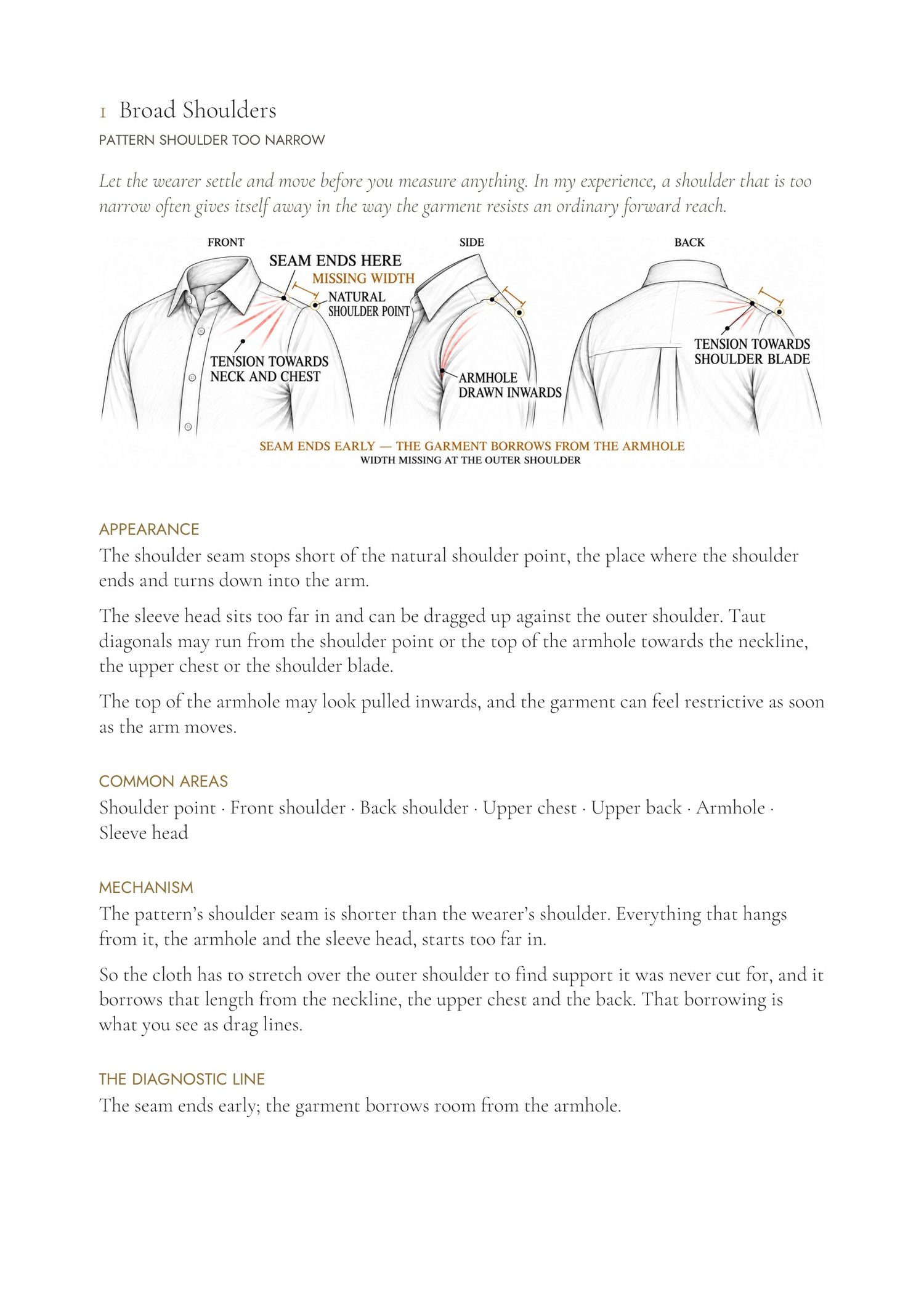
Every case is illustrated with a clear drawing showing where the tension shows, where it begins and what the fitting should test, so you learn to recognise the pattern itself, not just the single example.
Read it or listen to it. The guide works with screen readers such as VoiceOver, and every one of the 104 illustrations has a written description, so your phone, tablet or computer can read the whole guide aloud to you, drawings included.
These are not recipes. The direction of a correction can be learned; its amount belongs to the garment and the body in front of you. This guide teaches you where to look, what to test, and how to confirm it before you cut.
Format: PDF, A4, 224 pages, for reading on screen. Every case is bookmarked so you can go straight to it. The file is tagged for screen readers, with a description for every illustration, and has been tested with VoiceOver.
What readers say
"I mostly make clothes for my husband now and need to make corrections, which I find hard to understand. The guide really helps to grasp the idea of which body parts affect the specific drag lines… It's really well explained."
— Tanya, home sewist