
GLP Language Sample Assessment and Analysis Guide
GLP Language Sample Assessment and Analysis Guide Power of Play Speech Therapy
This is a fully editable, clinician-ready Word document designed to support speech-language pathologists in understanding, assessing, and treating Gestalt Language Processors using the Natural Language Acquisition (NLA) framework. Everything inside is customizable to fit your practice, your clients, and your documentation style.
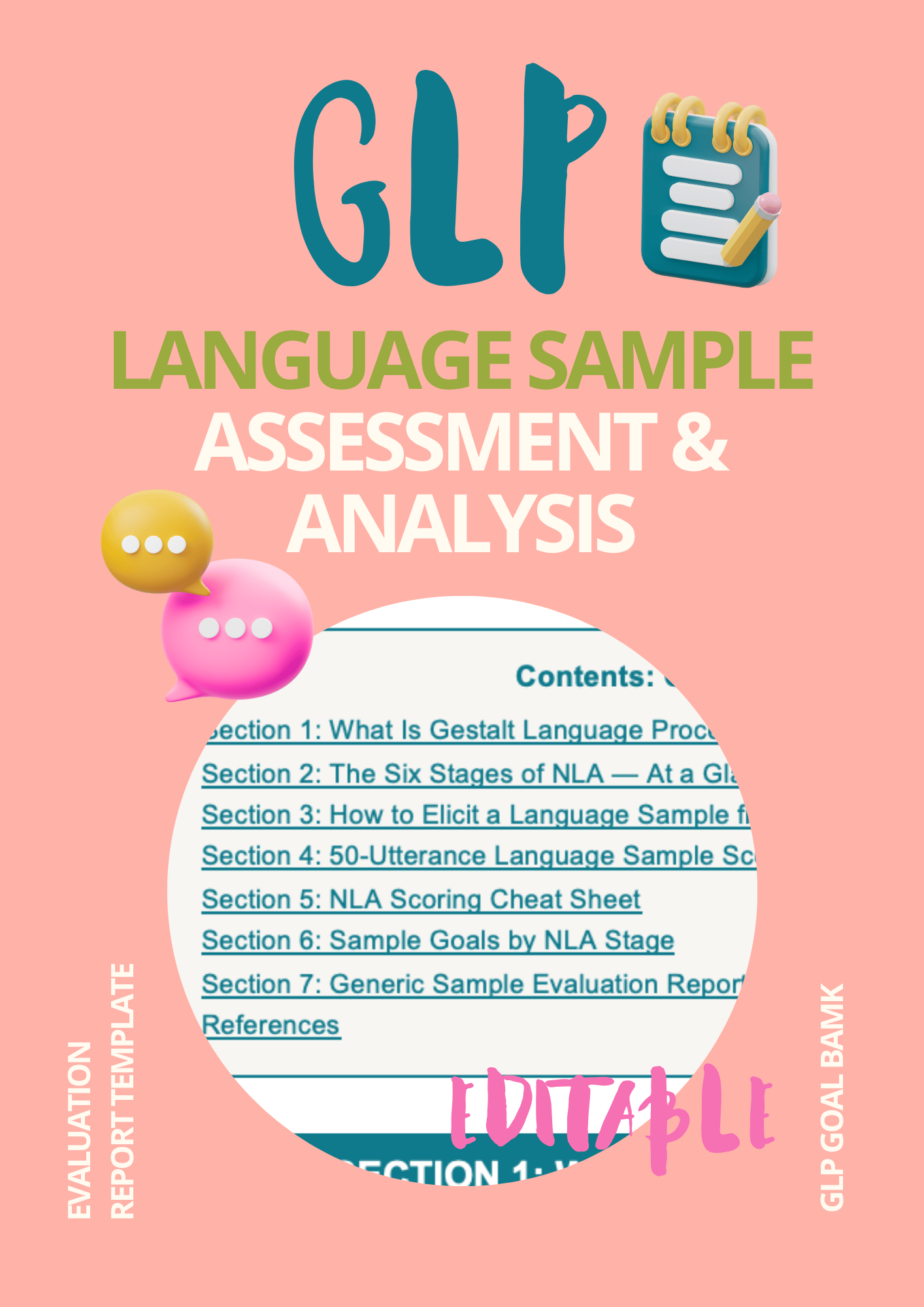
The guide is organized into 7 clickable sections with a hyperlinked table of contents so you can jump directly to what you need without scrolling through the entire document.
What is included:
Section 1 provides a plain-language explanation of what Gestalt Language Processing is, how it differs from analytic language processing, and why traditional vocabulary-building strategies do not apply to GLP clients.
Section 2 breaks down all six stages of Natural Language Acquisition in a clear reference table, including the critical Stage 1 versus Stage 3 single-word distinction that is one of the most common sources of clinical confusion.
Section 3 is a step-by-step guide to eliciting a valid language sample from a GLP client, including a pre-session preparation checklist, what to do and what to avoid during the session, and transcription guidance.
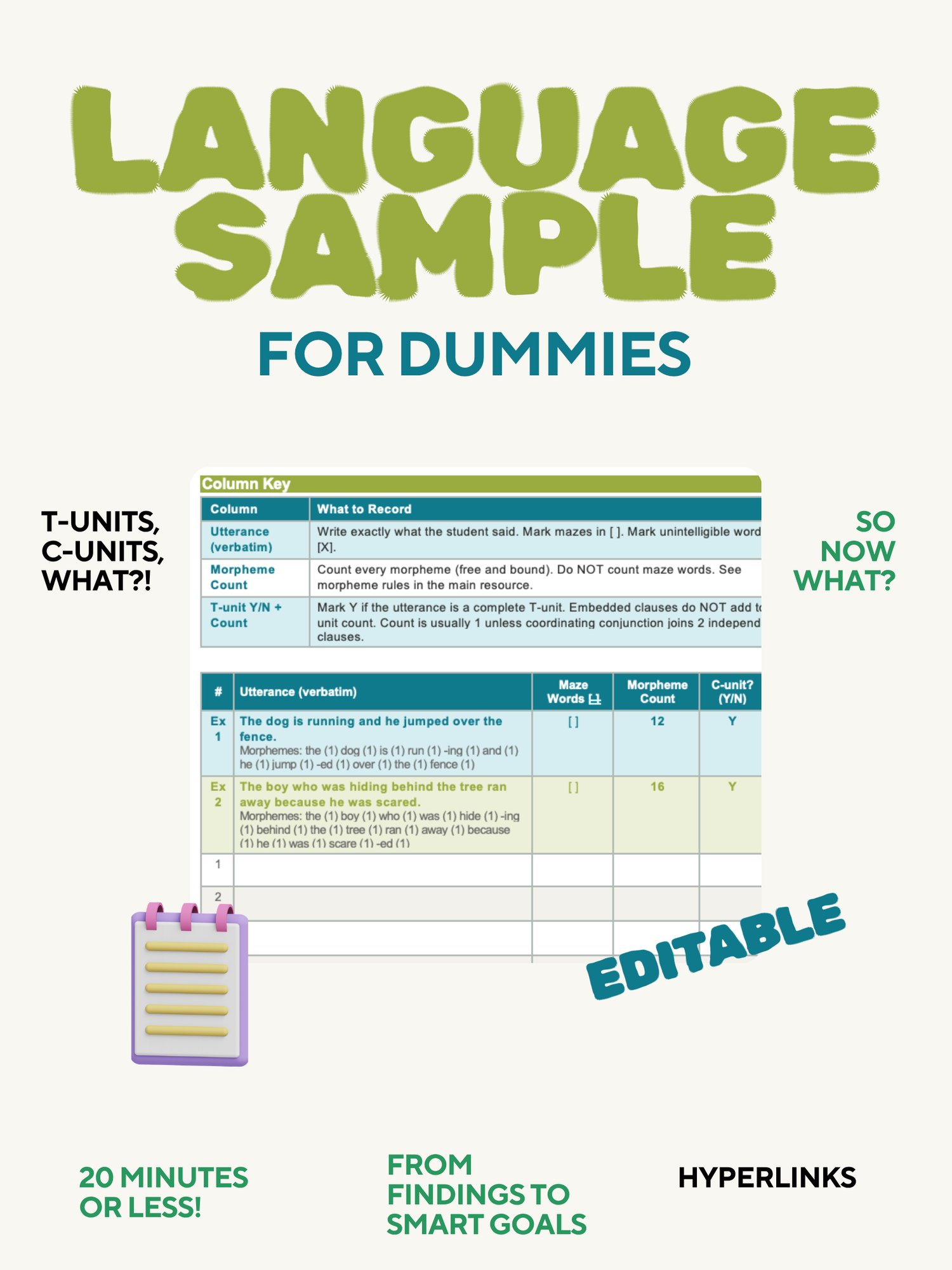
Section 4 is a fillable 50-utterance language sample scoring form with columns for each NLA stage, a totals row, and a percentage calculation table.
Section 5 is a quick-reference NLA scoring cheat sheet covering all six stages, the taught language scoring rule, and a percentage interpretation guide to help you know what your data means clinically.
Section 6 is a SMART goal bank organized by NLA stage, from foundational regulation and connection goals through Stage 4 grammar goals, with measurable criteria and measurement methods built into every goal.
Section 7 is a fully templated, neurodiversity-affirming evaluation report with every section a clinician needs, including background, medical history, therapy history, evaluation narrative, expressive language with NLA stage breakdown, receptive language, prelinguistic skills, play skills, pragmatic language and social communication, summary and recommendations, SMART goals, and recommendations for follow-up.
All text is editable. Swap in your practice name, add your logo, adjust goal targets to match your client's baseline, and personalize report language to fit your documentation style. The hyperlinked table of contents updates automatically as you edit.
Built for SLPs who are newer to the NLA framework and for experienced clinicians who want a streamlined, organized reference they can use in session and for documentation.