
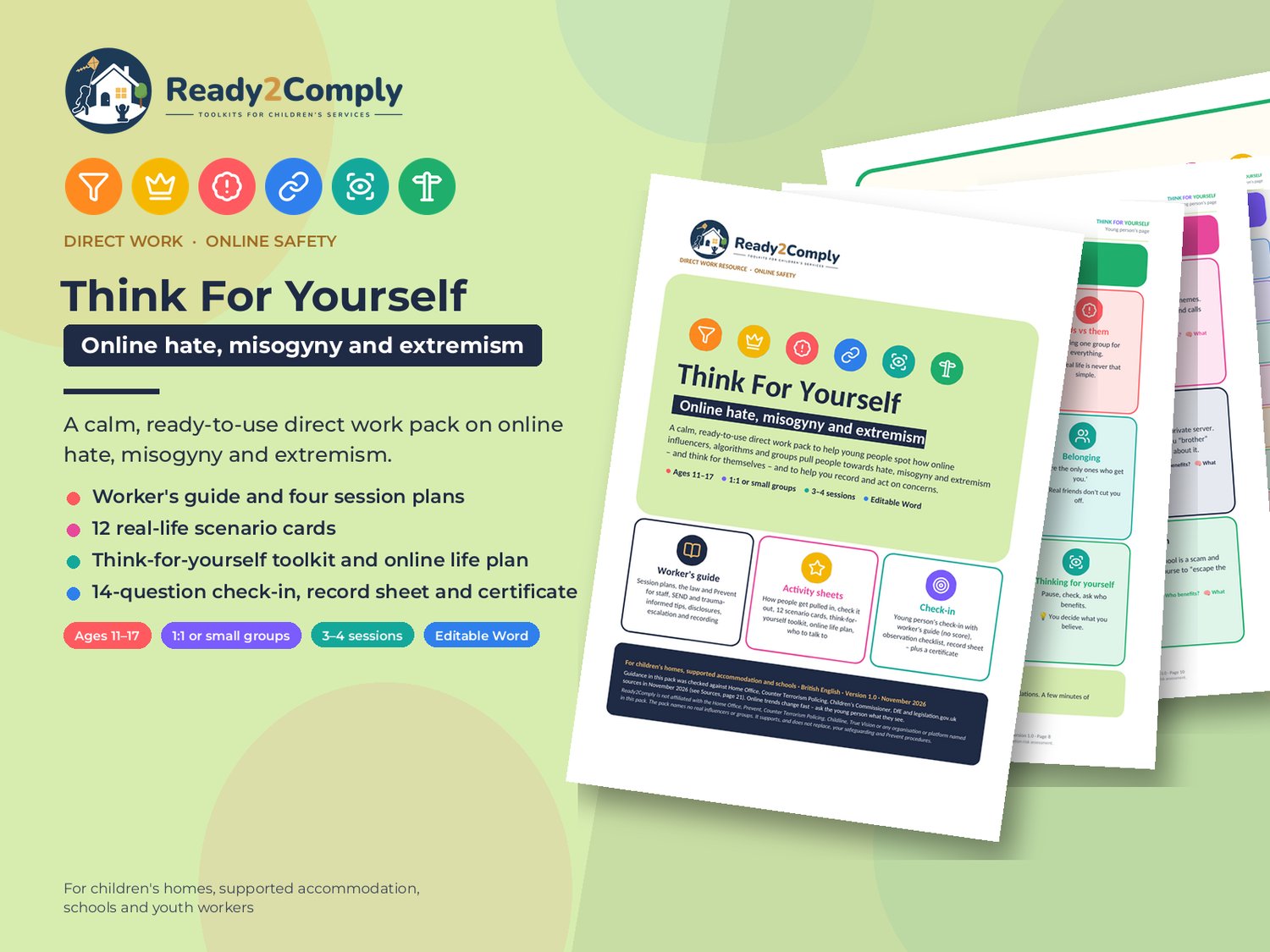
Online Extremism and Misogyny Direct Work Pack
Help young people think critically about online hate, misogyny and extremist content – and how algorithms and influencers pull people in – with a calm, ready-to-use direct work pack.
Think For Yourself – Online hate, misogyny and extremism is an editable Word pack for keywork with young people aged 11–17. It gives you a worker's guide, four session plans, 12 real-life scenario cards, 'Online extremism: what you need to know', the 'Check it out' activity, 'My think-for-yourself toolkit', 'My online life plan', a 'Who can I talk to?' page, an observation checklist, a record sheet and a certificate – plus a separate guide to adapting the pack for young people with SEND.
Uses a 14-question check-in with no score or labels – it is a conversation aid, not a radicalisation risk tool. Covers how algorithms and feeds work, manosphere-style misogyny, conspiracy and hate content, grooming into extremist groups, the law, and how Prevent works as a support process. Names no real influencers.
What's included (one zip: editable Word pack, 22 pages, plus a print-ready PDF of the pack, the SEND adapting guide in Word and PDF and the Staff Delivery Guide in Word):
• Worker's guide – session plans, the law for staff, SEND and trauma-informed tips, what to do if a young person tells you something, when to escalate to the DSL or Registered Manager, and how to record the work.
• Four ready-to-run session plans.
• 'Online extremism: what you need to know' – plain-English facts, checked against official sources.
• 12 scenario cards and a 'what would you do?' page.
• 'Check it out' activity with a word bank.
• 'My think-for-yourself toolkit' and 'My online life plan'.
• 'Who can I talk to?' page with real helplines.
• 14-question check-in with a guide for workers – no score or labels.
• Worker observation checklist, record sheet and certificate.
• Adapting this pack for SEND – autism, learning disability, FASD and speech, language and communication needs.
• Staff Delivery Guide – how to deliver the sessions: before the session, having the conversation, what to do if it doesn't go as planned (including disclosures), revisiting, measuring understanding, and example wording for logs, key work records and plans, plus a one-page session record.
Written around the protection of children standard in the Children's Homes (England) Regulations 2015, the protection standard in the Supported Accommodation (England) Regulations 2023 and Keeping Children Safe in Education (for school users), plus topic sources including: Home Office – Individuals referred to and supported through the Prevent programme, April 2024 to March 2025; Counter Terrorism Policing – ACT Early: signs and support; Children's Commissioner for England – Prevent and children, August 2026; DfE – Keeping Children Safe in Education 2026 and Prevent duty guidance; Ofcom – Protecting children online: Protection of Children Codes. Facts were checked in November 2026 – the law and services change, so check the current position.
Ready2Comply is not affiliated with the Home Office, Prevent, ACT Early or any platform. Platform names are trademarks of their owners and are used only because young people recognise them. The pack uses no third-party logos.
Who it's for: key workers, teachers, mentors and youth workers supporting young people aged 11–17 in children's homes, supported accommodation and schools.
Licence: one purchase = one home or service.
These templates support good practice. They don't replace professional judgement or legal advice, and they don't guarantee any inspection or regulatory outcome. Ready2Comply is independent and not affiliated with, or endorsed by, Ofsted or the Department for Education. Your statutory rights under UK consumer law are not affected.