



The Tazkiya workbook
A method for the woman ready to bring her faith and her mind into the same room, and finally understand herself instead of just enduring herself.
This is for the woman who has held things in for a long time; suppressed them, managed them, carried them quietly, and who's ready to let them go and feel lighter. The woman searching for nafs ul mutmainnah, ( A content heart) You may have sat with a therapist, tried some form of talking therapy, or been through the NHS sessions too. Each one gave you something, even if none of it fully closed the gap you were looking to close.
You're masking well. People assume you're fine. You aren't, and you're tired of the effort it takes to keep that up.
You may be doing well by every outward measure: financially, physically, in how your life looks from the outside; and still sitting with a discontentment you can't quite name. Not a lack of blessing. A lack of alignment.
Are you at the point where you're actually ready to let things go? Where the rush and the overwhelm of life has started to exhaust you, and what you want now is to slow down, to be more mindful, more aware, and to come to terms with what's happened, not in spite of it, but with it as part of your strength?
If there's a pull in you toward that kind of stillness, toward your soul searching for connection with its purpose, take it as a sign rather than a symptom. It may be your nafs asking to settle, your fitrah asking to be remembered, not proof that something is wrong with you.
This is why faith and neuroscience sit together here. Allah tells us He does not change the condition of a people until they change what is within themselves. If you've read that verse and felt the pull to actually explore what's within you, rather than simply believe it, you're in the right place.
What's inside
You won't just read this workbook. You'll write it, one theme at a time, using a framework called H.E.A.L.
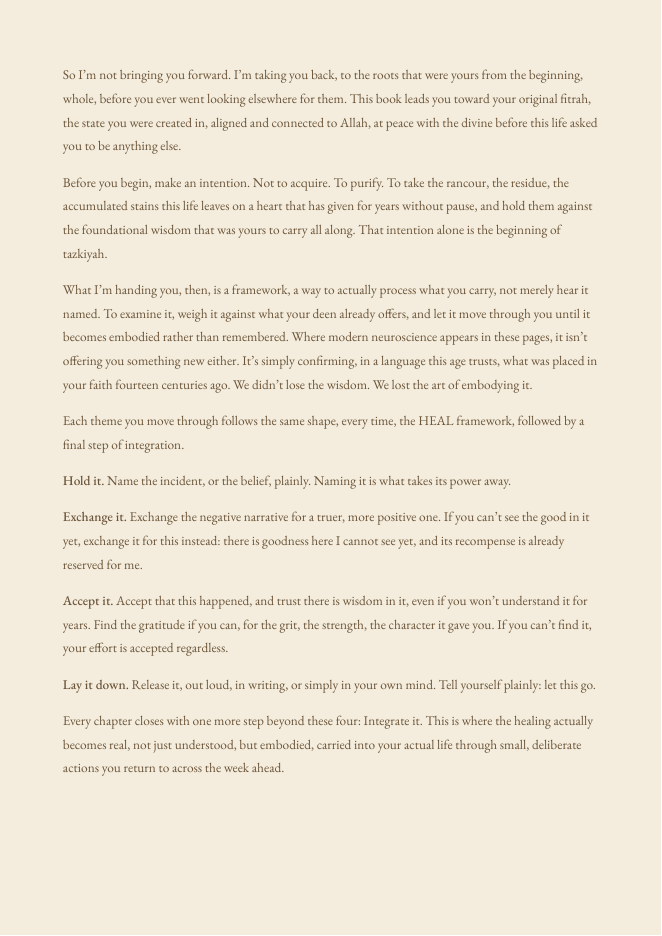
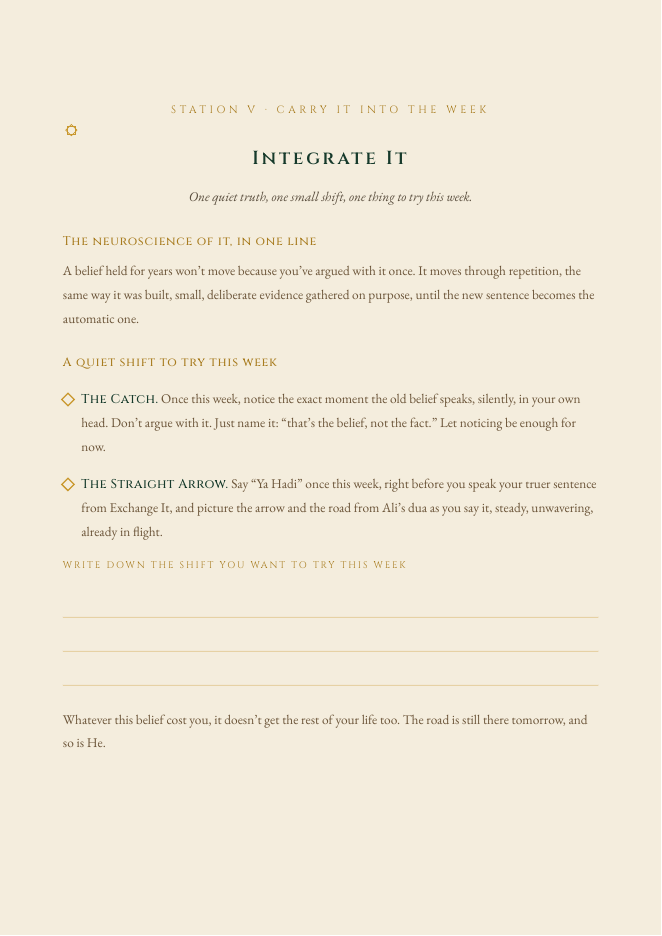
Four steps repeat across every theme. You Hold it: you name the belief you've been carrying, because naming it is what takes it out of the dark and puts it somewhere you can actually work with it. You Exchange it: you shift your perspective, toward something more faith-aligned. You Accept it: you accept your fate, and you accept it with gratitude, appreciating what it has given you through the experience. You Lay it down: you release it fully, in your own words, written or spoken. And then, every time, you Integrate it: you let what you've named, reframed, and released actually settle into how you live, not just what you've written on the page.
Here's where the framework lands:
Beliefs: trace the behaviours and patterns you didn't choose back to the belief that's actually been running them.
Identity: find where your identity really came from; a belief, something once said to you, a childhood scene, an old wound.
Self-Value: start from what Allah says about your worth, and rebuild your sense of value from there, not from what you've achieved or given.
Shame: recognise which of three streams of shame you've been carrying, understand how and why, and finally lay it down.
Fear: name what's actually been keeping you small, so it stops having the grip it's had.
Forgiveness: let go of the grudges and the pain you've been holding, and free yourself of the weight of what was done to you.
Love: understand that loving yourself isn't indulgence; it's a gift Allah gave you the faculties for, and living it out is how you preserve the amanah of your self, your body.
You won't work through every theme. Only the ones that are actually yours. And this isn't a workbook you finish once and put away; when a theme resurfaces in your life, you come back to that section's H.E.A.L. cycle, and once you know the framework, you can use it for whatever else comes up too.
What changes
When you work through this framework, you're not consuming information; you're integrating it. Most of what's inside is knowledge you've already been given somewhere along the way; the ayat you've read, the hadith you've heard, the reminders you've sat through more than once. What changes is that you finally do something with it: name it, hold it, reframe it, release it, one theme at a time, instead of letting it sit unused in the back of your mind.
This isn't a promise of resolution by the last page. It's a step, an active one, that you take yourself: toward being more aware of your choices, more settled within yourself, more attentive to what your inner world is actually asking of you, and more willing to love and care for yourself as the amanah Allah entrusted you with. It's your part in living out the verse above; the internal work that has to come before anything external can shift.
Price
This is an early-stage price, not a discount. There's real proof behind this content: I've tested and refined it live, in workshops, and over near a decade of teaching Islamic theology in the classroom. What's new is the written format itself; it doesn't have a track record of its own yet. This price is here to remove your hesitation now, while it's still early. It will move up once the workbook has testimonials of its own.
What it isn't
This isn't a substitute for licensed clinical or emergency care. If you're in crisis, this isn't where to start.
This isn't therapy stripped of faith, or faith stripped of the mind. It holds both, and if you're looking for one without the other, this won't feel like the right fit.
This isn't a workbook you finish in a weekend. It's self-paced, because real change doesn't run on a schedule, and if you want something quick, this will feel slow.
This won't resolve your marriage, your relationships, or your family circumstances on its own. It gives you the work that's actually yours to do.
What this asks of you is a willingness to look inward. That's the only requirement. Everything else is already within you, waiting to be named; and if that's where you are, you're exactly who this was written for.