
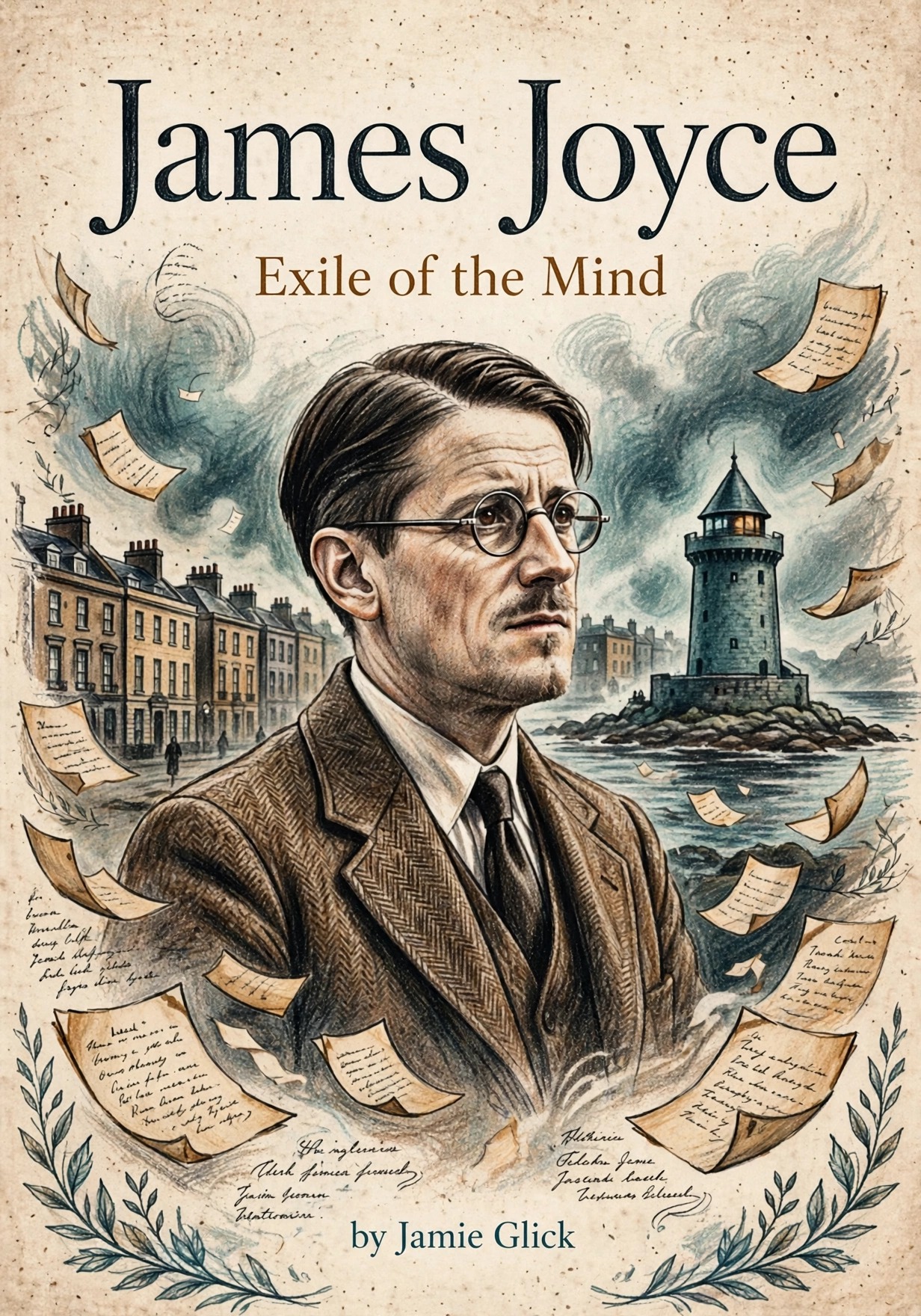
James Joyce: Exile of the Mind
James Joyce: Exile of the Mind is the definitive biography of James Joyce (1882–1941) — the Irish modernist who shattered the conventions of fiction and rebuilt the novel from the inside out. Across ten richly detailed chapters, it follows Joyce from the gaslit streets of Dublin to the cafés of Trieste, Zurich, and Paris, tracing how a penniless exile became the most revolutionary writer of the twentieth century. Born on February 2, 1882, in the Dublin suburb of Rathgar, James Augustine Aloysius Joyce was the eldest surviving child of John Stanislaus Joyce, a charming, improvident rate-collector whose slow decline from respectability became the raw material of his son's art. Educated by the Jesuits at Clongowes Wood College, Belvedere College, and University College Dublin, Joyce was the brilliant scholarship boy who absorbed everything — Aquinas, Aristotle, Ibsen, Dante — and then turned his back on church, nation, and family in favor of what he called his only arms: silence, exile, and cunning. On June 16, 1904, a twenty-two-year-old Joyce walked out with Nora Barnacle, a Galway chambermaid with laughing eyes and no literary pretensions, who would become his wife, his muse, and the emotional center of everything he wrote. Within months they had fled Ireland together — first to Zurich, then to Trieste — beginning an exile that would last the rest of his life. That first date, June 16, became Bloomsday, the single day in 1904 on which the entirety of Ulysses unfolds. In Trieste, Joyce taught English at the Berlitz school, befriended the novelist Italo Svevo (the model for Leopold Bloom), and fought a humiliating decade-long battle to get Dubliners into print — its stories of paralysis and epiphany finally appearing in 1914. A Portrait of the Artist as a Young Man followed in 1916, serialized with the backing of Ezra Pound and Harriet Shaw Weaver, announcing Stephen Dedalus — and his creator — as the non serviam artist of the modern age. Then came the mountain. In Zurich during the First World War, and in Paris through the 1920s, Joyce composed Ulysses: eighteen episodes, one Dublin day, the whole of human experience compressed into the wanderings of Bloom, the musings of Stephen, and Molly's immortal yes. Banned as obscene in America and England, it was published in Paris on Joyce's fortieth birthday — February 2, 1922 — by Sylvia Beach of Shakespeare and Company, and was immediately recognized as the defining novel of the century. The Paris years brought fame, disciples, and suffering in equal measure: celebrated by T. S. Eliot and Hemingway, sustained by Weaver's selfless patronage, and tormented by near-blindness that required a dozen eye operations. Through it all Joyce labored in secret on his final enigma, the "Work in Progress" — seventeen years of puns, portmanteaus, and dream-logic that emerged in 1939 as Finnegans Wake, a book that remains literature's most daring experiment. Behind the monument stood the man: the jealous husband, the anxious father — above all of Lucia, the gifted dancer whose mental illness broke his heart — the tippler, the spendthrift, the exile who never went home. When war came again, Joyce fled to Zurich, where he died on January 13, 1941, and was buried in Fluntern Cemetery beneath a statue of the writer, arms crossed, watching the city that had sheltered him twice. Rich in narrative depth and historical context, James Joyce: Exile of the Mind captures both the earthy, punning humor and the towering intellect of the man who wrote the inner life of the twentieth century — the exile who left Dublin to invent it forever. A must-read for anyone seeking to understand the mind behind the myth.