

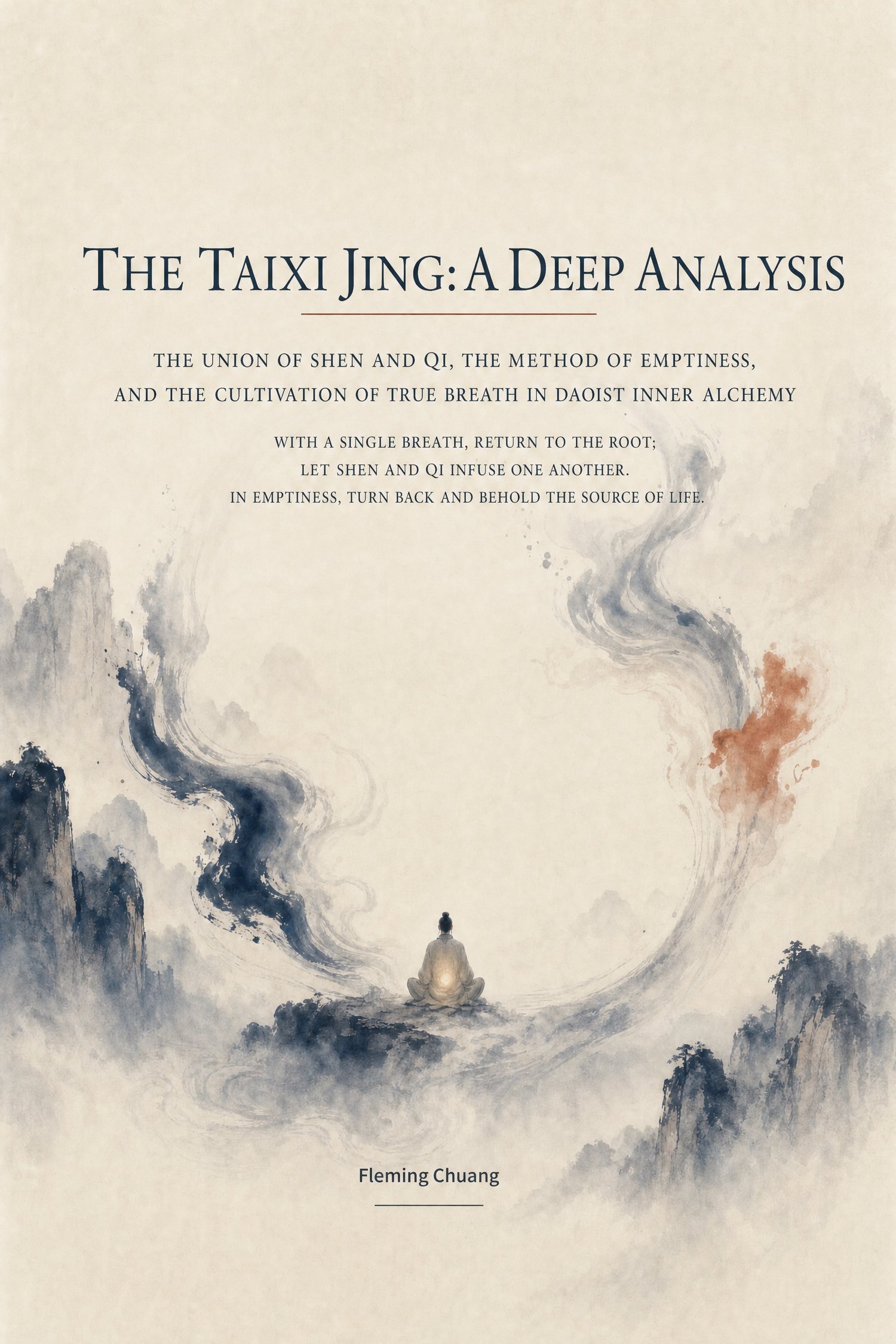
The Taixi Jing: A Deep Analysis
The Taixi Jing—often translated as the Classic of Embryonic Breathing—contains only a few dozen lines, yet its language opens onto a complete vision of Daoist cultivation. At its center is the union of shen (spirit, heart-mind) and qi (vital energy), held together through emptiness, stillness, and the return of attention to the root of life.
In The Taixi Jing: A Deep Analysis, Fleming Chuang guides readers through the scripture’s textual history and its place within the Daoist canon. The book presents a plain-English rendering of the classical passage, followed by a close, line-by-line explanation that clarifies such key terms as subdued qi, true breath, the sacred embryo, the inner elixir, and the lower dantian.
The discussion then places the Taixi Jing in conversation with the Dao De Jing, the Huangdi Neijing, the Huangting Jing, and the Baopuzi. These comparisons reveal how ideas of infant-like softness, tranquil emptiness, guarded spirit, and subtle breathing converge across Chinese philosophical, medical, and alchemical traditions.
A substantial practice-oriented chapter describes preparation, posture, abdominal breathing, attention at the lower dantian, the principle of “neither forcing nor forgetting,” and the cautions surrounding breath retention. The final chapter considers what embryonic breathing may mean for modern readers—not as a promise of miraculous cures, but as a traditional framework for reflection, disciplined attention, and life-nourishing practice.
Accessible to newcomers and useful to serious students, this book offers a bridge between a terse ancient text and the questions of contemporary readers. It is an invitation to read slowly, breathe gently, and investigate how Daoist inner alchemy understands the source, conservation, and transformation of life.