

2019 Conference Climate Change & Gardens 14. Mark Broadmeadow
From 2019: Resilient trees: planning for the future – Mark Broadmeadow
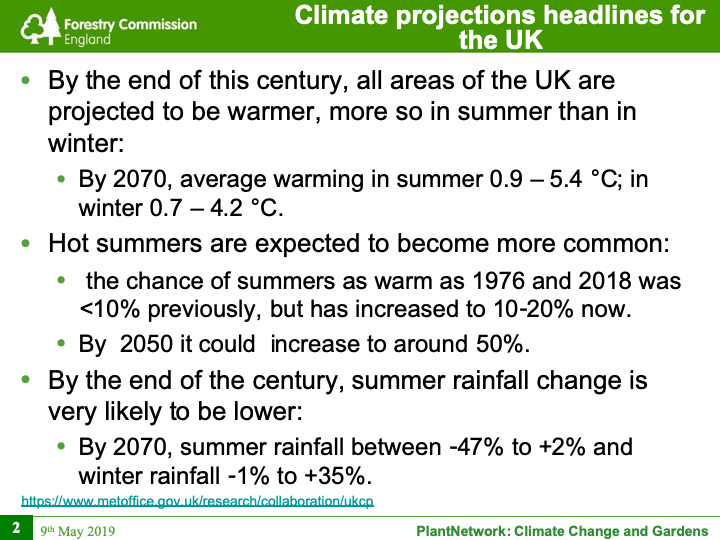
Mark stressed that climate ‘uncertainty is not a reason for inaction’ which is why a number of organisations such as the Forestry Commission are looking for tree species that would be suitable for growing in the UK in a changed climate. Britain and Ireland have relatively few native tree species while conifer and broadleaf plantations tend to use only a small number of species. For instance, 89% of conifer plantations consist of only 6 species while 5 species dominate 77% of broadleaf woodlands.
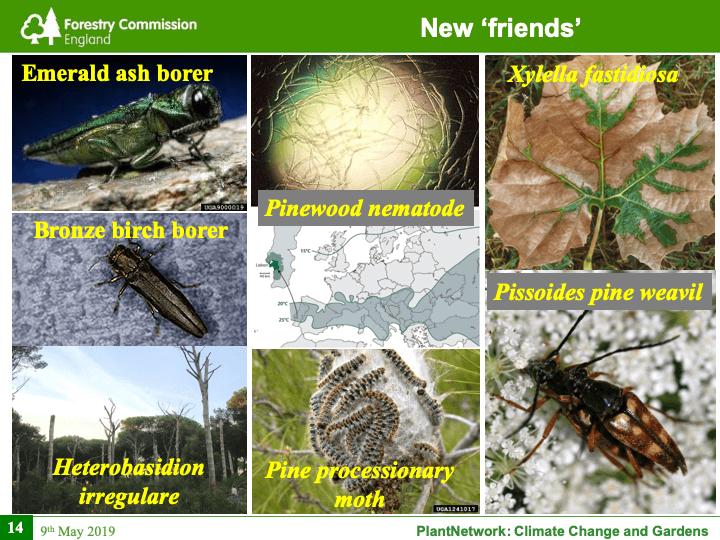
It is expected a greater diversity of tree species would improve the soil microbiome. Trees from SE Europe as well as South America (especially Chile), New Zealand, southern USA and eastern Europe are currently being evaluated for performance under predicted climate forecasts for 2050-2080 temperatures as well as survival in the current climate: all these areas currently match the predictions for the UK climate in 50 years’ time. Issues to consider for new tree species are soil preferences, soil moisture requirements, ability to survive temperature extremes (2019 compared to 2050), availability of genetic diversity to increase adaptability to climate change and pest/disease problems, vegetative
regeneration properties/ease of seed germination (e.g. vernalisation required?), shade tolerance to allow young trees to regenerate under established canopy, performance in fires, windstorms and floods, and ecological performance (in a functioning ecosystem). Natives sourced from different climate zones (e.g. southern Europe), near natives or ‘minor’ natives are also possible woodland mixes.
Care must be taken with some exotics, particularly those that are already showing invasive potential in areas of introduction e.g. Robinia pseudoacacia outside its native range in the USA.