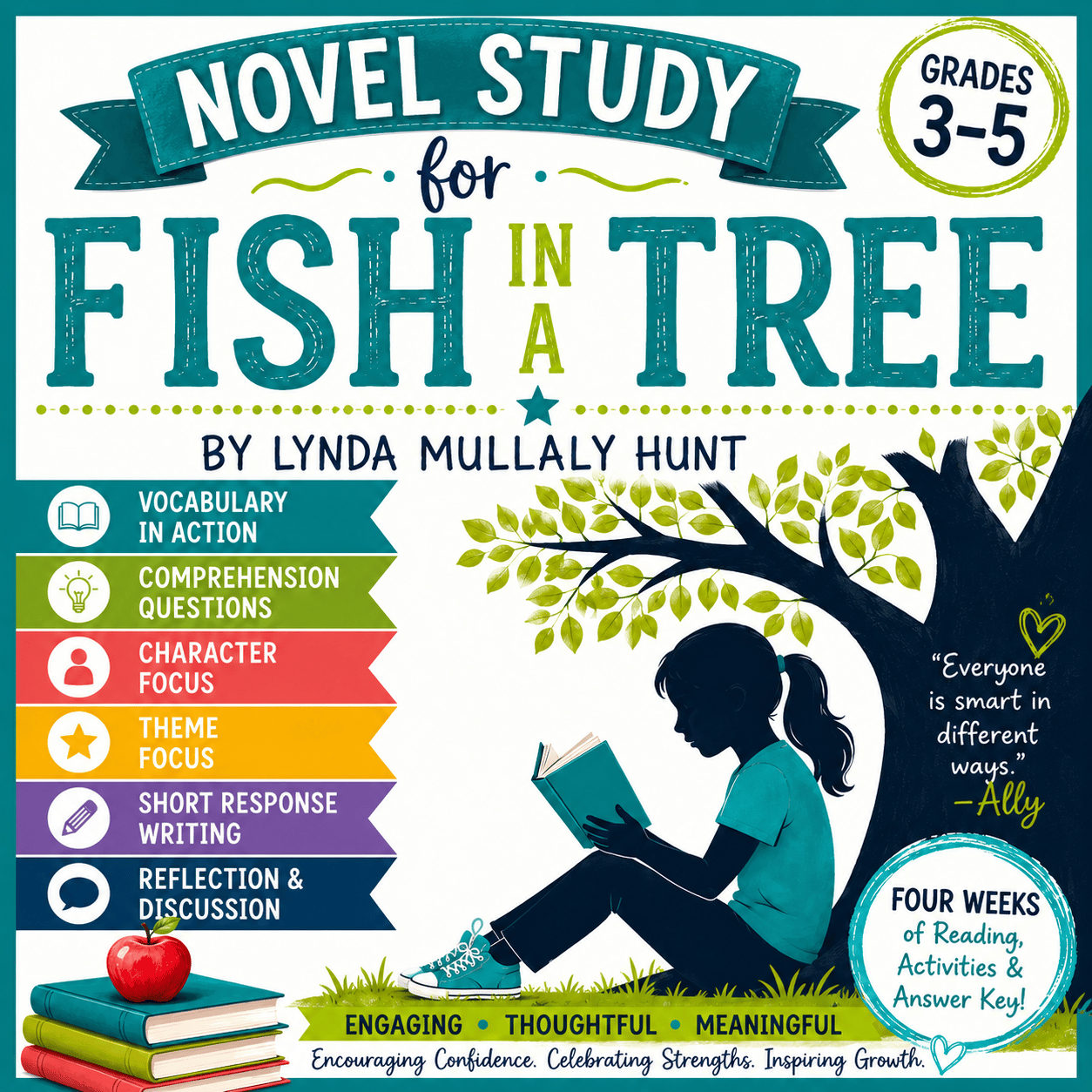
Fish in a Tree Novel Study | Grades 3–5 Reading Comprehension, Vocabulary, Character Analysis, Writing Activities & Answer Keys
Fish in a Tree Novel Study by Lynda Mullaly Hunt | Complete 4-Week Reading Comprehension & Literature Unit | Grades 3–5
Help students discover that everyone learns differently—and that every learner has unique strengths worth celebrating!
Bring the powerful and inspiring story of Fish in a Tree by Lynda Mullaly Hunt into your classroom with this comprehensive 52-page, four-week novel study designed to strengthen reading comprehension, vocabulary development, character analysis, critical thinking, and evidence-based writing.
Created for Grades 3–5, this printable literature unit provides structured, meaningful activities that guide students through Ally Nickerson’s journey of perseverance, friendship, self-discovery, and personal growth.
As students follow Ally’s experiences with dyslexia, school challenges, bullying, and the encouragement she receives from Mr. Daniels and her friends, they explore important lessons about empathy, resilience, belonging, and recognizing individual strengths.
Rather than focusing exclusively on recalling events, this novel study encourages students to think critically, analyze characters, identify literary themes, support their ideas with textual evidence, and connect literature to their own experiences.
Perfect for elementary ELA classrooms, homeschool instruction, literature circles, reading intervention groups, and independent reading enrichment!
📚 WHAT’S INCLUDED IN THIS 52-PAGE NOVEL STUDY?
This comprehensive printable PDF includes four weeks of structured instructional activities covering Chapters 1–51 of Fish in a Tree.
Each instructional week provides consistent literacy activities, teacher guidance, and opportunities for meaningful discussion and reflection.
1. Teacher Notes & Weekly Instructional Guidance
Each week begins with an instructional overview designed to help educators guide students through the assigned chapters.
Teacher notes include:
- Weekly reading summaries
- Chapters covered
- Important events and developments
- Character analysis focus
- Central literary themes
- Writing objectives
- Suggested discussion questions
- Opportunities for deeper literary exploration
These organized instructional notes help teachers and homeschool parents plan meaningful reading experiences without developing an entire novel unit from scratch.
2. Vocabulary in Action
Help students strengthen vocabulary knowledge through activities that emphasize context clues, word meaning, and connections to literature.
Students practice:
- Determining vocabulary meanings using context clues
- Identifying clues that support word meanings
- Connecting vocabulary to characters and events
- Explaining vocabulary within the context of the story
- Strengthening academic language and comprehension
Vocabulary activities encourage students to move beyond memorizing definitions toward understanding how language contributes to meaning.
3. Reading Comprehension — Thinking About the Story
Structured comprehension questions encourage students to read carefully, identify important information, and explain their understanding.
Students will:
- Recall and explain significant events
- Analyze character actions and decisions
- Identify important story details
- Make logical inferences
- Examine character relationships
- Explain how events contribute to the plot
- Support answers using evidence from the novel
These activities promote reading accountability while helping students develop stronger comprehension and analytical skills.
4. Character Focus & Literary Analysis
Students examine how characters reveal their personalities, motivations, strengths, and challenges through their actions and relationships.
Character analysis activities encourage students to:
- Identify meaningful character traits
- Explain character motivations
- Support interpretations with textual evidence
- Examine relationships between characters
- Analyze character growth and development
- Make predictions based on story events
- Explore how experiences influence identity and confidence
Special attention is given to Ally Nickerson’s transformation and the influence of Mr. Daniels, Keisha, and Albert.
5. Theme Focus Activities
Help students identify and analyze the important messages woven throughout Fish in a Tree.
Students explore themes including:
- Perseverance and determination
- Friendship and belonging
- Self-acceptance and confidence
- Courage and personal growth
- Empathy and understanding
- Resilience when facing challenges
- Learning differences and individual strengths
- The importance of supportive relationships
Each theme-focused activity encourages students to connect literary ideas to specific events, character experiences, and real-world situations.
6. Short-Response Writing Activities
Develop students’ ability to communicate their understanding through organized, evidence-based writing.
Students practice:
- Responding thoughtfully to literary prompts
- Supporting ideas with relevant details
- Explaining character traits and motivations
- Analyzing themes and important lessons
- Organizing written responses
- Communicating interpretations clearly
These activities can also serve as formative assessments to evaluate students’ reading comprehension and literary analysis skills.
7. Reflection & Personal Connections
The Ask Yourself / Think About activities encourage students to connect the novel’s themes to their own experiences.
Reflection questions invite students to consider:
- How they respond to challenges
- The importance of perseverance
- What makes someone a supportive friend
- How kindness influences relationships
- Why everyone deserves to feel accepted
- How people discover their individual strengths
- The importance of believing in themselves
These activities provide meaningful opportunities for discussion, reflection, and social-emotional learning.
8. Answer Keys Included!
A detailed answer key provides instructional support for:
✔ Vocabulary in Action
✔ Reading Comprehension Questions
✔ Character Focus Activities
✔ Theme Focus Activities
✔ Short-Response Writing
✔ Reflection Activities
Answer keys help teachers and homeschool parents evaluate student understanding, facilitate discussions, and guide students toward stronger literary interpretations.
📖 COMPLETE FOUR-WEEK NOVEL STUDY BREAKDOWN
The unit follows the novel’s progression through four carefully organized instructional sections.
🌱 WEEK 1: CHAPTERS 1–15
Theme: Perseverance
Students meet Ally Nickerson, a creative and intelligent student who struggles with reading, writing, and fitting in at school.
As Ally attempts to hide her academic challenges, readers explore how frustration, misunderstanding, and self-doubt influence her behavior.
Students examine:
- Ally’s experiences at school
- Her struggles with reading and writing
- The impact of bullying
- Her relationship with her family
- The arrival of Mr. Daniels
- Ally’s creativity, determination, and resilience
Essential Question: How can perseverance help us overcome challenges?
Literacy Focus: Reading comprehension, character traits, vocabulary development, and supporting responses with text evidence.
🌼 WEEK 2: CHAPTERS 16–30
Theme: Friendship and Belonging
As Ally begins developing friendships with Keisha and Albert, she discovers the importance of acceptance, encouragement, and supportive relationships.
Mr. Daniels introduces new learning strategies and helps Ally recognize that her challenges do not define her abilities.
Students examine:
- The development of Ally’s friendships
- The importance of kindness and acceptance
- Mr. Daniels’ influence on Ally
- How supportive relationships build confidence
- The effects of bullying and exclusion
- The relationship between belonging and self-worth
Essential Question: How do friendships help us recognize our strengths and overcome challenges?
Literacy Focus: Character relationships, theme development, inference, and evidence-based responses.
🌿 WEEK 3: CHAPTERS 31–45
Theme: Self-Acceptance
Students explore a significant turning point in Ally’s journey as she learns about dyslexia and begins understanding her learning differences.
Through encouragement, supportive friendships, and growing self-awareness, Ally starts recognizing her abilities and developing confidence.
Students examine:
- Ally’s discovery of dyslexia
- The relationship between learning differences and self-esteem
- How understanding ourselves builds confidence
- The importance of recognizing individual strengths
- Ally’s developing resilience
- The influence of supportive teachers and friends
Essential Question: How does understanding and accepting ourselves help us grow?
Literacy Focus: Character development, theme analysis, textual evidence, and written explanations.
🌻 WEEK 4: CHAPTERS 46–51
Theme: Courage and Growth
In the final section, students reflect on Ally’s transformation and examine how perseverance, friendship, courage, and self-acceptance contribute to her personal growth.
Students analyze:
- How Ally changes throughout the novel
- The development of her confidence
- The importance of courage
- How relationships influence personal growth
- Lessons learned from Ally’s experiences
- The novel’s message about intelligence, learning, and individual strengths
Essential Question: How can courage and self-belief help us become the best versions of ourselves?
Literacy Focus: Character growth, theme development, reflection, and literary analysis.
🎯 READING & LANGUAGE ARTS SKILLS DEVELOPED
This novel study provides opportunities for students to strengthen essential elementary literacy skills.
Reading Comprehension
- Identifying key details
- Understanding story events
- Making inferences
- Explaining character actions
- Supporting interpretations with evidence
Literary Analysis
- Identifying character traits
- Analyzing character development
- Exploring relationships
- Identifying central themes
- Examining how characters respond to challenges
Vocabulary Development
- Using context clues
- Understanding academic vocabulary
- Connecting words to story events
- Explaining word meanings
Writing & Critical Thinking
- Developing evidence-based responses
- Explaining interpretations
- Making meaningful connections
- Organizing written ideas
- Reflecting on literary themes
Speaking & Listening
- Participating in discussions
- Sharing interpretations
- Supporting opinions
- Listening to different perspectives
- Building on classmates’ ideas
📘 COMMON CORE ELA SKILLS
This resource incorporates activities connected to Common Core English Language Arts skills for Grades 3–5.
Reading Literature
- RL.3.1–RL.5.1: Asking and answering questions using text evidence
- RL.3.2–RL.5.2: Identifying themes and central messages
- RL.3.3–RL.5.3: Analyzing characters and their responses to events
- RL.3.4–RL.5.4: Understanding vocabulary in context
- RL.3.6–RL.5.6: Exploring point of view
Writing
- W.3.1–W.5.1: Supporting opinions with reasons
- W.3.2–W.5.2: Writing informative explanations
- W.3.9–W.5.9: Using literary evidence to support analysis
Speaking & Listening
- SL.3.1–SL.5.1: Participating in collaborative discussions
- SL.3.4–SL.5.4: Communicating ideas with supporting details
Language
- L.3.4–L.5.4: Determining word meanings using context clues
- L.3.6–L.5.6: Developing academic vocabulary
Activities can be adapted to individual student needs and instructional expectations.
👩🏫 WHO IS THIS RESOURCE PERFECT FOR?
Elementary ELA Teachers
Create an engaging four-week literature unit that integrates comprehension, vocabulary, literary analysis, and writing.
Homeschool Families
Guide students through a meaningful novel study with organized reading assignments, structured activities, and answer keys.
Reading Intervention Teachers
Use selected activities to reinforce comprehension, vocabulary, and evidence-based responses with appropriate instructional support.
Literature Circles & Book Clubs
Encourage students to discuss characters, themes, relationships, and meaningful life lessons.
Small-Group Reading Instruction
Provide structured opportunities for guided reading discussions, comprehension practice, and literary analysis.
Independent Reading Enrichment
Extend students’ reading experiences with thoughtful questions, written responses, and reflection activities.
Upper Elementary Literacy Programs
Support reading comprehension and critical thinking while encouraging meaningful conversations about friendship, perseverance, and learning differences.
⭐ WHY EDUCATORS WILL LOVE THIS NOVEL STUDY
✔ Comprehensive 52-Page Resource
Provides a complete four-week instructional sequence with activities covering the novel.
✔ Consistent Weekly Organization
Students encounter familiar activity formats that help establish expectations and promote independent learning.
✔ More Than Basic Reading Questions
Activities emphasize literary interpretation, character development, textual evidence, and critical thinking.
✔ Meaningful Themes
Students explore perseverance, empathy, friendship, self-acceptance, and individual strengths.
✔ Opportunities for Social-Emotional Learning
Reflection activities encourage students to think about their experiences, relationships, and personal growth.
✔ Teacher Guidance Included
Weekly overviews, discussion opportunities, and instructional notes support implementation.
✔ Answer Keys Provided
Suggested responses help educators guide discussions and evaluate student understanding.
✔ Flexible Instructional Applications
Appropriate for classroom instruction, homeschool learning, literature circles, and small-group activities.
✔ Printable Digital Format
Download the PDF and print the pages needed for your instructional setting.
📥 PRODUCT DETAILS
Product: Fish in a Tree Novel Study
Novel Author: Lynda Mullaly Hunt
Created By: 305HippieChic
Recommended Grades: 3–5
Additional Uses: Advanced Grade 2 Readers, Grade 6 Reading Intervention, and Homeschool Instruction
Subject: English Language Arts / Reading / Literature
Resource Type: Printable Novel Study / Literature Unit
Format: PDF Digital Download
Total Pages: 52
Instructional Duration: 4 Weeks
Chapters Covered: 1–51
Includes:
- Teacher Notes
- Vocabulary Activities
- Reading Comprehension Questions
- Character Analysis
- Theme Exploration
- Short-Response Writing
- Reflection Activities
- Answer Keys
Preparation: Print and Assign
📌 IMPORTANT PURCHASE INFORMATION
This listing is for a digital PDF educational resource. No physical product will be shipped.
Students will need their own copy of Fish in a Tree by Lynda Mullaly Hunt. The novel is not included with this purchase.
This resource is an independently created educational companion and is not affiliated with or endorsed by the novel’s author or publisher.
Purchase includes a single-user educational license for classroom, homeschool, tutoring, or other permitted instructional use.
Redistribution, resale, or sharing of the digital resource with other educators or organizations is not permitted.
🌼 HELP STUDENTS DISCOVER THAT EVERYONE HAS STRENGTHS WORTH CELEBRATING!
Fish in a Tree is more than a story about learning differences. It is a meaningful exploration of perseverance, friendship, empathy, self-acceptance, and the importance of recognizing the unique abilities within every learner.
This comprehensive four-week novel study helps students strengthen essential literacy skills while discovering valuable lessons about themselves and others.
Bring meaningful literature instruction into your classroom or homeschool with this engaging, thoughtfully organized novel study!
Add the Fish in a Tree Novel Study to your educational resource collection today!
🌼 305HippieChic
Print. Write. Think. Learn.