







Long vs Short Explained for Beginners (PDF)
You hear someone say they went short, or that they are long, and it sounds like a language nobody taught you. Or you only ever buy, because nobody explained that a trade can make money when price falls, or what can go wrong when it does.
This guide explains going long and going short from zero: what each one is, how a short works behind the screen, where the stop and target go on each side, and why a short's loss has no ceiling. It is 42 pages, written for someone who has never traded, with every word explained before it is used.
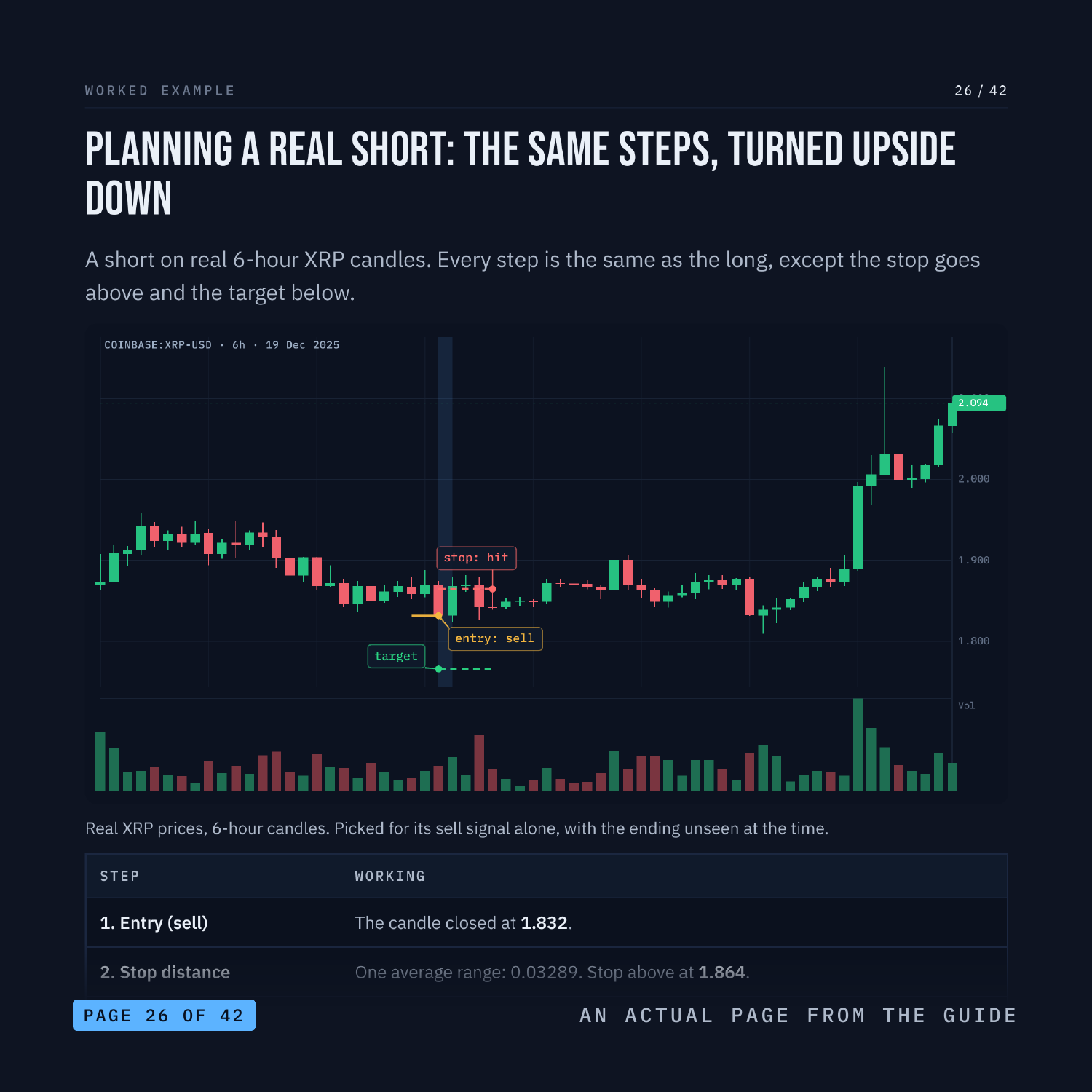
Every idea is drawn with the words on the picture: a long and a short on a price ladder with example numbers, the five steps of borrowing, selling, buying back and returning a coin, the floor under a long and the missing ceiling over a short, and where the stop and target go on each side. Real XRP, Dogecoin, Solana, Chainlink and Avalanche charts show both sides. Then ten coins' long and short test trades are set beside what each coin's price did over the same dates, you plan a long and a short yourself, and it ends with a checklist to run before either one.
WHAT'S INSIDE
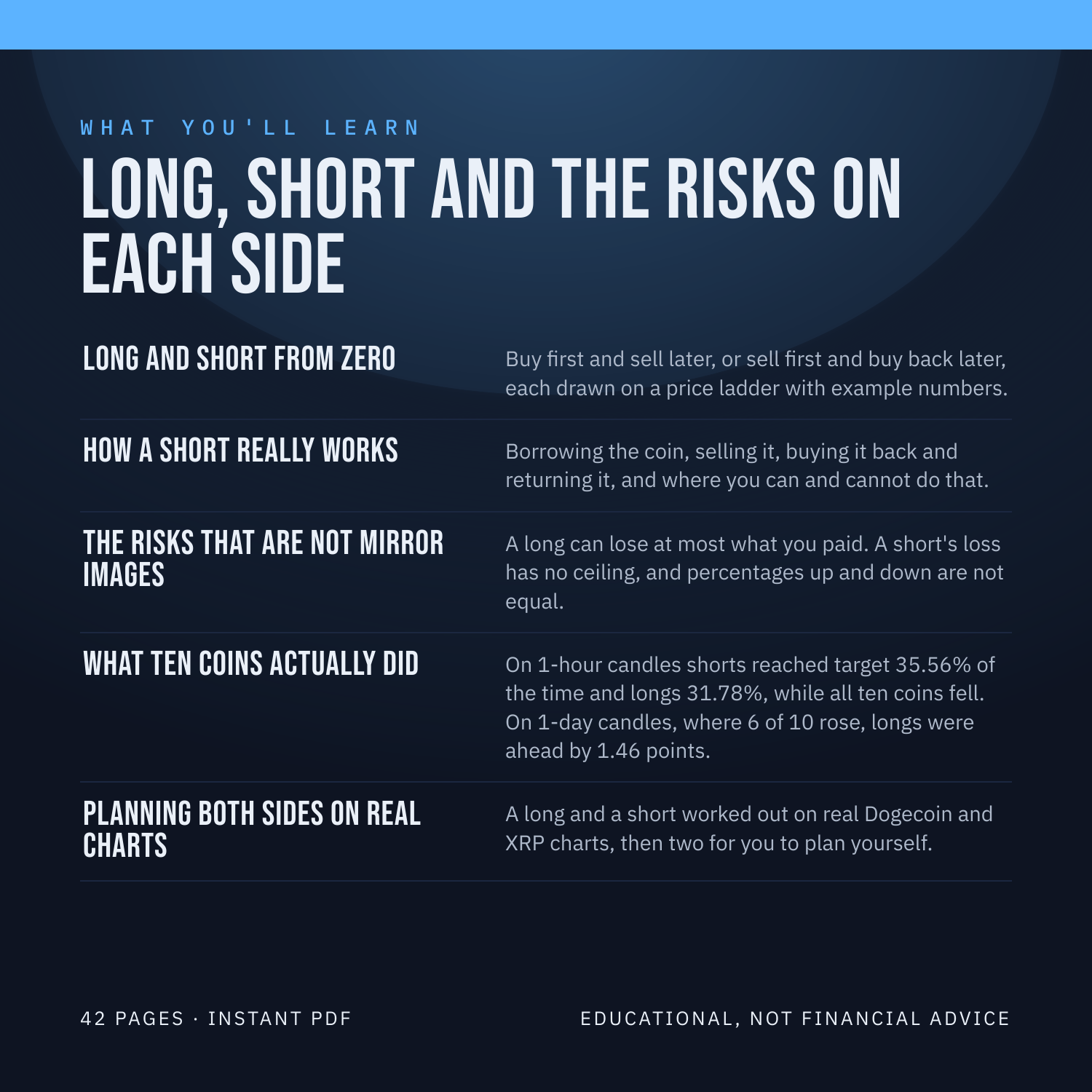
- Long and short from zero: Buy first and sell later, or sell first and buy back later, each drawn on a price ladder with example numbers.
- How a short really works: Borrowing the coin, selling it, buying it back and returning it, and where you can and cannot do that.
- The risks that are not mirror images: A long can lose at most what you paid. A short's loss has no ceiling, and percentages up and down are not equal.
- What ten coins actually did: On 1-hour candles shorts reached target 35.56% of the time and longs 31.78%, while all ten coins fell. On 1-day candles, where 6 of 10 rose, longs were ahead by 1.46 points.
- Planning both sides on real charts: A long and a short worked out on real Dogecoin and XRP charts, then two for you to plan yourself.
WHAT YOU'LL BE ABLE TO DO
- Explain what going long and going short mean, with numbers.
- Place the stop and target on the correct side for either trade.
- Size a long or a short so a stop costs the same amount.
- Read a long-versus-short result next to what the market did.
AN HONEST NOTE
No guide can tell you which way price will go, and this one does not try. Short test trades did better on 1-hour candles over a year in which all ten coins fell; the guide shows why that is a fact about that year and not a reason to go short. No rule to copy, no profit figures, no promises. Educational, not financial advice.
Instant PDF download.