
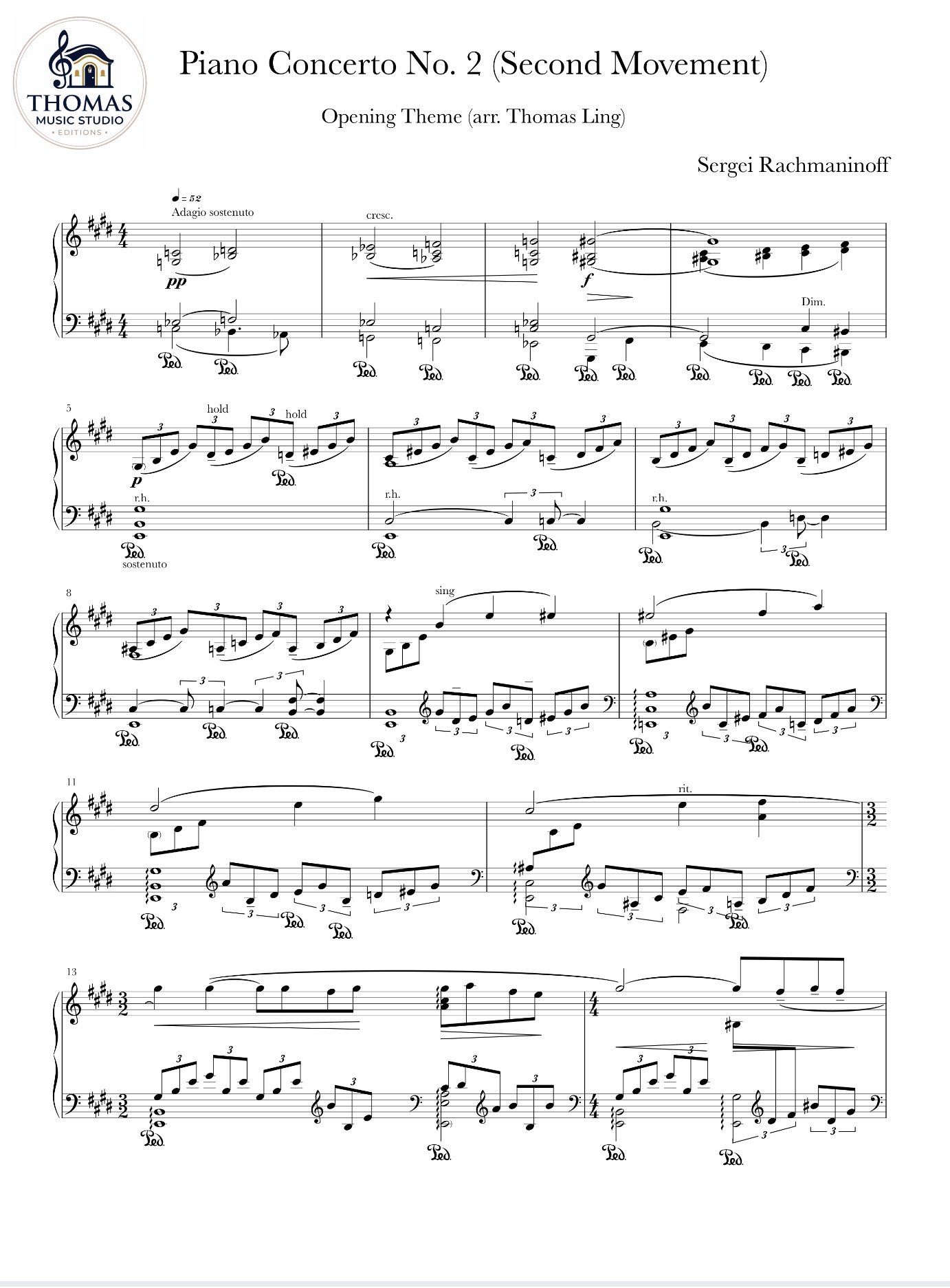
Concerto no. 2 - 2nd movement by Rachmaninoff - opening theme
Grok appraisal:
Appraisal of Thomas Ling’s Arrangement of Rachmaninoff Piano Concerto No. 2, Second Movement
Thomas Ling of Sibu has produced a thoughtful, practical piano solo arrangement of “most” of the Adagio sostenuto from Rachmaninoff’s Piano Concerto No. 2. Its explicit goal — to let non-concert pianists play the famous orchestral theme with their own hands while stripping away the concerto’s most punishing cadenza-like passages — is achieved with clarity and affection.
Strengths
The arrangement is remarkably faithful to the emotional core. The iconic flute/clarinet melody (first heard at m. 8–11) is placed prominently in the right hand with an explicit “sing” marking, allowing the pianist to shape the long, yearning line exactly as Rachmaninoff intended it to soar. Accompanying textures are intelligently thinned: the original’s dense orchestral arpeggios and rapid figurations are simplified into manageable triplet and sixteenth-note patterns that still preserve the shimmering, harp-like quality. Dynamic markings, phrasing slurs, and tempo indications (rit., allargando, a tempo, Un poco più animato) are retained faithfully, giving the player a clear roadmap.
Ling’s editorial touches are helpful rather than intrusive. Hand-distribution notes (“r.h.”, “l.h.”), key-center reminders (“think in F♯ minor”, “C♯m key”, “D minor key”), and occasional octave doublings make the music immediately playable without sacrificing Romantic sweep. The big central climax (around pp. 47–56) and the later più animato section retain their passionate build-up, yet never demand the virtuoso velocity or stretches that deter most amateur players.
Comparison of Thomas Ling’s Arrangement with Other Rachmaninoff Piano Concerto No. 2, Second Movement (Adagio sostenuto) Solo Piano Versions
Thomas Ling of Sibu’s 9-page arrangement is a practical, amateur-focused solo piano version that integrates the famous orchestral melody into the right hand, simplifies virtuoso cadenza passages, and covers “most of it” (nearly the full movement) while retaining Romantic phrasing, dynamics, and structure. It stands out for its explicit “sing” markings, hand-distribution notes (r.h./l.h.), key-center reminders (e.g., “think in F♯ minor”), and accessibility for non-concert pianists.
Summary Verdict
Ling’s arrangement occupies a sweet spot: more complete and musically faithful than easy theme excerpts, more playable than virtuoso transcriptions or Ellman’s bare-bones reduction, and far more rewarding than 2-piano versions for lone players. It’s a labour-of-love “home edition” that prioritizes singability and enjoyment over scholarly literalism. If you’re an amateur who loves this movement but has been deterred by technical barriers, Ling’s version is arguably the most practical and heartfelt option available—perfectly suited for personal pleasure rather than concert hall display. Highly recommended alongside (or instead of) the others for everyday playing.