
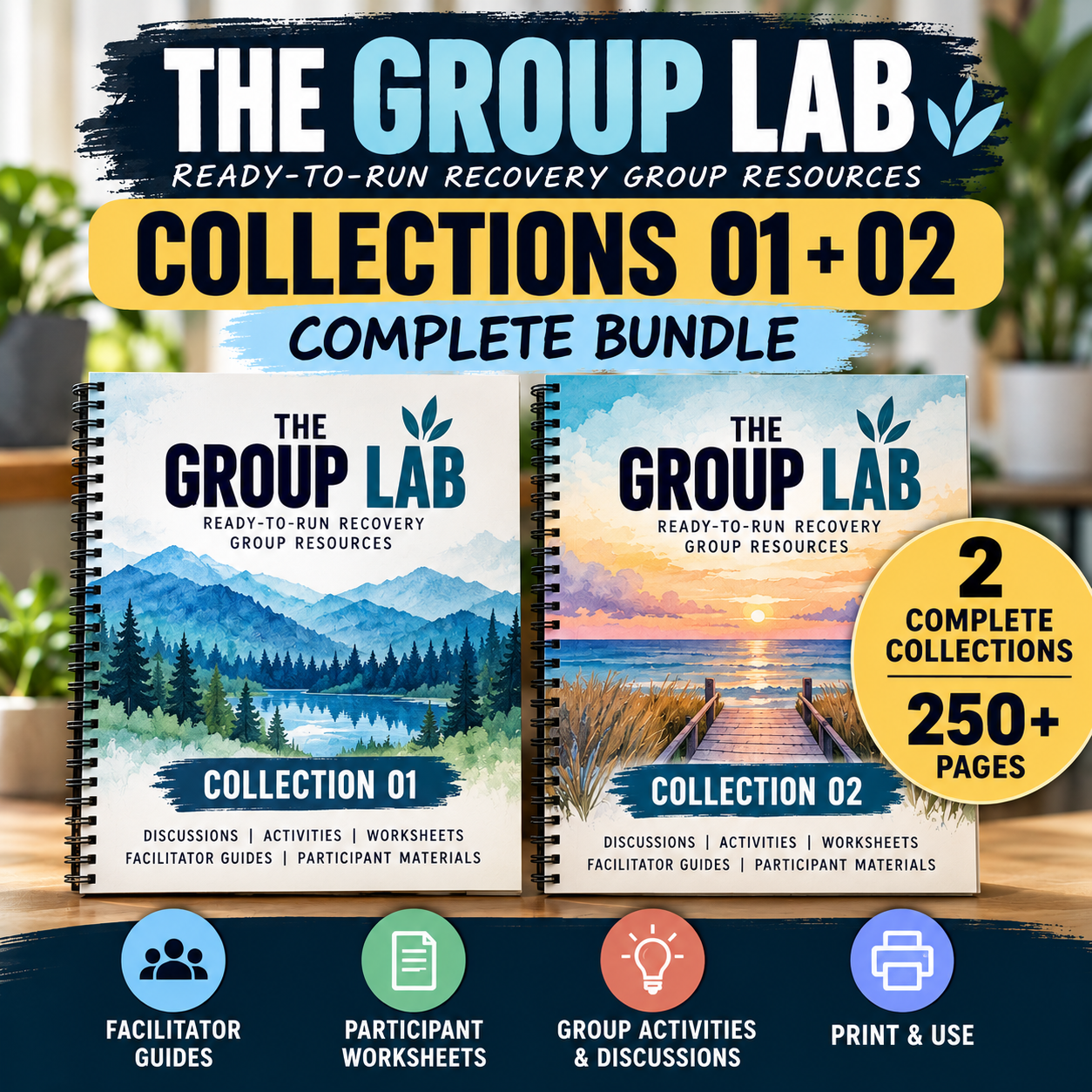
The Group Lab: Ready-to-Run Recovery Group Resources — Collections 01 + 02 Bundle
The Group Lab: Ready-to-Run Recovery Group Resources — Collections 01 + 02 Complete Bundle
Two complete collections. 250+ pages. One ready-to-run recovery group resource library.
Spend less time building groups from scratch and more time facilitating them.
The Group Lab Collections 01 + 02 Complete Bundle brings together the first two collections of The Group Lab into one comprehensive digital resource for substance use and recovery-focused group facilitation.
Inside, you’ll find 250+ pages of facilitator guides, participant worksheets, structured activities, discussion material, reflection exercises, and practical recovery tools designed to help turn important recovery concepts into organized, engaging groups.
COLLECTION 01 — FOUNDATIONAL RECOVERY RESOURCES
Collection 01 establishes the foundation of The Group Lab approach: structured recovery groups designed to promote discussion, self-reflection, critical thinking, and practical application.
Facilitators receive organized material for introducing and guiding each group, while participants receive corresponding worksheets and activities that help them actively engage with the topic.
Collection 01 is designed to provide versatile, ready-to-run material that can be incorporated into ongoing recovery programming or used whenever a facilitator needs a complete stand-alone group.
COLLECTION 02 — RECOVERY PATTERNS & INTERRUPTION
Collection 02 builds on that foundation by examining the patterns that influence recovery—and the places where those patterns can be interrupted.
The collection includes 7 complete resources:
01 — The Craving Curve
Understand how cravings rise, peak, change, and pass while identifying ways to respond without immediately acting on an urge.
02 — The Relapse Warning System
Identify changes in thoughts, emotions, behaviors, routines, and connection that may signal recovery drift.
03 — The Recovery Autopilot Audit
Examine automatic habits and patterns that can influence behavior before deliberate decision-making begins.
04 — The Trigger Chain
Break down the progression from trigger to consequence and identify opportunities to interrupt the sequence.
05 — The Recovery Decision Window
Examine high-pressure moments and create space between an urge, a decision, and an action.
06 — The Recovery Friction Map
Explore how environment and accessibility can make recovery-supporting behaviors easier and high-risk behaviors more difficult.
07 — The Recovery Momentum System
Examine how small, repeatable actions build direction and how recovery momentum can be restarted following disruption.
WHAT’S INCLUDED
• 2 complete Group Lab collections
• 250+ pages of recovery group resources
• Facilitator guides
• Participant worksheets
• Structured group activities
• Discussion and processing prompts
• Individual reflection exercises
• Practical recovery tools and models
• Collection roadmaps and facilitator guidance
• Print-and-use PDF format
DESIGNED FOR
Counselors, therapists, group facilitators, behavioral health professionals, substance use treatment programs, outpatient and intensive outpatient programs, residential treatment settings, recovery centers, sober living environments, peer recovery settings, and other professionals facilitating recovery-focused groups.
Resources can be used individually as stand-alone groups or incorporated into a broader recovery curriculum.
WHY CHOOSE THE BUNDLE?
Collections 01 and 02 are available separately. This bundle brings both together into one 250+ page resource library, giving facilitators a larger selection of ready-to-run material while offering greater value than purchasing both collections individually.
Use one resource today, save another for next week, or incorporate the collections into your existing group schedule.
Less time building groups from scratch. More time facilitating them.
DIGITAL PRODUCT
This is a digital PDF product. No physical product will be shipped.
Materials are intended as educational and group-facilitation resources and are not a substitute for individualized clinical assessment, diagnosis, treatment planning, or professional judgment.