
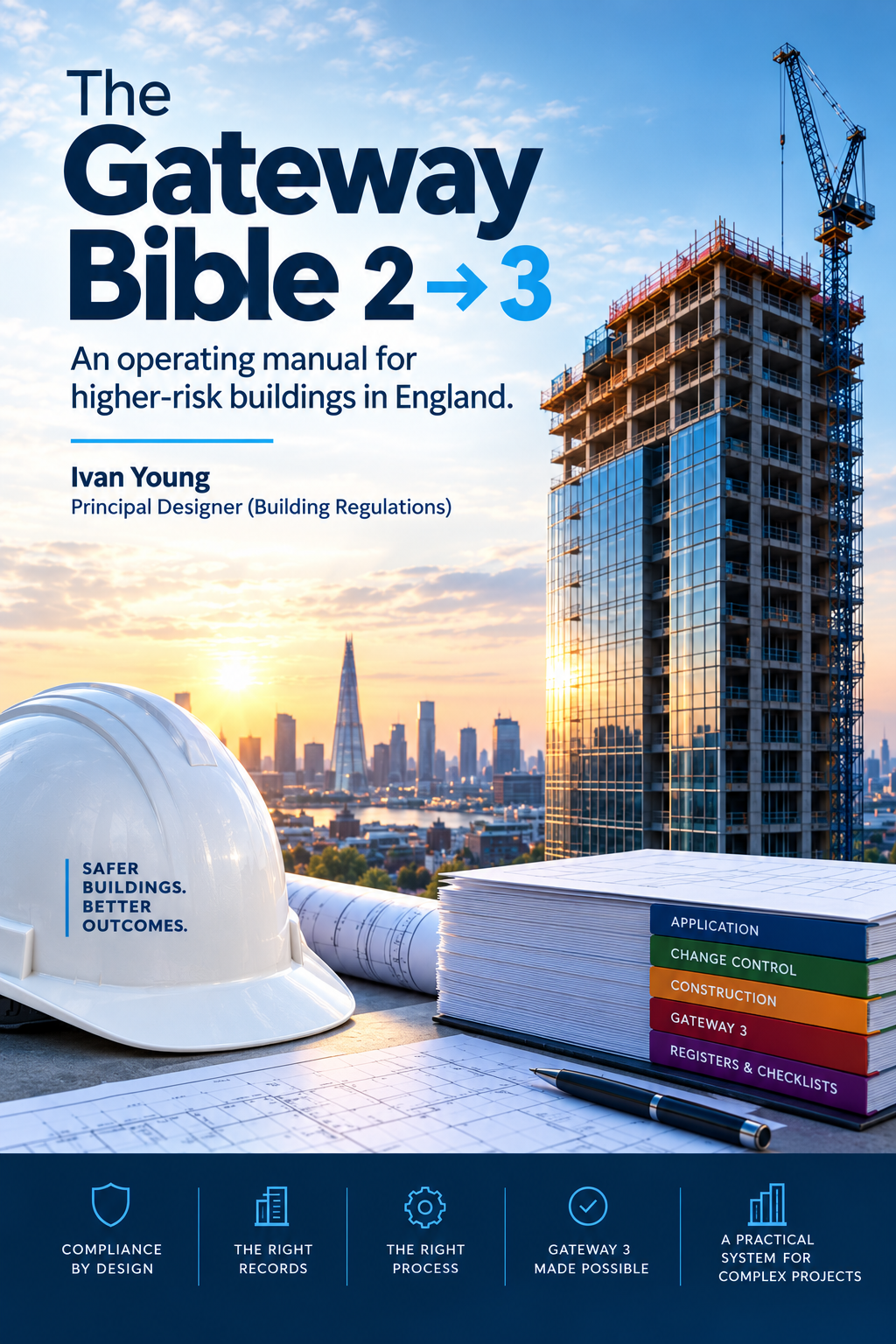
The Gateway Bible
The Gateway Bible
Gateway 1 consent to Gateway 3. An operating manual for higher-risk buildings in England.
191 pages. Nine parts. Edition 2, 2026.
The regime is forgiving at the start and absolute at the end.
At Gateway 2 an imperfect application can be rescued. The regulator may grant approval subject to requirements, with your consent, and the project carries on.
At Gateway 3 there is no equivalent. Regulation 44(2) requires the regulator to reject the application if it is not satisfied. No conditional certificate, nothing to negotiate, no deferral. The building is finished, it cannot be occupied, it cannot be sold, and it cannot earn, while everything owed on it continues to be owed.
A regime built that way has to be worked from the end backward. That is what this manual does.
It picks up immediately after Gateway 1 consent and runs through to the completion certificate. It tells you what to do, in what order, and what will go wrong if you leave something out.
What is in it
The Gateway 2 application, item by item, and the seven accompanying documents against their statutory content requirements.
Everything you build before you submit anything: the record architecture, seven registers, the design responsibility matrix, competence assessment, the compliance demonstration framework, and the design maturity gate.
142 numbered design rules, written to be issued to the design team and attached to their appointments.
Work to an existing higher-risk building, including a standalone section for anyone altering a single flat.
Change control with the classification tests verbatim, and carrying the record through construction.
Gateway 3, the handover, and the inspection.
Then four reference parts. Sixty failure diagnostics indexed by symptom, telling you where the thread actually broke. Every register, gate and checklist collected clean. A reverse index by regulation. And every client duty in one place, written to be given to a client.
How it is written
It separates law from method throughout. Where something is required, the provision is named and you can stand on it. Where something is discipline that exceeds the statutory minimum, it says so. Where a statement has not been checked against the legislation itself, it is flagged, and every flag is collected in one place at the front.
It was built on real projects and refined against what actually went wrong on them.
Scope
England only. The higher-risk building regime does not apply in Wales, Scotland or Northern Ireland. Design and construction phase only, from appointment to the completion certificate. The occupation phase is out of scope.