
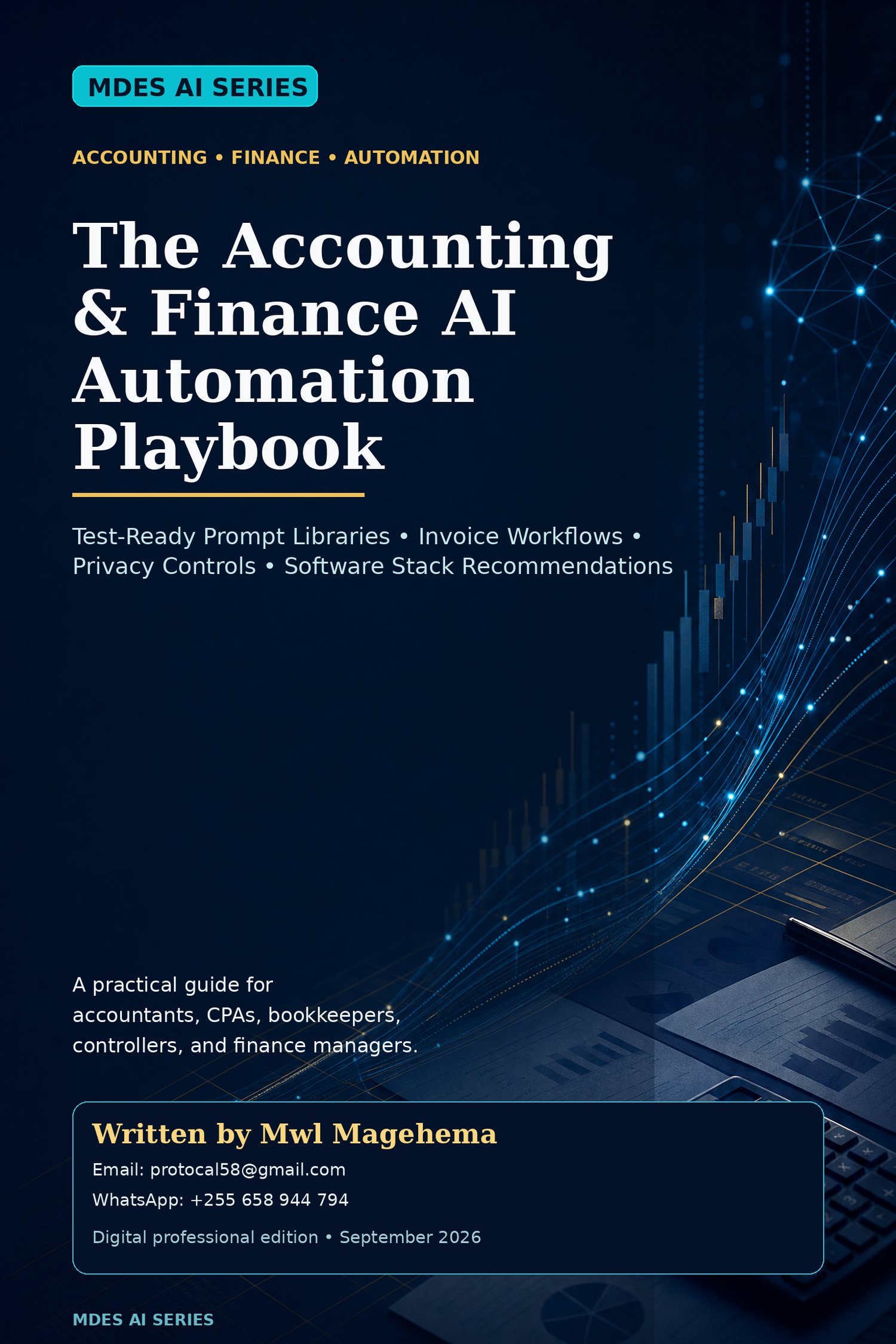
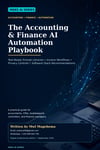



Accounting & Finance AI Automation Playbook; Use AI in accounting without losing control
Accounting & Finance AI Automation Playbook;
Use AI in accounting without losing control
AI is changing how finance teams analyze data, process invoices, prepare reports, and manage repetitive work. But accounting professionals need more than generic AI advice. They need practical prompts, reviewable workflows, clear control points, and a safe path from financial data to useful decisions.
The Accounting & Finance AI Automation Playbook provides that framework. It shows you how to use AI as a supervised finance assistant while keeping source evidence, professional judgment, privacy, and accountability visible throughout the process.
Automate the analysis path. Do not automate professional sign-off.
What’s inside the playbook?
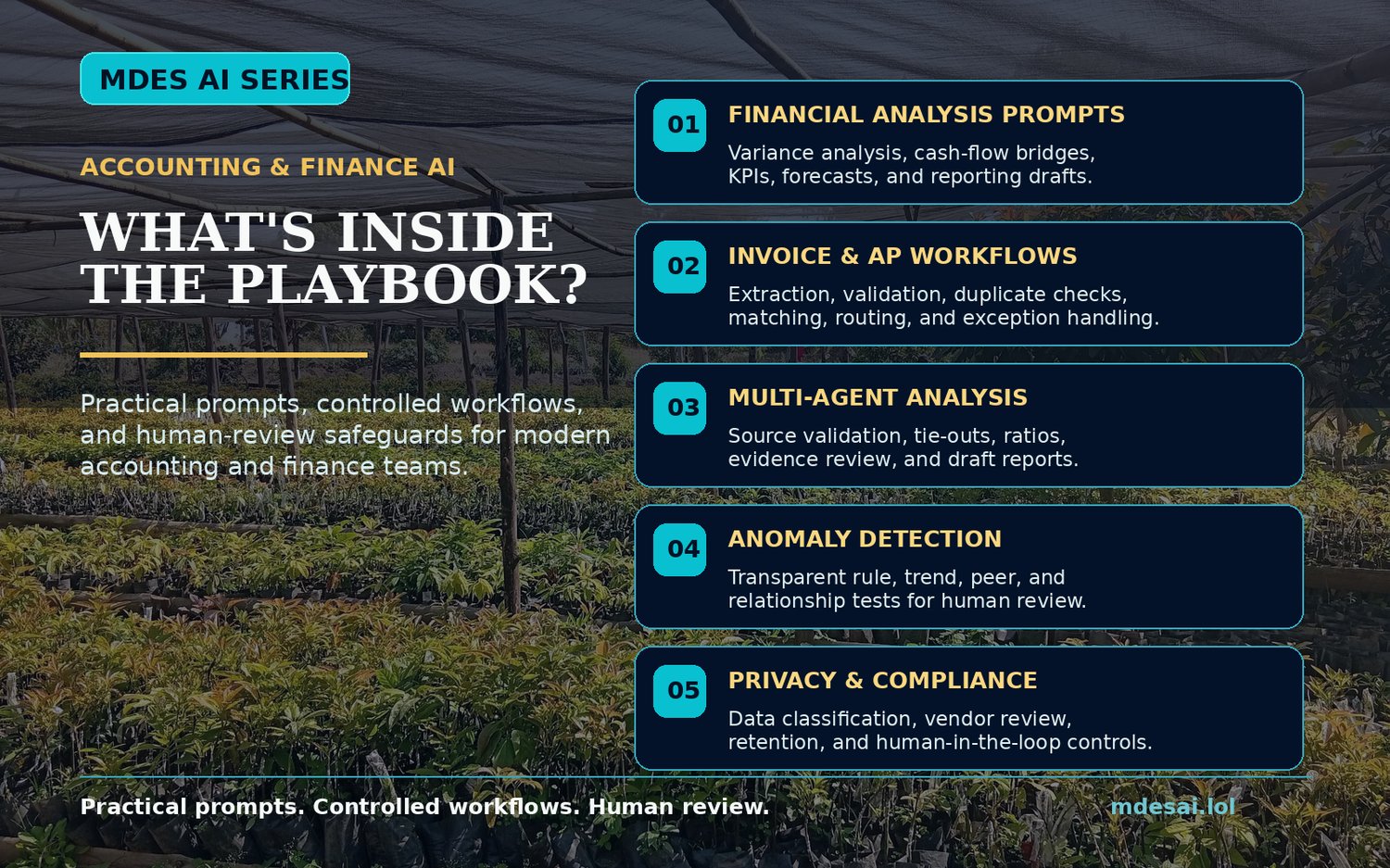
The playbook is organized around five core capability areas.
1. Financial analysis prompts
Use ready-to-adapt prompts for variance analysis, cash-flow bridges, KPIs, forecasts, management commentary, reconciliation reviews, close-risk scans, audit-request preparation, and journal-entry support. Prompts are structured to preserve source values, show calculations, label assumptions, identify missing evidence, and route consequential decisions to a human reviewer.
2. Invoice and AP workflows
Build a safer invoice process from capture → classify → extract → validate → match → route → approve → post → retain. The playbook includes invoice schemas, field extraction prompts, arithmetic validation, supplier and duplicate checks, two-way and three-way matching, approval routing, bank-change warning signals, posting preparation, and exception handling.
3. Multi-agent analysis
Move financial data through a structured sequence of specialist agents: Source Steward, Statement Validator, Analysis Engine, Anomaly Detector, Evidence Investigator, Skeptical Reviewer, and Report Composer.
The workflow covers source validation, statement tie-outs, ratios, trend analysis, working-capital metrics, cash-flow bridges, evidence review, false-positive challenges, and draft report composition.
4. Anomaly detection
Use transparent rule, trend, contribution, peer, and relationship tests to identify candidates for human review. The prompts cover threshold breaches, out-of-period postings, unusual descriptions, duplicate references, manual journals, end-of-period spikes, sign reversals, new-account activity, contribution analysis, peer comparisons, and broken relationships between financial metrics.
The goal is to create review signals and evidence requests—not unsupported accusations or automated fraud conclusions.
5. Privacy and compliance
Learn how to design safer AI workflows using data classification, minimization, masking, tokenization, vendor review, retention checks, impact-assessment screening, professional confidentiality safeguards, transparency, human oversight, and incident-response procedures.
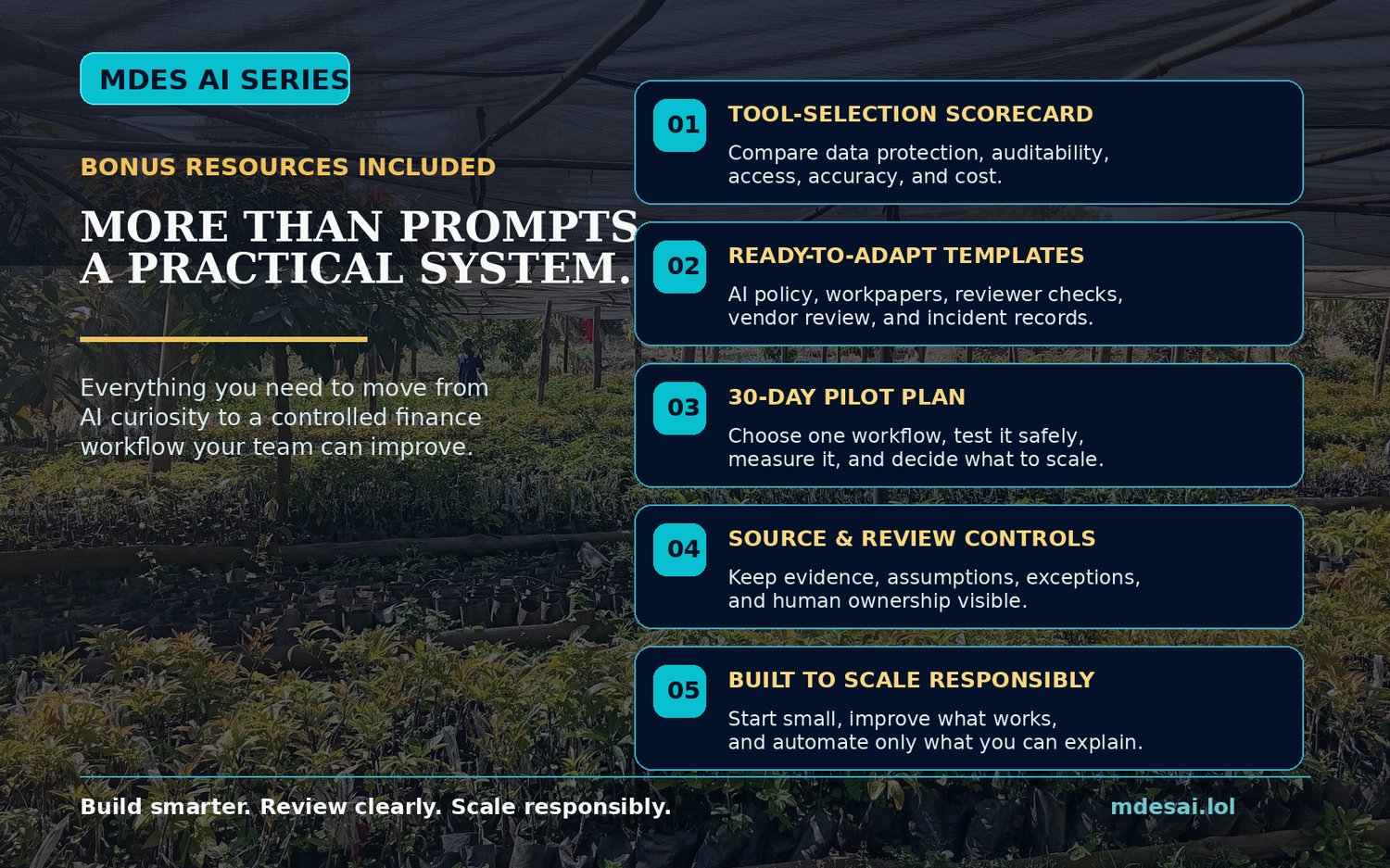
Additional resources included
Beyond the five core areas, you will also receive software-stack recommendations, a weighted tool-selection scorecard, practical implementation templates, and a structured 30-day pilot plan.
The tool-selection scorecard helps compare data protection, auditability, identity, segregation of duties, accuracy, exception handling, integration, usability, and cost.
Templates include an AI use policy, AI-assisted workpaper cover sheet, reviewer checklist, AI use-case register, vendor due-diligence checklist, prompt version-control record, incident report, and pilot measurement framework.
The 30-day plan helps you choose one workflow, define controls, run a shadow pilot, test failure cases, measure quality, and decide what is ready for controlled use.
Who this playbook is for
This product is designed for accountants, CPAs, bookkeepers, accounting-firm owners, controllers, finance managers, FP&A professionals, finance operations leaders, shared-service teams, and business owners responsible for financial reporting.
It is especially useful for teams asking:
•How can we use AI in accounting?
•Which finance workflows should we automate first?
•How do we use AI without exposing confidential data?
•How do we validate AI-generated financial analysis?
•How can we detect unusual transactions more efficiently?
•How do we build AI workflows that reviewers can understand?
Why this playbook is different
This is not a collection of generic chatbot prompts. It is an operating guide built around structured inputs, controlled outputs, source evidence, calculation checks, exception queues, reviewer ownership, prompt versioning, human-in-the-loop decisions, and clear stop conditions.
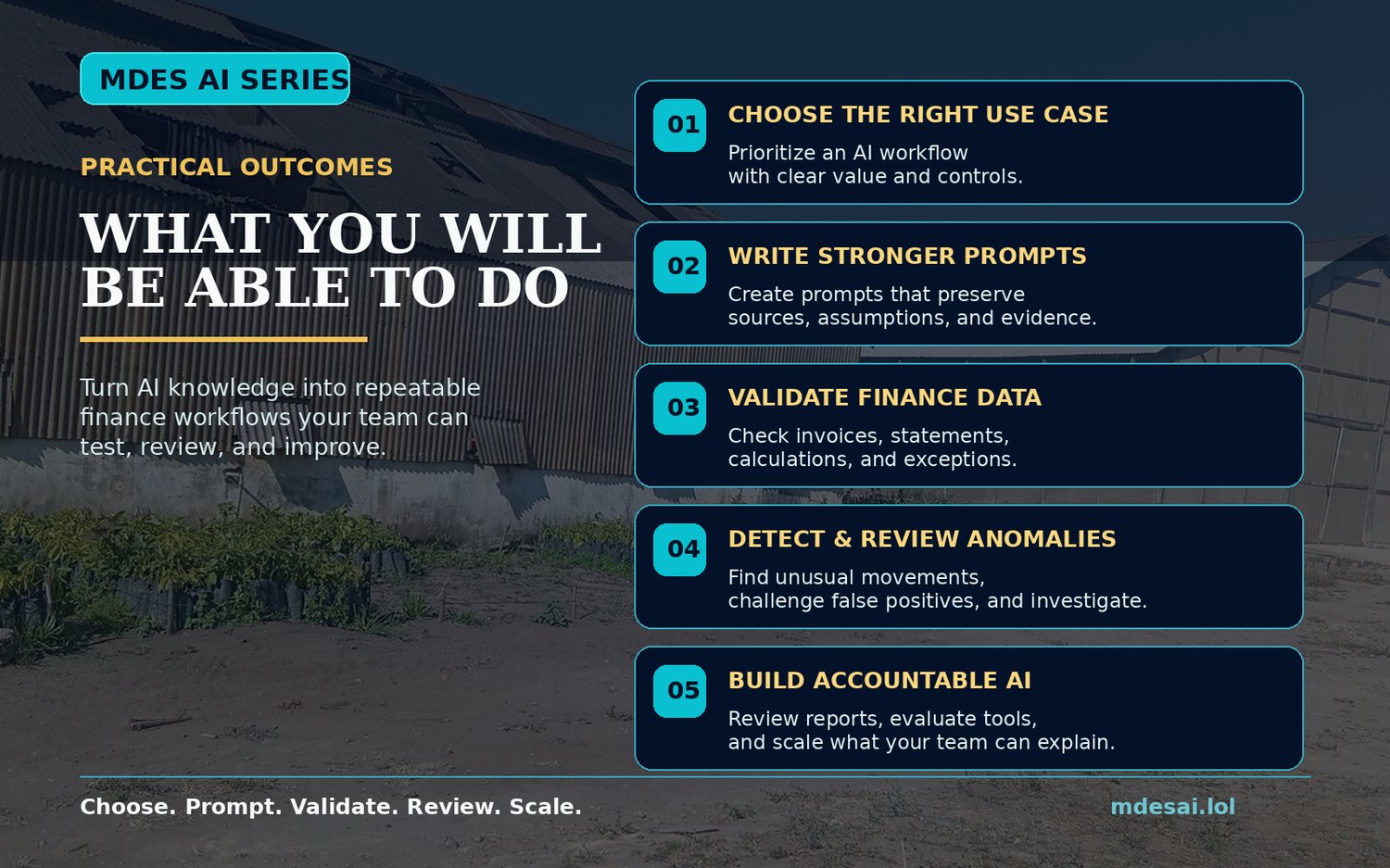
You will learn how to move from vague AI experimentation to a controlled workflow your team can test, explain, improve, and reproduce.
Important use notice
This product is an educational implementation resource. It is not legal, tax, audit, accounting, privacy, cybersecurity, or regulatory advice.
AI outputs may be incomplete, inaccurate, outdated, or confidently wrong. Always review AI-assisted work with the appropriate qualified professional before using it for a journal entry, payment, filing, tax position, financial statement, audit conclusion, client communication, or other consequential decision.
Privacy, data-transfer, retention, professional, tax, and AI requirements vary by jurisdiction, entity, engagement, and accounting framework. Review the workflows with the relevant professional, privacy, security, or legal adviser before production use.
Delivery
Digital product. Access and delivery are provided through Payhip after purchase.
Suggested Payhip purchase button:
Get the Accounting & Finance AI Automation Playbook
https://payhip.com/b/EOaTP