

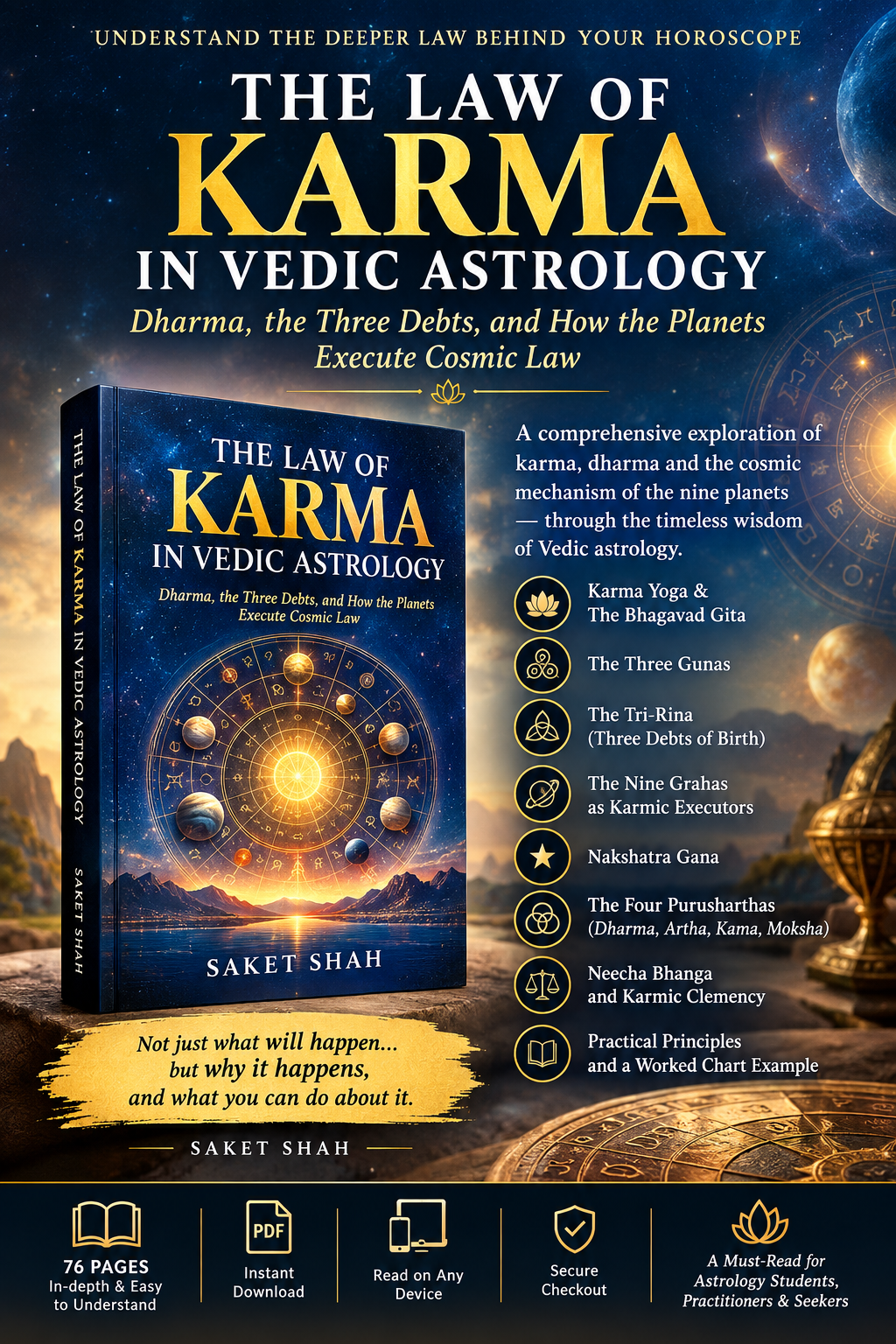
THE LAW OF KARMA IN VEDIC ASTROLOGY Dharma, the Three Debts, and How the Planets Execute Cosmic Law
The Law of Karma in Vedic Astrology
Dharma, the Three Debts, and How the Planets Execute Cosmic Law
By Saket Shah
What if the planets are not the creators of your karma—but the administrators of a cosmic law already in motion?
The Law of Karma in Vedic Astrology explores the philosophical and technical foundations behind karma as understood through classical Vedic thought and Jyotisha.
This book goes beneath ordinary horoscope interpretation to examine why karma operates, how Vedic astrology reads it, what debts are carried into birth, how the nine grahas administer karmic consequences, and where the tradition allows mitigation, grace, and release.
Discover the Deeper Architecture of Karma
Karma is often reduced to a simple idea:
“What you do comes back to you.”
But the classical Vedic framework is far more sophisticated.
This book examines karma through multiple interconnected systems, including:
- Karma Yoga and the Bhagavad Gita
- The Three Gunas — Sattva, Rajas and Tamas
- Daiva and Purushakara — destiny and present effort
- The Five Threads of causality
- Punya and Papa
- The ancient Tri-Rina — Three Debts of Birth
- The Nine Grahas as Karmic Executors
- Nakshatra Gana
- The Four Purusharthas
- The Dharma, Artha, Kama and Moksha Trines
- Neecha Bhanga Raja Yoga
- Karmic mitigation and grace
- Practical principles for living with karma
- A complete worked chart example
The book deliberately brings these ideas together into one coherent framework.
What Exactly Does the Law of Karma State?
The book begins with the fundamental philosophical question:
What is karma actually claiming?
Rather than presenting karma as arbitrary punishment imposed by an external authority, the book examines the classical idea of karma as a law of cause and consequence.
It then connects this philosophy with the practical teaching of Karma Yoga:
Act fully.
Perform your duty.
Release attachment to the specific result.
The book explores how intention, action and attachment affect the karmic process, while examining the three gunas that give action its qualitative character.
Destiny vs Free Will
One of the most important questions in astrology is:
How much of life is already determined—and how much can we change?
This book does not treat the question as a simplistic battle between fate and free will.
It examines the classical framework of:
Daiva — the fruit of past action
Purushakara — present deliberate effort
Kala — time and circumstance
Swabhava — inherent nature
Niyati — what is genuinely fixed
Yadrichha — chance, in traditions that recognize it
Most importantly, the framework identifies present effort as the area in which a person can actively exercise agency.
This gives Jyotisha a different purpose:
not to make a person passive, but to understand the karmic circumstances in which present effort must operate.
The Three Original Debts of Birth
One of the central sections introduces the Tri-Rina:
1. Deva Rina
The debt to the cosmic forces and conditions that sustain life.
2. Rishi Rina
The debt to sages, teachers, knowledge and the transmission of wisdom.
3. Pitru Rina
The debt to ancestors, lineage and the generations that come after us.
The book examines their classical sources, meanings, methods of repayment and astrological correlates.
This makes the book especially valuable for readers interested in karmic debts, ancestral karma, dharma and the philosophical foundations of Jyotisha.
The Nine Planets as Karmic Executors
One of the book's distinctive frameworks is the idea that:
The planets do not create karma. They administer it.
Each graha is assigned a particular karmic “office.”
☀️ Sun — The Sovereign
Authority, dharma and rightful responsibility.
🌙 Moon — The Recorder
Mental impressions, emotional patterns and samskaras.
🔥 Mars — The Enforcer
Action, courage, initiative and consequences of action or inaction.
☿ Mercury — The Advocate
Intention, communication, interpretation and understanding.
♃ Jupiter — The Judge of Mercy
Wisdom, ethics, merit and the possibility of mitigation.
♀ Venus — The Arbiter
Relationship, reciprocity, exchange and fairness.
♄ Saturn — The Chief Justice
Time, discipline, limitation and exact karmic reckoning.
☊ Rahu — The Prosecutor of New Territory
Unfamiliar experiences, craving and new karmic development.
☋ Ketu — The Officer of Release
Detachment, completion and the dissolution of old attachments.
This planetary framework is developed extensively in the book.
Understand Karma Through the Four Purusharthas
The book connects karma with the four classical aims of human life:
Dharma — Artha — Kama — Moksha
And then maps them onto the corresponding house trines:
Dharma: 1st, 5th, 9th
Artha: 2nd, 6th, 10th
Kama: 3rd, 7th, 11th
Moksha: 4th, 8th, 12th
This provides a powerful framework for understanding how different areas of a horoscope participate in the larger karmic structure.
Is Difficult Karma Always Final?
One of the most intriguing sections examines Neecha Bhanga Raja Yoga.
A debilitated planet is not necessarily treated as an irreversible sentence.
The book examines classical conditions through which debilitation may be substantially reduced or transformed, including:
- An angular dispositor
- An angular exaltation lord
- Aspect or conjunction involving the exaltation lord
- An exalted dispositor
- Mutual exchange / Parivartana
The book presents this doctrine as an important illustration of mitigation and karmic grace within the technical structure of Vedic astrology.
Who Is This Book For?
This book is particularly suited for:
- Vedic astrology students
- Jyotish practitioners
- Advanced astrology researchers
- Students of karma and reincarnation
- Readers interested in the Bhagavad Gita
- Students of the three gunas
- Astrologers studying planetary karma
- Readers researching ancestral karma
- Students of nakshatras
- Readers studying the Purusharthas
- Those interested in Neecha Bhanga Raja Yoga
- Anyone wanting a deeper philosophical foundation for karmic astrology
It is also designed as a companion to Karmic Debt in Astrology and Pending Karma in Astrology, while approaching karma from a different philosophical and structural perspective.
What You Will Explore Inside
PART ONE
Foundations — The Philosophy Behind the Law
PART TWO
The Tri-Rina — The Three Original Debts of Birth
PART THREE
The Nine Grahas as Karmic Executors
PART FOUR
Nakshatra Gana and the Moral Texture of Karma
PART FIVE
The Four Purusharthas and the Trines of the Chart
PART SIX
Karmic Clemency — Neecha Bhanga and the Doctrine of Grace
PART SEVEN
Living the Law — Seven Practical Principles
PART EIGHT
Reading a Chart Through This Framework — A Worked Example
Plus:
Glossary of Terms
The complete contents are laid out across the opening pages of the book.
A Different Way to Look at Your Horoscope
Instead of asking only:
“What will happen to me?”
this book encourages a deeper set of questions:
What karmic principle is operating?
What debt or responsibility does this represent?
Which planetary office is involved?
Which Purushartha is being activated?
Where does present effort remain available?
Is there a classical mechanism for mitigation?
What does the chart reveal about the relationship between karma and conscious action?
That shift—from prediction alone toward understanding the architecture of karma—is at the heart of this book.
Your Horoscope as a Map of Karma
The book presents Jyotisha as a way of making the daiva component of life more legible, while preserving the importance of purushartha, or present effort.
The birth chart is therefore approached not simply as a final verdict, but as a framework for understanding the karmic circumstances in which conscious action takes place.
Get the Complete Book
If you want to explore the philosophical foundations behind karmic astrology—not merely individual planetary predictions—The Law of Karma in Vedic Astrology offers a structured journey through karma, dharma, debt, planets, nakshatras, purusharthas and karmic mitigation.
Inside the complete book:
76 pages of focused material on the law of karma through the lens of Vedic astrology.
Written by Saket Shah
Download the complete book and explore the deeper law behind the horoscope.
The planets may show the account.
The deeper question is: why does the account exist—and what can you do with it?
Keywords
- Law of Karma in Vedic Astrology
- Karma in Vedic Astrology
- Vedic Astrology Karma
- Karmic Astrology
- Karma and Astrology
- Karmic Astrology Book
- Vedic Astrology Book
- Karma Astrology Book
- Astrology and Karma
- Understanding Karma
- law of karma in Vedic astrology book
- karma and destiny in Vedic astrology
- fate and free will in Vedic astrology
- karma yoga and astrology
- three debts in Vedic astrology
- Tri-Rina in Vedic astrology
- nine planets as karmic executors
- planets and karmic consequences
- nakshatra gana in Vedic astrology
- four purusharthas in Vedic astrology
- Dharma Artha Kama Moksha astrology
- Neecha Bhanga and karma
- karmic patterns in birth chart
- past karma in astrology
- understanding destiny through Vedic astrology
- spiritual astrology and karma
- Jyotisha and the law of karma
- best Vedic astrology books
- Vedic astrology ebooks
- advanced Vedic astrology book
- astrology books for advanced students
- karmic astrology ebook
- Vedic astrology PDF book
- astrology karma ebook
- spiritual astrology book
- Jyotisha books
- Indian astrology books
- advanced astrology studies
- Karma Yoga
- Three Gunas
- Daiva and Purushakara
- Punya and Papa
- Deva Rina
- Rishi Rina
- Pitru Rina
- Nine Grahas
- Nakshatra Gana
- Purusharthas
- Dharma Trine
- Artha Trine
- Kama Trine
- Moksha Trine
- Neecha Bhanga Raja Yoga
- Karmic Clemency
- Mahadasha and Karma
- Planetary Karma
- Cosmic Law
- Dharma and Destiny